The Child Arrived. The Bills Followed. Nobody Told You What You're Entitled To.
You took in a child because nobody else could. Within a week, you had bought a bed, new clothes, school shoes, and food for an extra mouth — on a pension or a salary that was already spoken for. Work and Income has a helpline, but the hold times are long, the caseworker speaks in acronyms, and the moment you make contact a strict 20-working-day clock starts ticking. If your documents are not in order by the end of that window, your application is cancelled and you start from scratch — losing every day of payment you cannot get backdated.
Meanwhile, the Unsupported Child's Benefit or Orphan's Benefit the child qualifies for is sitting unclaimed. So are the supplementary allowances that most relative caregivers never hear about: the $350 Establishment Grant, the Holiday and Birthday Allowances, the annual School Start-up Payment, and the Extraordinary Care Fund — up to $2,000 per child per year for therapy, sports fees, school camps, and equipment. These are real money, they are non-taxable, and they do not reduce your NZ Superannuation or any other personal income by a single dollar.
The Caregiver Benefit Readiness System
This guide is a complete preparation and application system for grandparents and relatives in New Zealand who are raising a child they did not expect. It takes you from the moment you realise you need financial help, through the Form M14 application with every document certified and ready, to the supplementary allowances most caregivers miss — and then keeps you organised for the mandatory Confirming Your Circumstances (CYC) reviews that start in July 2026.
Free information exists — Work and Income's website, the GRG helpline, Citizens Advice Bureau volunteers — and we link to all of it. What does not exist for free is a single document that puts the steps in order, tells you exactly what to bring and when, and prevents you from triggering the 20-working-day clock before you are ready.
What You Get
- Benefit Route Decision Flowchart — a structured worksheet that distinguishes between Unsupported Child's Benefit (family breakdown), Orphan's Benefit (deceased, untraceable, or incapacitated parents), Sole Parent Support, and Oranga Tamariki board payments, so you apply through the right channel from day one
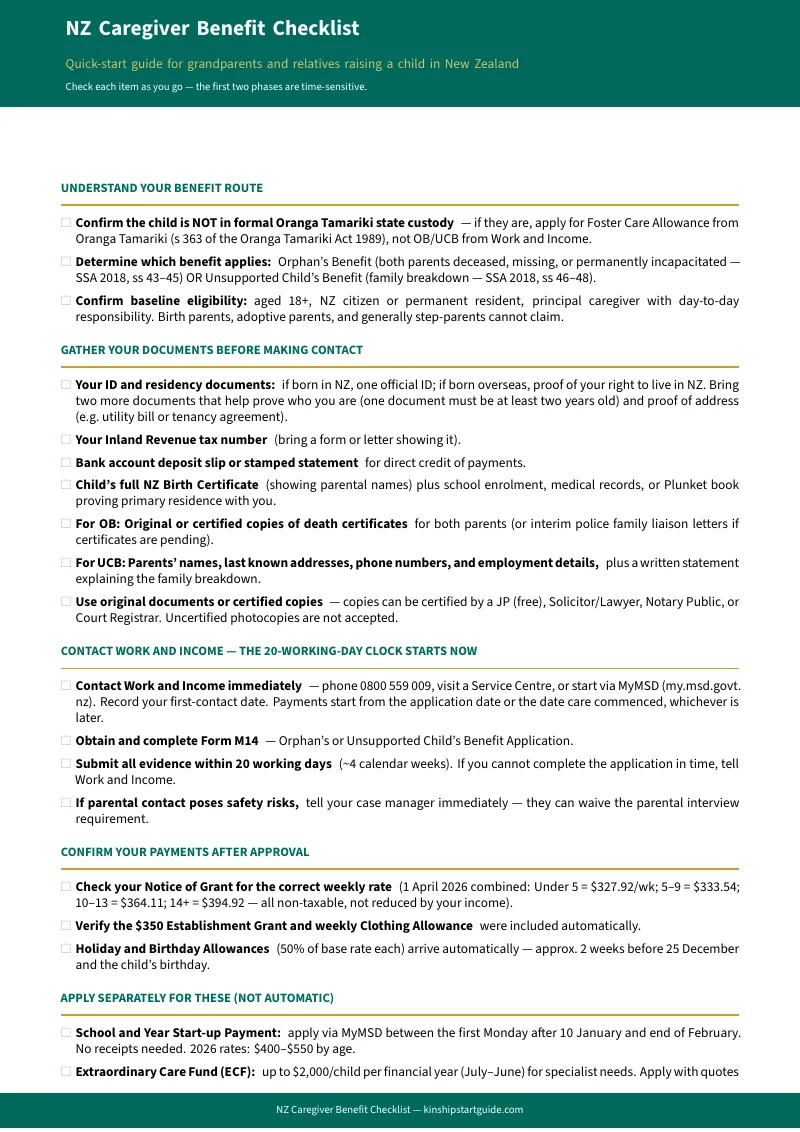
- Certified Document Readiness Checklist — every piece of evidence Work and Income requires for Form M14 (birth certificates, certified ID, proof of family breakdown, income statements), with what counts as a valid certified copy and where to get documents certified for free by a Justice of the Peace
- Current Weekly Rates by Age Bracket — the 1 April 2026 rates with worked dollar examples showing exactly how UCB or OB sits alongside NZ Superannuation or a full salary, including the Clothing Allowance that arrives automatically each week
- Supplementary Allowance Map — a visual summary of every extra payment: which ones are automatic (Establishment Grant, Holiday and Birthday Allowances) and which require a separate application (School Start-up Payment, Extraordinary Care Fund, Child Disability Allowance)
- Extraordinary Care Fund Roadmap — the panel application process including the four annual rounds, dollar limits ($100–$2,000), what qualifies, and the independent letter-of-support rules (one letter for under $500, two letters from different professionals for $500 and above)
- Work and Income Interaction Log — a printable ledger for recording every phone call, caseworker name, date, meeting outcome, and document submission receipt, so you have a formal evidence trail if files go missing during the 20-working-day window
- CYC Review Preparation Checklist — a proactive checklist for the mandatory July 2026 Confirming Your Circumstances reviews, covering what you must report (child leaving school, entering employment, parent returning to care) and the records to keep up to date
- Three-Stage Appeals Guide — how to file a Review of Decision, what happens at the Benefits Review Committee hearing, and when to escalate to the Social Security Appeal Authority, with referrals to free advocacy from GRG Trust NZ and Community Law Centres
Who This Is For
- Grandparents on NZ Superannuation who have taken in a grandchild and need to claim the weekly benefit without affecting their pension
- Aunts, uncles, and older siblings who stepped in during a family crisis and want one clear list of every payment the child qualifies for
- Caregivers without a court order who need to know what evidence Work and Income accepts instead of a Parenting Order or Guardianship Order
- Whānau caring for tamariki and navigating the system for the first time, including the Family Group Conference process
- Adult children or tech-literate relatives helping an older family member organise the paperwork — the guide is designed to be printed, filled in at the kitchen table, and taken to the appointment
Why Not Just Google It?
You can find most of the individual facts for free. Work and Income publishes the rates, the GRG helpline (0800 472 637) gives personal advice, and Citizens Advice Bureau volunteers offer free referrals. We link to every one of them in the guide.
What you cannot find for free is a single document that puts the steps in the right order for a relative caregiver. The Work and Income website spreads UCB information across dozens of pages. The Form M14 instructions assume you already know what "family breakdown" means in MSD language, which documents need to be certified (not just photocopied), and that the 20-working-day clock starts running the moment you make contact — before you have gathered a single piece of evidence. Outdated community advice still references the 12-month expected care rule that was abolished in July 2021, which means people in temporary or emergency placements are being told they do not qualify when they do.
The guide assembles the steps, the forms, the evidence requirements, and the supplementary payments into one printable system that a stressed grandparent can follow from the kitchen table — without spending hours searching, calling the wrong number, or triggering a deadline they did not know existed.
No Risk
Full refund, no time limit. If the guide does not help, email [email protected] and we will refund the full amount — no questions, no forms, no waiting period.
The free checklist gives you the five essential documents and the key eligibility points on a single printable page. Download it now and decide whether the full system is worth it after you have seen what the checklist covers.
If you are ready for the complete preparation system — the step-by-step application guide, the printable worksheets, the supplementary allowance roadmap, and the CYC review checklist — get the full guide for and start preparing before the clock starts.
Frequently Asked Questions
What if the rules change after I buy?
We update the guide when the rules change. Email us any time, even years later, and we'll send you the current edition free.