Your Income Stays Out of It. The Child Gets the Money Idaho Already Set Aside.
You didn't plan to raise another child. But here you are — stretching a fixed income across a second set of groceries, school fees, doctor visits, and winter coats that weren't in any budget. Idaho has cash grants, food benefits, and full health coverage specifically for this child, and the law says your income doesn't enter the calculation for the biggest one. The problem is that nobody at the IDHW office volunteered that information — and an application that should take a few weeks can stall for months if you miss a procedural step they never warned you about.
The Idaho Kinship Benefits Navigator is the independent roadmap that organises every public benefit a relative caregiver can claim for a child in Idaho — program by program, form by form, with the exact documents to bring and the exact words to use when a caseworker asks for income information they have no right to demand on a child-only application.
What the Guide Covers
- TAFI Relative Caretaker Grant (child-only cash) — the non-parent cash grant where your pension, Social Security, wages, and savings are completely excluded from the eligibility determination. The child's own income is all that counts, up to a $309 monthly cap. The guide walks you through the idalink application, explains the child-only income rules, and shows you how to handle a caseworker who defaults to the standard household means test
- Relationship proof without a court order — IDHW accepts a parent or stepparent statement, birth record, marriage license, divorce decree, obituary, baptismal record, or school record. The guide maps each document to the programs that accept it, so you know what to bring before you reach the office window
- Guardianship Assistance payments — monthly payments at foster-care rates for relatives who become legal guardians after a formal Child and Family Services placement. The guide explains the strict eligibility boundary: the child must have entered the formal care system first, so you know up front whether this pathway applies to your situation
- Medicaid, CHIP, and Katie Beckett — full health coverage for children under Modified Adjusted Gross Income rules, plus the Katie Beckett pathway for children with disabilities whose household income would otherwise exceed the limit. When the caregiver doesn't claim the child as a tax dependent, eligibility is calculated on the child's income alone
- SNAP food benefits and the medical expense deduction — how joint meal-preparation rules affect household income, how to declare the child correctly to avoid improper benefit terminations, and how caregivers age 60 and older can deduct out-of-pocket medical expenses to increase the monthly allotment
- WIC, free school meals, and ICCP childcare help — WIC for children under five, Idaho's free and reduced school meals application, and the Idaho Child Care Program for relative caregivers who are working, in school, in job training, or participating in TAFI, with the application process for each
- LIHEAP utility assistance and Title III-E Caregiver Support — seasonal energy help through the Low Income Home Energy Assistance Program, plus federal caregiver support grants through the local Area Agency on Aging for grandparents age 55 and older raising grandchildren
- Application workflow, renewals, and appeals — a recommended filing order so you gather documents once and use them across IDHW programs, plus printable Application Tracking Log, Renewal and Reporting Calendar, and Fair Hearing Notice Tracker
- Printable worksheets — Document Folder Checklist, Benefit Eligibility Quick-Reference Card, Child vs Caregiver Income Separator, SNAP Medical Expense Worksheet, Agency Communication Log, idalink Application Checklist, and Agency Contact Card, ready to fill in and bring to your IDHW field office
Who This Is For
- Grandparents on Social Security, a pension, or SSI who are paying for a grandchild out of savings they cannot replace — and who need to know that IDHW cannot count those savings on a child-only TAFI application
- Aunts, uncles, older siblings, and close family friends who took in a child with no notice and need to find out what the child is entitled to before the next bill arrives
- Relatives who were told they earn too much to qualify for cash help — they may not, because the TAFI child-only grant ignores the caregiver's income entirely
- Adult children or advocates researching options on behalf of an older relative caregiver who needs clear, step-by-step instructions they can print and bring to the IDHW office or follow on idalink
- Rural caregivers in the Magic Valley, Snake River Plain, or Panhandle who live hours from a regional IDHW field office and need to know exactly what to prepare before a phone interview or idalink submission
Why Not Just Call 211 or Apply Through idalink?
You absolutely should — with the guide open in front of you. Idaho 211 CareLine connects you with kinship navigators and local resources, and idalink lets you apply for TAFI, SNAP, and Medicaid online. IDHW's kinship navigation service develops service plans and case-manages them. The free help is valuable and this guide tells you how to reach all of it.
The guide doesn't replace free services — it prepares you to use them without costly mistakes. A TAFI intake worker will not mention that SNAP has a separate medical expense deduction for older caregivers, or that childcare subsidies through ICCP have different qualifying activities. And the idalink portal accepts your application without explaining which income rules apply to which program — a difference that determines whether the child gets a cash grant or the application sits in limbo while a caseworker asks for your pay stubs.
The guide handles the part nobody else covers: the cross-agency picture of every benefit the child may be entitled to, the filing order that saves you from gathering the same documents three times, and the procedural traps that stall applications for families who can't afford to wait.
Not Right for Everyone
This guide focuses on public benefit applications and financial help. It is not legal advice, and it does not cover contested custody disputes, juvenile court proceedings, or advice on whether to pursue guardianship. If you are involved in an active court case, your assigned caseworker or a legal aid attorney is the right first step. If you or the child are in immediate crisis — facing homelessness or a safety threat — call the Idaho Child Protection Hotline at 1-855-552-KIDS (5437) or 211 before anything else.
What You Get
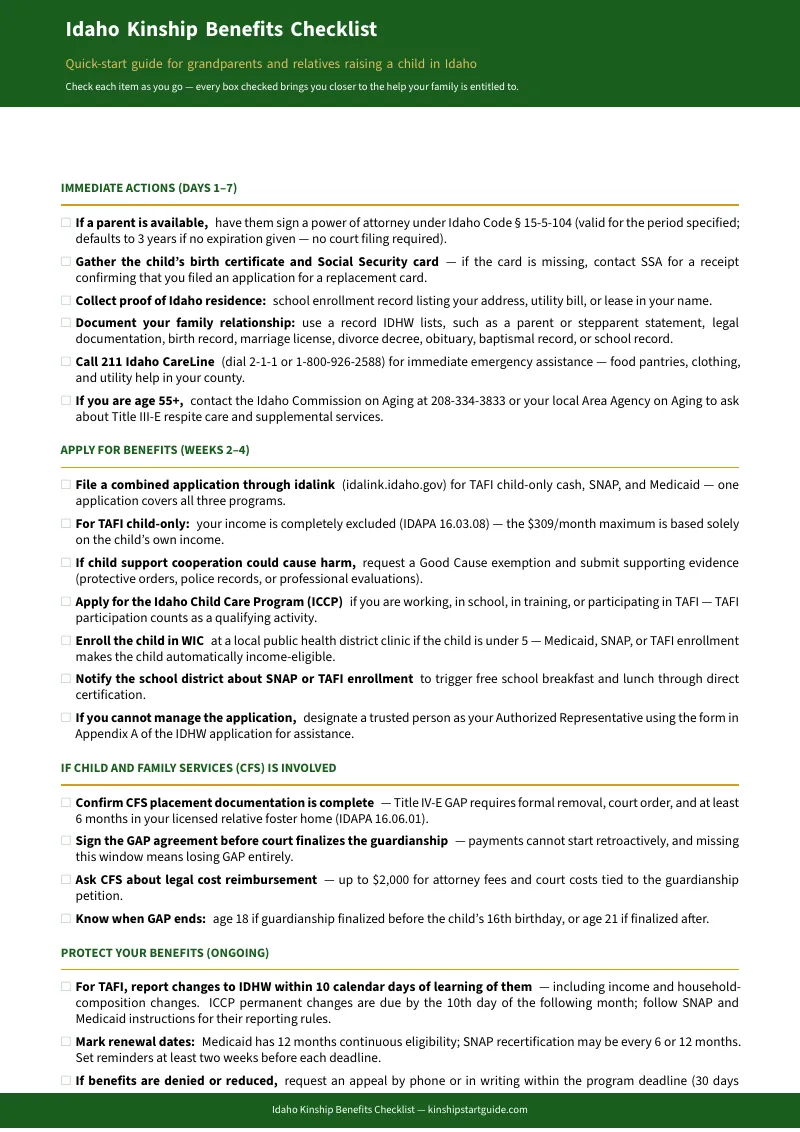
The download includes 12 PDFs: the complete 51-page guide, a 2-page quick-start checklist (also available as a free standalone download), and 10 fillable worksheets — tracking logs, document checklists, an income separator, a SNAP medical expense sheet, a fair-hearing tracker, an idalink application checklist, and an agency contact card — ready to print, fill in, and bring to your IDHW field office or use alongside the idalink portal.
Full refund, no time limit. If the guide doesn't help, email [email protected] and we'll send your money back.
Get the Idaho Kinship Benefits Navigator →
Frequently Asked Questions
What if the rules change after I buy?
We update the guide when the rules change. Email us any time, even years later, and we'll send you the current edition free.