The clinic wants a court order. The school wants custody papers. Washington law says you need neither.
You took in a child — maybe your grandchild, a niece, a nephew, or the child of a friend who can't be there right now. The reasons are painful and private, and you didn't have weeks to plan. What you had was overnight.
Now the child needs to see a doctor. Needs to start school. Needs a dentist. And every front desk you walk up to asks for paperwork that sounds like it requires a lawyer, a judge, or a parent who isn't available.
Here's what most caregivers in Washington don't know: the state has a Layered Consent System — four separate instruments that let you handle medical care, school enrollment, and daily authority using documents you fill out at your kitchen table. No court hearing. No attorney. In most cases, no parent signature. The problem isn't the law. The problem is that clinics and schools routinely get the law wrong, and when they turn you away, you don't know which statute to cite or what to say next.
What the Layered Consent System Covers
The guide walks you through every consent instrument Washington recognises for a caregiver without a court order, and shows you exactly when to use each one:
- The Kinship Caregiver Health Declaration (RCW 7.70.065) — Washington's first-day document. Field-by-field instructions for the declaration that lets a relative caregiver consent to medical, dental, and mental health care for up to six months — without a parent's signature, without notarisation, and without a court filing
- The Parental Power of Attorney (RCW 11.130.145) — when the parent is cooperative but temporarily unavailable. Covers school, medical, and daily care for up to twenty-four months. The guide explains when a POA gives you authority the health declaration doesn't, and when you don't need one at all
- School enrollment under OSPI guidance — the residency rules that let a child attend your local school district, the documents the district can and cannot demand, and what to do when a clerk insists on a court order that Washington law does not require
- Medical consent tiers — the critical distinction between relative and non-relative authority, what each tier covers (routine care, dental, specialists, prescriptions, mental health), and where caregiver consent reaches its legal ceiling
- Adolescent self-consent — how Washington law lets teenagers consent to certain treatments independently, including mental health counselling under SHB 3139, and how your caregiver authority interacts with a teenager's own rights
When the School or Clinic Says No
School districts and medical offices across Washington routinely contradict state law. Clinic intake desks refuse unnotarised declarations. School clerks demand court custody papers that OSPI's enrollment guidance explicitly disclaims. Pediatric offices turn away caregivers who hold a legally valid health declaration because the receptionist hasn't seen one before.
The guide includes statutory escalation scripts — citing the exact RCW sections, OSPI guidance, and McKinney-Vento provisions — that you can present to a reluctant administrator or clinic manager. You shouldn't need them. But when someone who hasn't read the law stands between a child and a doctor's appointment, you will be glad you have them.
The Decision Table — Which Document Fits Your Situation
Should you use the health declaration, a parental power of attorney, a district caregiver form, or a court order? The guide includes a comparison table that lays out the cost, the authority each instrument grants, who needs to sign, how long it lasts, and when the simpler option stops being enough. Most caregivers discover they can skip the courthouse entirely. Some learn they need the court sooner than they thought. Either way, you stop guessing.
Who This Is For
- A grandparent, aunt, uncle, or older sibling who has taken in a child and needs to get that child into school and to the doctor — this week
- A family friend or godparent who is not a blood relative and wants to know exactly what Washington law allows and where the limits are
- A family helper or adult child buying this on behalf of an older relative who needs clear, step-by-step instructions
- Anyone who was turned away by a school or clinic and told they need "custody papers" — and wants to know whether that's actually true under Washington law
Why Not Free Resources?
The NJP Health 752 declaration form is free, and we link directly to it in the guide. DSHS publishes a kinship caregiver brochure. CLEAR provides a free legal advice hotline. The guide doesn't replace any of that — it bridges the gap between having the form and knowing what to do with it.
Free resources give you the health declaration. They don't give you field-by-field instructions for executing it correctly under penalty of perjury. They don't tell you what to say when a school district in Yakima demands court custody papers that Washington law doesn't require. They don't explain the difference between a relative's medical consent authority and a non-relative's limited school-only authority. They don't cover the six-month expiration trap — the automatic expiry that catches families off-guard mid-treatment cycle. And they don't walk you through the decision tree that shows when the health declaration is enough and when you need to escalate to a power of attorney or a court filing.
What You Get
- The complete guide — 13 chapters covering every consent pathway, school enrollment, medical tiers, adolescent self-consent, special education standing, IEP and Section 504 rights, childcare and travel authority, DCYF and dependency, refusal escalation, and the court option decision tree
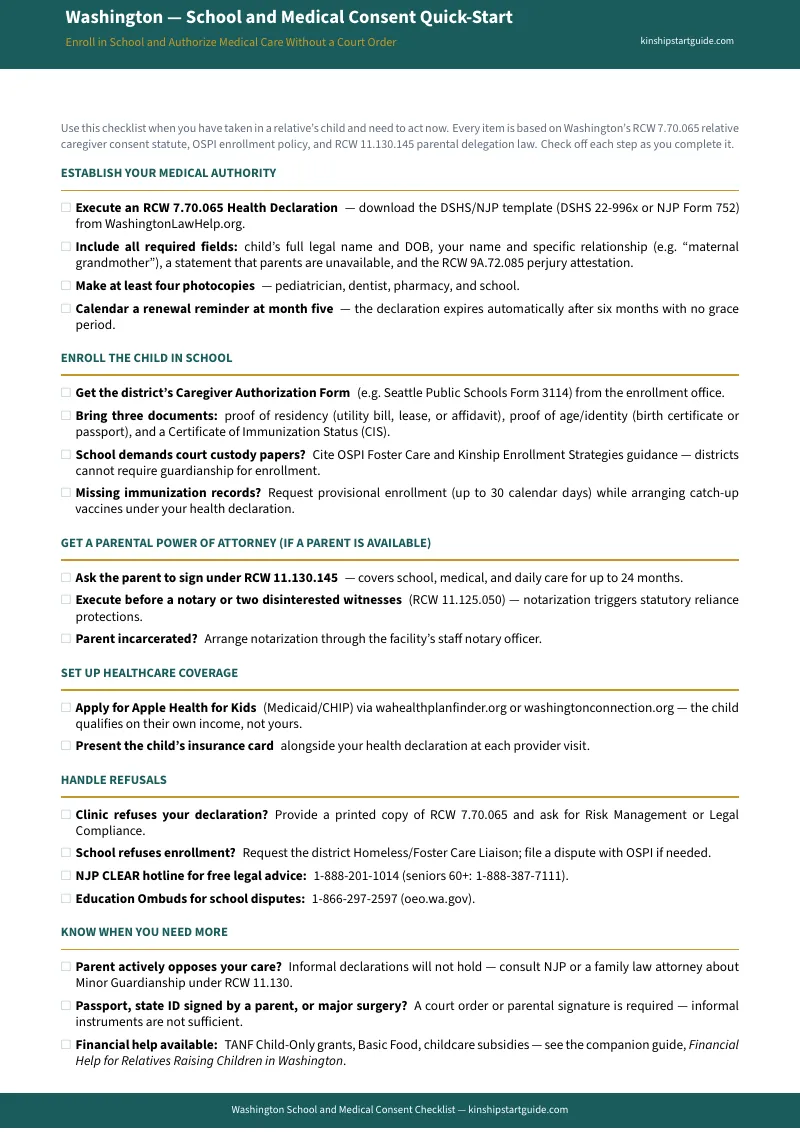
- The quick-start checklist — a printable 20-item summary of the forms, enrollment documents, and contact numbers you need in the first 72 hours
- Health declaration completion worksheet — fill this in before the official form so nothing gets rejected for a missing field or an incorrect perjury attestation
- School enrollment checklist — every document to bring to the district office, with the statutory basis for each and what to say if they ask for more
- Medical provider intake prep sheet — what to bring to the child's first appointment with a new pediatrician, dentist, or specialist, including Apple Health and ProviderOne details
- Statutory escalation scripts — ready-to-use scripts citing RCW 7.70.065, OSPI enrollment guidance, and McKinney-Vento provisions for when an administrator refuses valid paperwork
- Instrument comparison table — health declaration vs. POA vs. district caregiver form vs. court order, with costs, signing requirements, and authority scope
- Instrument decision flowchart — a one-page visual that tells you which document fits your situation
- Six-month renewal tracker — a log system so your health declaration never expires without warning mid-treatment
- Key contacts and resources — NJP, CLEAR hotline, Kinship Navigators, OSPI Education Ombuds, and DCYF contacts
Satisfaction Guarantee
Full refund, no time limit. If the guide doesn't help you navigate your situation, email [email protected] and we'll refund every penny — no forms, no waiting period, no questions.
A Child Shouldn't Wait for a Court Date to See a Doctor
Washington built a system so they don't have to. The guide shows you how to use it — and what to do when someone tries to tell you it doesn't exist.
Download includes the full guide, the quick-start checklist, and standalone printable worksheets and scripts. Instant access after purchase.
Already have the free checklist? The full guide goes deeper — field-by-field declaration instructions, statutory escalation scripts, the six-month renewal tracker, the instrument comparison table, and the decision flowchart that turns "I think this is right" into "I know exactly what to do."
Frequently Asked Questions
What if the rules change after I buy?
We update the guide when the rules change. Email us any time, even years later, and we'll send you the current edition free.