Your grandchild is here. The bills came with them.
One morning your life had a shape you understood — a budget, a routine, a refrigerator stocked for one or two. Then a phone call changed everything. A grandchild, a niece, a nephew moved in, and overnight you became the person responsible for groceries, doctor visits, school supplies, diapers, and a bedroom that didn't exist last week.
North Carolina has real money set aside for this child — cash grants that ignore your Social Security check entirely, health coverage with no premium, food benefits, childcare subsidies. But the system that holds that money is scattered across 100 county DSS offices, an online portal called ePASS that times out if you pause too long, and program rules that contradict each other from one benefit to the next.
The NC Kinship Benefits Navigator puts every program, every form, and every application step in one printable guide — organized by the order you need them, not the order the state website lists them.
What the guide walks you through
- Work First Child-Only Cash — the monthly grant where your income is completely excluded from the calculation. The guide explains who qualifies as a "specified relative," what the child support cooperation requirement means, how to request a good-cause exemption, and what happens in the seven Electing counties (Beaufort, Caldwell, Catawba, Lenoir, Lincoln, Macon, Wilson) where local rules can differ.
- Guardianship Assistance Program (GAP) — the higher monthly payment available when a child enters your care through the child welfare system. The guide lays out every prerequisite: DSS custody, foster care licensing, six months of placement, and the court-ordered guardianship that activates the payment.
- NC Medicaid and CFSP — full health, dental, vision, and behavioral health coverage for the child, including the Children and Families Specialty Plan for children with complex needs. The guide covers MAGI rules, how the tax-dependent question affects household size, and what happened when NC Health Choice was folded into Medicaid.
- Food and Nutrition Services (FNS/SNAP) — monthly food benefits loaded onto an EBT card. Unlike child-only cash, FNS counts the entire household's income — but the guide explains the separate-household strategy for caregivers who purchase and prepare food independently, the documentation DSS accepts, and the maximum allotments by household size.
- Childcare subsidies — reduced or free childcare through the Division of Child Development and Early Education. When neither biological parent lives in the home, the income unit is the child and siblings only — the guide walks through the voucher application, waitlist priorities, and county-specific availability.
- Emergency and seasonal help — LIEAP for winter heating costs, the Emergency Assistance fund for crisis situations, WIC for children under five, free school meals through Direct Certification, and the Family Caregiver Support Program for relatives age 55 and older.
The worksheets and tools inside
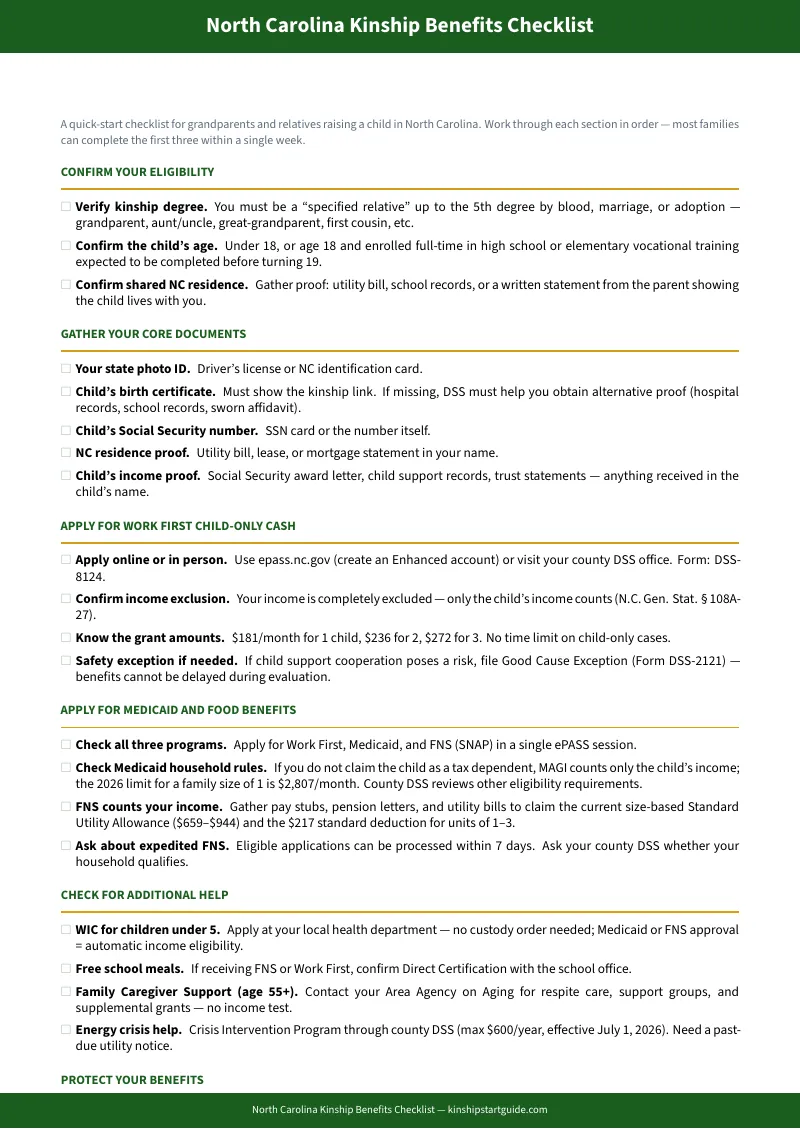
- Document assembly checklist — every piece of paper DSS needs for each program, organized so you gather once and apply to multiple benefits without a second trip
- Application route guide — step-by-step instructions for ePASS online, mail-in, and in-person drop-box applications across Standard and Electing counties
- Appeal deadline tracker — a printable log for every Notice of Action, the continue-benefits deadline, the hearing request window (60 days for most programs, 90 for FNS), and hearing outcomes
- Income-by-program worksheet — a side-by-side comparison showing which income counts for which program, so you stop mixing up the rules between Work First (child-only) and FNS (whole household)
- Agency communication log — a record of every phone call, office visit, and document you submit, with dates and names, so nothing falls through the cracks
- Free-help directory — NC 211, Legal Aid of North Carolina (1-866-219-LANC), the Charlotte Center for Legal Advocacy, and county-specific DSS contacts
Who this is for
- Grandparents on Social Security or a pension who are covering a grandchild's expenses and cannot afford to lose a benefit because of a paperwork mistake
- Aunts, uncles, and older siblings who took a child in suddenly and have no idea what the child is entitled to
- Relatives who were told they need a court order before applying — they don't, and the guide explains why
- Adult children or family friends helping an older relative navigate the system on their behalf
Why not just call DSS or look it up online?
You absolutely can, and the guide lists every phone number and office address you'll need. But DSS caseworkers manage individual program silos — the person who handles your Work First application doesn't explain FNS household rules, and neither one mentions the childcare subsidy. The NCDHHS website describes each program on a separate page with no cross-references. The ePASS portal accepts applications but gives no guidance on what to upload or how to structure your household.
The result is that caregivers apply to one program at a time, bring the wrong documents, get denied for reasons they could have prevented, and miss programs they didn't know existed. The guide puts all of it in one place — the programs, the forms, the income rules, the deadlines — so you can apply to everything the child qualifies for in the right order, with the right paperwork, the first time.
What this guide is not
This is not a legal guide and does not advise you on whether to file for custody or guardianship. It does not promise approval, specific payment amounts, or faster processing. It is an independent organizational tool that explains public benefit programs in plain language, links to every official form and portal, and gives you the worksheets to stay organized. If you need help with court filings or custody, the guide hands you off to the North Carolina Guardianship and Custody Process Guide. If you need school enrollment or medical consent authority, see the School and Medical Consent Guide.
Your purchase, protected
Full refund, no time limit. If the guide doesn't help, email [email protected] and you'll get your money back. No forms, no deadline, no questions.
The free checklist gives you the overview — which programs exist and which agency handles each. The full guide shows you how to actually apply: the right forms, the documents to bring, how to structure your household for each program, and what to do when a caseworker asks for information that shouldn't be part of your case. Get the full guide →
Frequently Asked Questions
What if the rules change after I buy?
We update the guide when the rules change. Email us any time, even years later, and we'll send you the current edition free.