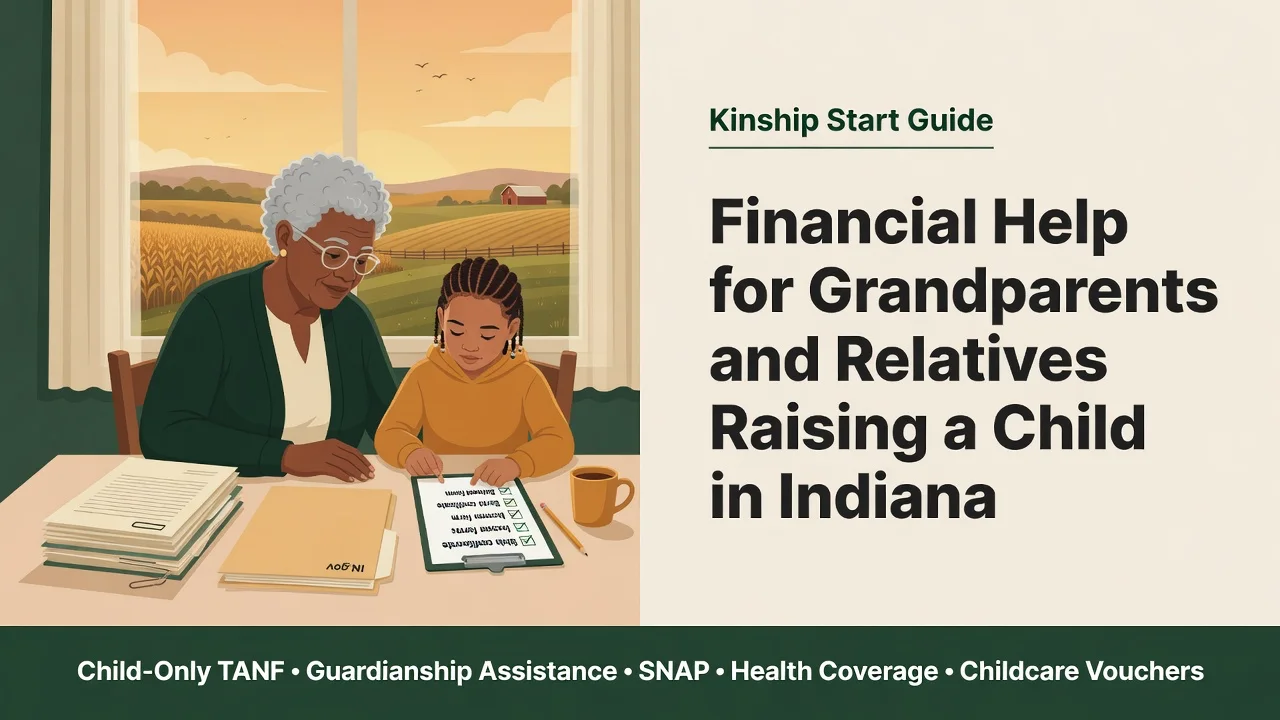
You're paying for everything out of pocket because nobody told you what the child qualifies for
A child landed in your home — maybe overnight, maybe over a weekend — and suddenly you're buying groceries for one more, paying for school supplies, figuring out health insurance, and wondering how long your savings can stretch. You've heard Indiana has programmes for grandparents and relatives raising children, but every agency has a different website, different rules, and different forms. You tried the FSSA Benefits Portal and got lost in income questions that didn't seem to apply. You called the DFR county office and sat on hold for 45 minutes before someone told you to "just apply online."
Here is what most kinship caregivers in Indiana don't realise until months into the process: most of these programmes do not count your income at all. The Child-Only TANF grant looks only at the child's own income — not your retirement, not your disability payments, not your wages. Hoosier Healthwise evaluates the child separately from the adult household. The money is there. The barrier is knowing how each programme works, what documents each agency wants to see, and which legal arrangement unlocks which payment.
The Indiana Kinship Benefits Navigator
This guide puts every programme a relative caregiver in Indiana can access into a single, printable document — organised not by agency, but by what you need to do and in what order. It is the guide you would want a knowledgeable DFR caseworker to sit down and walk you through, except you can read it at your own pace, highlight the parts that apply to your situation, and bring it with you to every office visit and phone call.
It does not replace free government services and it does not guarantee any outcome. What it does is save you the weeks of phone calls, conflicting advice, and wasted trips that come from trying to piece the system together on your own.
What's inside the guide
- Child-Only TANF Cash Grant — how the income exclusion works for non-needy relative caregivers, what the child qualifies for (up to $248/month for one child), and how to navigate the FSSA Benefits Portal so your income is correctly excluded from the calculation
- DCS Unlicensed Relative Stipend — the $300/month payment available to relatives caring for a child under a DCS safety plan, what qualifies as a "safety placement," and how to contact your DCS Family Case Manager
- Guardianship Assistance Program (KinGAP) — who qualifies (the child must have been in a licensed relative foster home for six consecutive months), what it pays, and how it differs from the unlicensed stipend
- Hoosier Healthwise and HIP — the separate income rules for children versus adults, why the child almost certainly qualifies even if you don't, and how to apply through the FSSA Benefits Portal
- SNAP food benefits — how household composition affects eligibility when a grandchild lives with you, why your income counts for SNAP even when it is excluded from Child-Only TANF, and what to bring to your phone interview
- WIC — coverage for children under five and how kinship caregivers apply
- CCDF childcare vouchers — how to apply through Indiana's Carefinder portal, waitlist realities, and the copay calculation
- Title III-E Respite and Support — how grandparents and relatives aged 55 and older can access respite care, support groups, and supplemental services through Indiana's Area Agencies on Aging
- Indiana Kinship Benefits Decision Tree — a fillable flowchart of which programmes open from your current legal arrangement
- Household Income Decision Tree — a fillable worksheet showing whose income counts for which programme, so you can see before you apply whether the child qualifies on their own
- Legal Arrangement and Benefit Eligibility Matrix — what each legal status (informal care, Power of Attorney, guardianship, DCS placement) unlocks across all programmes, with apply-by columns
- DFR Application Document Prep Checklist — the exact paperwork each agency needs, including the Authorized Representative forms (State Form 53460 for SNAP/TANF and State Form 55366 for health coverage), with columns for original, copy, and where you submitted it
- Application Tracking Log — a running log of every submission, including the FSSA Document Center fax numbers and mailing address, so you have proof of when you sent what
- Agency Communication Log — date, person, and follow-up for every call, visit, fax, and mailing
- KinGAP Eligibility Tracker — the five mandatory milestones in order, with the agreement-before-order date check
- Benefit Renewal Calendar — TANF, SNAP interim report, Hoosier Healthwise, and a 12-month write-in grid
- Notice Tracking and Fair Hearing Worksheet — Indiana gives you 33 days from a denial notice to request a fair hearing, and benefits can continue while the hearing is pending if you file within 10 days of the notice; this worksheet tracks both clocks
- Agency Contact Card — statewide numbers plus blanks for your county DFR office, FCM, township trustee, and case numbers
Who this is for
- Grandparents, aunts, uncles, or older siblings raising a child in Indiana who need to know what money and coverage the child is entitled to
- Caregivers on Social Security, SSDI, or a pension who were told — or assumed — their income disqualified the child from cash assistance
- Relatives with a Power of Attorney who want to understand which additional programmes open up with a guardianship order, and which don't require one at all
- Social workers, church volunteers, and family friends helping a kinship family find the right agencies and fill out the right forms
Who this is not for
- Anyone seeking legal advice on whether to file for guardianship — this guide explains programme rules, not legal strategy. Contact Indiana Legal Help or Indiana Legal Services for legal guidance.
- Anyone looking to become a licensed foster parent — the guide covers kinship care payments, not foster licensing. Contact DCS Foster Care for licensing information.
- Anyone needing help with Social Security benefits or tax credits for grandchildren — those are covered in separate, dedicated guides.
- Anyone in a food or housing emergency right now — call 211 or visit your local DFR county office for immediate help.
Why not just use the free information?
You should. Every programme in this guide is administered by a free government agency, and every application is free to file. Indiana Legal Help will give you free guardianship forms. The Kinship Indiana Support Services (KISS) programme offers case management and support groups at no cost. Indiana 211 connects you with local resources.
The problem isn't that the information doesn't exist. It's that it's spread across FSSA, DCS, the courts, the Area Agencies on Aging, and dozens of policy documents written for caseworkers, not for a grandparent who just took in a child last Tuesday. The FSSA Benefits Portal asks income questions that make working or retired caregivers abandon the application — not realising that a child-only case works differently. The DCS website describes the Guardianship Assistance Program without making clear that it requires six months in a licensed foster home first, and that without that placement you can still access the unlicensed stipend and every DFR programme. Each agency knows its own rules but can't walk you through the others.
This guide connects those dots. It puts the eligibility rules, document checklists, and application steps for every programme side by side, so you can see the full picture before you start making calls.
Satisfaction guarantee
Every purchase comes with a full refund, no time limit. If the guide doesn't help your situation, email [email protected] and we'll refund you — no forms, no waiting period.
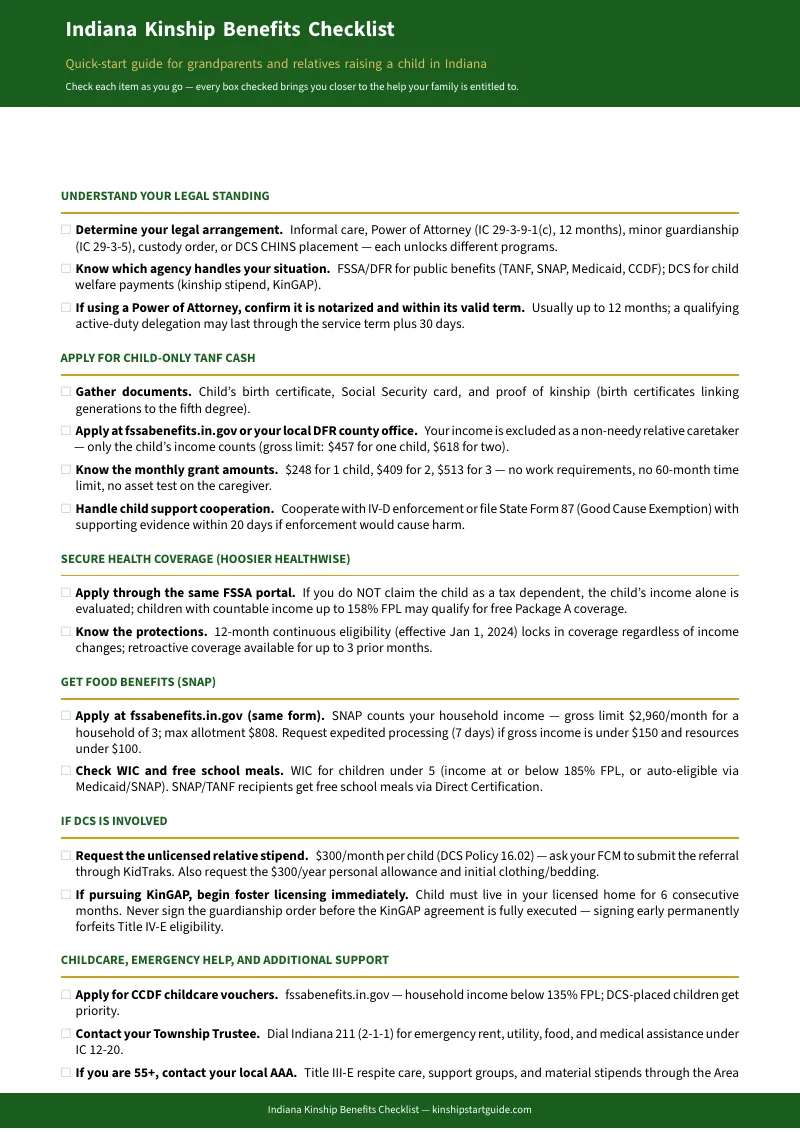
The free Indiana Kinship Benefits Checklist is available right now, no purchase required. It lists every programme, the agency to contact, and the basic documents you'll need. If that's enough to get you started, it's yours to keep.
If you want the full programme-by-programme walkthrough — the income decision tree, the document checklists, the legal arrangement matrix, and the step-by-step application instructions — the complete guide is ready for you.
Get the Indiana Kinship Financial Help Guide →
Frequently Asked Questions
What if the rules change after I buy?
We update the guide when the rules change. Email us any time, even years later, and we'll send you the current edition free.