Your Pension Stays Yours. The Child Gets the Money Hawaii Already Set Aside.
You didn't expect to raise another child. But here you are — stretching a retirement check across island grocery prices, school fees, doctor co-pays, and clothes a growing kid outgrows every few months. Hawaii has cash grants, food benefits, full health coverage, and childcare subsidies specifically for this child, and the law says your income doesn't enter the calculation. The problem is that nobody at the DHS processing center volunteered that information, and the state website splits each program across a different division with its own forms, its own rules, and its own phone number.
The Hawaii Kinship Benefits Navigator is the independent roadmap that organises every public benefit a relative caregiver can claim for a child in Hawaii — program by program, form by form, with the exact documents to bring and the exact words to use when an intake worker at the BESSD window asks for information they have no legal right to request on a child-only application.
What the Guide Covers
- Child-only TANF cash assistance (Form DHS 1240) — the application pathway that keeps your pension, Social Security, savings, and property completely out of the eligibility determination. A three-person child-only assistance unit can receive up to $985 per month, the child-only case is exempt from the federal 60-month time limit and First-To-Work employment requirements, and the guide walks you through every section of the form so the child-only rules apply from the start
- TAONF (Temporary Assistance for Other Needy Families) — the parallel cash program for households that don't meet standard TANF categories, with the same application form and the eligibility distinctions explained
- SNAP food benefits under Broad-Based Categorical Eligibility — Hawaii's 200% FPL gross income limit with no asset test, the purchase-and-prepare household rules, and how a relative caregiver can structure the household so retirement income stays out of the food benefit calculation. Maximum allotments are adjusted upward for Hawaii's higher food costs
- Med-QUEST health coverage through QUEST Integration — MAGI household rules that prohibit asset tests for children, with eligibility up to 313% FPL under S-CHIP. When you don't claim the child as a tax dependent, your income is excluded from the child's MAGI household entirely
- Child Care Connection Hawaii subsidies — income limits up to 85% of the State Median Income, the application process, background-check requirements for relative providers, and the Preschool Open Doors tuition assistance program for two- to four-year-olds
- Kinship Guardianship Assistance Program (KGAP) — monthly payments for relatives with a child welfare placement and Family Court guardianship order, with the eligibility rules that distinguish KGAP from informal TANF cash help
- Arrangement-versus-benefit matrix — a single table showing how informal care, voluntary placement, guardianship, and foster care each change what benefits the child can receive, so you can see the full picture before making decisions about court involvement
- Fair hearing appeals — what to do when a benefit is denied or reduced, how to file an administrative appeal within the 90-day window, and how to request continued benefits while the case is reviewed
Who This Is For
- Grandparents on Social Security, a pension, or SSI who are paying for a grandchild out of savings they can't replace — and who need to know that DHS cannot touch those savings on a child-only application
- Aunts, uncles, older siblings, and hānai family who took in a child with no notice and need to find out what the child is entitled to before the next bill arrives
- Relatives who were told they need a court guardianship order to get benefits — they don't for the core programs, and the guide explains why
- Neighbor Island families who face a long trip to the nearest DHS processing center and need every form, document, and question ready before they go
- Adult children or advocates researching options on behalf of an older relative caregiver who needs clear, step-by-step instructions
Why Not Just Call the DHS Help Line?
You absolutely should call DHS — with the guide open in front of you. The statewide support desk (1-855-643-1643) can answer general status questions, but in an informal kinship arrangement there is no assigned caseworker walking you through each program. Processing staff are not required to tell you that a simpler, asset-protected application pathway exists. One wrong household-composition answer can pull your retirement income into the eligibility test and trigger a denial that takes months to overturn through a fair hearing.
The guide doesn't replace free services — it prepares you to use them without costly mistakes. Legal Aid Society of Hawaii handles court guardianship. Family Programs Hawaii's Warmline (1-866-545-0882) handles crisis referrals. The guide handles the part nobody else covers: which path protects your retirement savings while getting the child every dollar Hawaii law already set aside for them.
Not Right for Everyone
This guide focuses on public benefit applications and financial help. It is not legal advice, and it does not cover contested custody disputes, juvenile dependency proceedings, or advice on whether to pursue guardianship. If you are involved in an active court case, an attorney or the Family Court Self-Help Center is the right first step. If you or the child are in immediate crisis — facing homelessness or a safety threat — call 211 or the Family Programs Hawaii Warmline before anything else.
What You Get
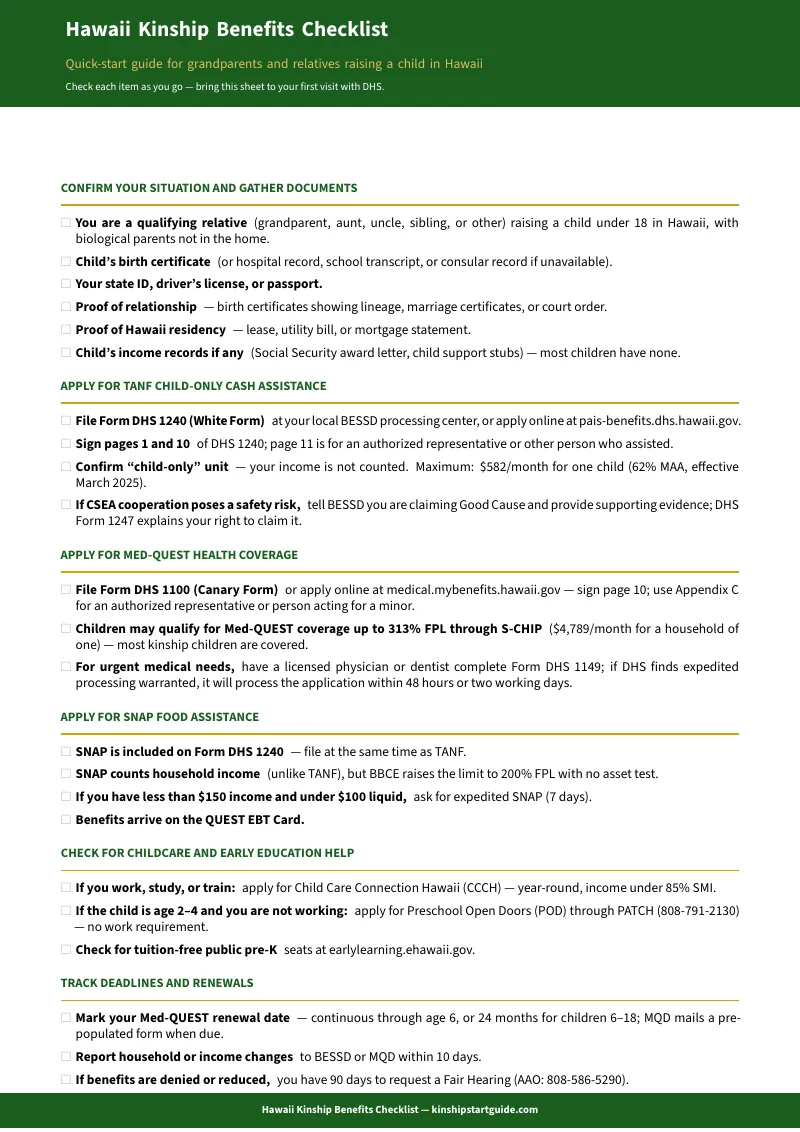
The download includes the complete 46-page guide, a quick-start checklist (also available as a free standalone download), and eight printable worksheets: an arrangement-versus-benefit matrix, an eligibility quick-check worksheet, an island-by-island processing center directory, a document-gathering checklist organized by program, an application submission tracker, an agency communication log, a deadline and renewal tracker, and a fair hearing preparation worksheet — ready to print, fill in, and bring to your DHS office or drop-box.
Full refund, no time limit. If the guide doesn't help, email [email protected] and we'll send your money back.
Get the Hawaii Kinship Benefits Navigator →
Frequently Asked Questions
What if the rules change after I buy?
We update the guide when the rules change. Email us any time, even years later, and we'll send you the current edition free.