
Every Georgia Probate Form Is Free. Filing the Wrong One in the Wrong Court Loses You the Filing Fee and Three Months.
Every Georgia Probate Court Standard Form is downloadable for free. Every statute is on the General Assembly's website. And none of that helps when you're standing at the Probate Court clerk's window with a stack of papers, a child who should be in school, and no clear answer to the question that actually matters: do you even need to be here, or would a Grandparent Power of Attorney have given you everything the school demands — with no hearing, no filing fee, and no waiting?
The Georgia Kinship Court Process Navigator is the independent guide that answers that question first, then walks you through whichever route fits — from the non-court Grandparent Power of Attorney through temporary and permanent probate guardianship, Superior Court third-party custody, standby guardianship, and emergency orders — form by form, step by step, across all 159 counties, with printable worksheets for tracking service, preparing your hearing evidence, and staying in compliance after the judge signs your order.
What the Guide Covers
- Legal route decision framework — a structured comparison of the Grandparent Power of Attorney, temporary guardianship, permanent guardianship, Superior Court third-party custody, and standby guardianship, so you pick the right path before you pay a filing fee or commit to a court calendar
- Grandparent Power of Attorney walkthrough (O.C.G.A. § 19-9-127) — who can execute the POA, what authority it grants for school enrolment and medical consent, the Probate Court registration requirement, when it is enough and when you need a court order instead
- Court selection across 159 counties — clear guidance on when your case belongs in Probate Court versus Superior Court, the automatic dismissal triggered when a parent objects to a probate guardianship petition, and when an equitable caregiver claim under O.C.G.A. § 19-7-3.1 applies
- Filing fees and fee waivers — the $125 statutory filing fee for a temporary guardianship petition under O.C.G.A. § 15-9-60(f)(2), county-level add-ons for background checks ($5–$20), sheriff service (~$50), publication charges ($50–$180), certified copies (~$10 each), and the Affidavit of Indigency that can waive court costs for qualifying petitioners
- Notice and service — who must be served, personal service versus certified mail versus sheriff service versus legal-organ publication, how to serve an incarcerated parent, and what to do when a parent cannot be found — including the due diligence search standard and the four-week publication requirement
- The parental presumption and Superior Court custody — when the Probate Court guardianship route is blocked by a parent's formal objection, the constitutional parental presumption in third-party custody proceedings, what "exceptional circumstances" means under Georgia law, and what evidence is persuasive
- Background checks and court evaluations — the mandatory criminal background check, what the court looks for, and how to prepare when a Guardian ad Litem is appointed
- Emergency and standby guardianship — the accelerated process for immediate appointment when the child's welfare is at risk, and the standby route for parents facing serious illness or incapacity who want to designate a successor in advance
- The hearing and the order — the mandatory in-person oath before the Probate Judge or Clerk (not a notary), what happens at the hearing for each court route, how to present your case without a lawyer, and what the judge's order means for your legal authority
- Post-order compliance — obtaining certified Letters of Guardianship, the mandatory annual Personal Status Report, address change requirements, and how guardianship can be modified or terminated
- Five procedural scenarios — worked examples for when both parents consent, one or both parents cannot be located, a parent is incarcerated, both parents are deceased, and a parent files a formal objection — each mapped to the specific steps, documents, and court route required
- Financial assistance routing — an overview of TANF child-only grants, the Kinship Navigator Program, Medicaid, and other programmes, with cross-references to the companion Georgia financial help guide for full programme-by-programme instructions
6 Printable Worksheets — Each a Standalone PDF
- Court and filing route decision worksheet — work through a series of yes/no questions about your family's circumstances to identify which court to file in and which documents to prepare
- Filing packet checklist — every document required for your filing, organised by court type (Probate guardianship vs. Superior Court custody), with reminders for county-specific supplements
- Service of process tracker — log for recording every service attempt: date, method (certified mail, sheriff service, publication), recipient, tracking number, and confirmation of receipt
- Hearing day evidence organiser — inventory sheet for every document you will bring to court, with copy counts for the judge, opposing party, and Guardian ad Litem
- Post-order compliance calendar — 12-month template for tracking annual Personal Status Report deadlines, school notifications, and review hearings
- Agency communication log — running record of every interaction with court clerks, DFCS caseworkers, Kinship Navigator staff, and community support agencies
Who This Is For
- Grandparents who have been caring for a grandchild informally and now need a court order because a school, doctor, or benefits office has refused to accept anything less
- Aunts, uncles, adult siblings, and other relatives who took in a child after a parent became unavailable — and who need lasting legal authority without retaining a family law attorney
- Relatives who aren't sure whether they need a court filing at all — the guide's decision framework compares the non-court Grandparent POA against probate guardianship and Superior Court custody so you don't pay a filing fee prematurely
- Adult children, community advocates, or Kinship Navigator staff helping an older caregiver understand the court system
Why Not Just Use the Free Court Forms?
You should. The Council of Probate Court Judges of Georgia publishes every standard form for free at gaprobate.gov, and the guide links directly to each one. GeorgiaLegalAid.org offers excellent self-help articles on guardianship and custody. The Georgia Kinship Navigator Program (1-855-357-6566) connects relatives to support services. The Georgia Legal Services Program and Atlanta Legal Aid Society offer free representation to qualifying caregivers. These resources are listed in the guide, and they should be your first stop if you qualify.
What none of these resources do is put it all in order for your specific situation. The gaprobate.gov form directory lists GPCSF 28 alongside dozens of other forms; it doesn't tell you whether the Grandparent Power of Attorney already covers what the school is demanding or whether you actually need to file in court. The court clerk will accept your petition, but they are legally prohibited from advising you that you filed in Probate Court when Superior Court was the right route, or that a parent's formal objection will automatically dismiss your probate petition without a hearing. Kinship Navigator staff can connect you to community resources, but they cannot select your forms or help you prepare your filing.
The guide organises the process around decisions — what to file, where, in what order, and what happens at each step — so you spend your energy on the child, not on figuring out which government website has the next piece of the puzzle.
Not Right for Everyone
This guide is not legal advice and does not replace a lawyer. It explains how the court process works for self-represented petitioners; it does not advise you on whether to file or predict what a judge will decide. If a parent is actively contesting your petition and you expect a full trial in Superior Court, consult a family law attorney — the guide covers what contested proceedings look like, but strategic litigation advice is beyond its scope. If the child is in immediate danger, contact local law enforcement or your county's Division of Family and Children Services before worrying about paperwork.
What You Get
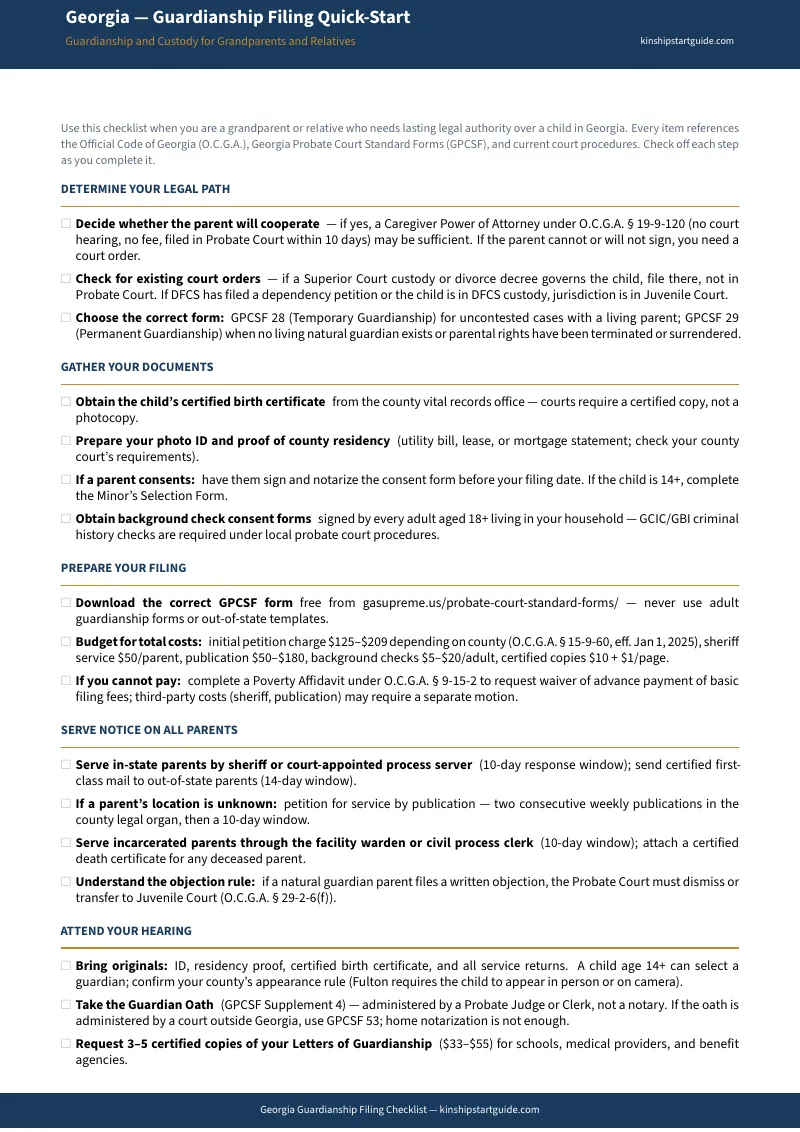
The download includes the complete 48-page court process guide, a quick-start filing checklist (also available as a free standalone download), and 6 printable standalone worksheets — a court and filing route decision worksheet, a filing packet checklist, a service of process tracker, a hearing day evidence organiser, a post-order compliance calendar, and an agency communication log. All 8 PDFs are ready to print, fill in, and bring to the courthouse.
Full refund, no time limit. If the guide doesn't help, email [email protected] and we'll send your money back.
Get the Georgia Kinship Court Process Navigator →
Frequently Asked Questions
What if the rules change after I buy?
We update the guide when the rules change. Email us any time, even years later, and we'll send you the current edition free.