
The Court Process Is Public and Free. Knowing Which Process to File Is What Costs You Six Months.
Every Judicial Council form is free. Every statute is online. And none of that helps when you're standing in the Superior Court clerk's office with a six-year-old beside you, a stack of GC-210 pages you're not sure you filled in correctly, and no clear answer to the question that matters most: did you even need to file this petition, or would a Caregiver's Authorization Affidavit have given you everything the school and the doctor require — for free, today, without a hearing?
The California Kinship Court Process Roadmap is the independent guide that answers that question first, then walks you through whichever route fits — from the no-court affidavit through probate guardianship, nonparent custody, standby guardianship, and emergency or temporary orders — form by form, step by step, with printable worksheets for tracking notice, preparing for the court investigator, and staying in compliance after the judge signs your order.
What the Guide Covers
- Legal route decision framework — a structured comparison of the Caregiver's Authorization Affidavit, probate guardianship of the person, guardianship of the estate, nonparent custody under the Family Code, and standby guardianship, so you pick the right path before you pay a filing fee or commit to a court calendar
- Caregiver's Authorization Affidavit walkthrough (Family Code §§ 6550–6552) — updated for the January 1, 2026 AB 495 changes that expanded eligibility to relatives within the fifth degree of kinship. No court filing, no judge, no notarisation. The guide explains who qualifies, what the affidavit covers, where it falls short, and the mandatory statutory warnings that must appear on the form
- Probate guardianship petition assembly — the complete Judicial Council form sequence: GC-210(P), GC-210(CA), GC-212, FL-105/GC-120, and supporting attachments, with item-by-item completion notes and a cause-of-petition phrasing guide for common scenarios (incarceration, treatment, abandonment, death)
- Filing fees and fee waivers — the $435 statewide filing fee, the $60 temporary petition fee, county-specific investigator assessments, and the fee waiver application (Form FW-001-GC) that covers all of these for qualifying low-income petitioners
- Notice and service of process — who must be notified (parents, grandparents, adult siblings), the 15-day personal service rule, mail service procedures, and what to do when a parent cannot be found, including a due diligence search tracking log and the requirements for service by posting or publication
- Court investigator preparation — what happens during the mandatory home visit under Probate Code § 1851.5, the background check and child abuse index clearance, how to prepare your household, and what questions to expect, with a printable preparation checklist
- Emergency and temporary guardianship — the ex parte temporary petition (GC-110(P)), the mandatory simultaneous filing of the general petition, and the legal standard for showing immediate danger, with the timeline for a temporary hearing
- The hearing and the order — what to expect in the courtroom, how to present your case without a lawyer, contested hearings when a parent objects, and what the judge's order means for your legal authority
- Post-order compliance — obtaining certified copies of Letters of Guardianship (GC-250), filing annual status reports (GC-251), notifying schools and medical providers, address change filings, and how guardianship can be modified or terminated
- Benefits after guardianship — a brief routing guide to CalWORKs child-only grants, Kin-GAP guardianship assistance payments, CalFresh, and Medi-Cal, with cross-references to the companion California financial help guide for full program-by-program instructions
7 Printable Worksheets — Each a Standalone PDF
- Legal route decision worksheet — compare the Caregiver's Authorization Affidavit, probate guardianship, nonparent custody, and standby guardianship against your situation before you commit to a set of forms
- Petition and form filing log — track every Judicial Council form from completion through court filing, including fee waiver and post-hearing forms
- Proof-of-service and due diligence tracking log — record dates, server names, tracking numbers, and due diligence search efforts for every person you're required to notify, including a missing-parent search log
- County verification worksheet — record your local Superior Court's specific filing rules, clerk hours, local cover sheet requirements, e-filing procedures, and investigator fee schedule
- Court investigator meeting checklist — household safety, documents to have ready, child's wellbeing documentation, and a walkthrough of what to expect during the home visit
- Hearing folder checklist — organise your courtroom binder in six tabbed sections so every document is in the order you'll need it at the hearing
- Post-order compliance calendar — annual GC-251 status report deadlines, certified copy tracking, school and medical notifications, and address change filings
Who This Is For
- Grandparents who have been caring for a grandchild informally and now need a court order because a school, doctor, or benefits office has refused to accept anything less
- Aunts, uncles, adult siblings, and other relatives who took in a child after a parent became unavailable — and who need lasting legal authority without retaining a family law attorney
- Relatives who aren't sure whether they need a court filing at all — the guide's decision framework compares the no-court affidavit against guardianship and custody so you don't pay a filing fee prematurely
- Adult children, community advocates, or kinship navigator staff helping an older caregiver understand the court system
Why Not Just Use the Free Court Forms?
You should. The Judicial Council of California publishes every mandatory form for free, and the guide links directly to each one. Court self-help centres offer in-person assistance, and legal aid organisations like Bet Tzedek and Public Counsel provide free representation to qualifying caregivers. These resources are listed in the guide, and they should be your first stop if you qualify.
What none of these resources do is put it all in order for your specific situation. The self-help website explains what a guardianship is; it doesn't tell you whether you need one or whether the Caregiver's Authorization Affidavit already covers everything the school is demanding. The court clerk will accept your petition; they won't tell you that you forgot to file Form GC-212 alongside it or that your notice to the father's last known address doesn't meet the due diligence standard. And no free resource hands you a printable tracking log for documenting service, a preparation checklist for the investigator's home visit, or a compliance calendar for the annual reports you'll owe after the order is signed.
The guide organises the process around decisions — what to file, when, in what order, and what happens at each step — so you spend your energy on the child, not on figuring out which government website has the next piece of the puzzle.
Not Right for Everyone
This guide is not legal advice and does not replace a lawyer. It explains how the court process works for self-represented petitioners; it does not advise you on whether to file or predict what a judge will decide. If a parent is actively contesting your petition and you expect a trial, consult a family law attorney — the guide covers what a contested hearing looks like, but strategic litigation advice is beyond its scope. If the child is in immediate danger, contact law enforcement or call the CDSS child abuse hotline (1-800-342-3720) before worrying about paperwork.
What You Get
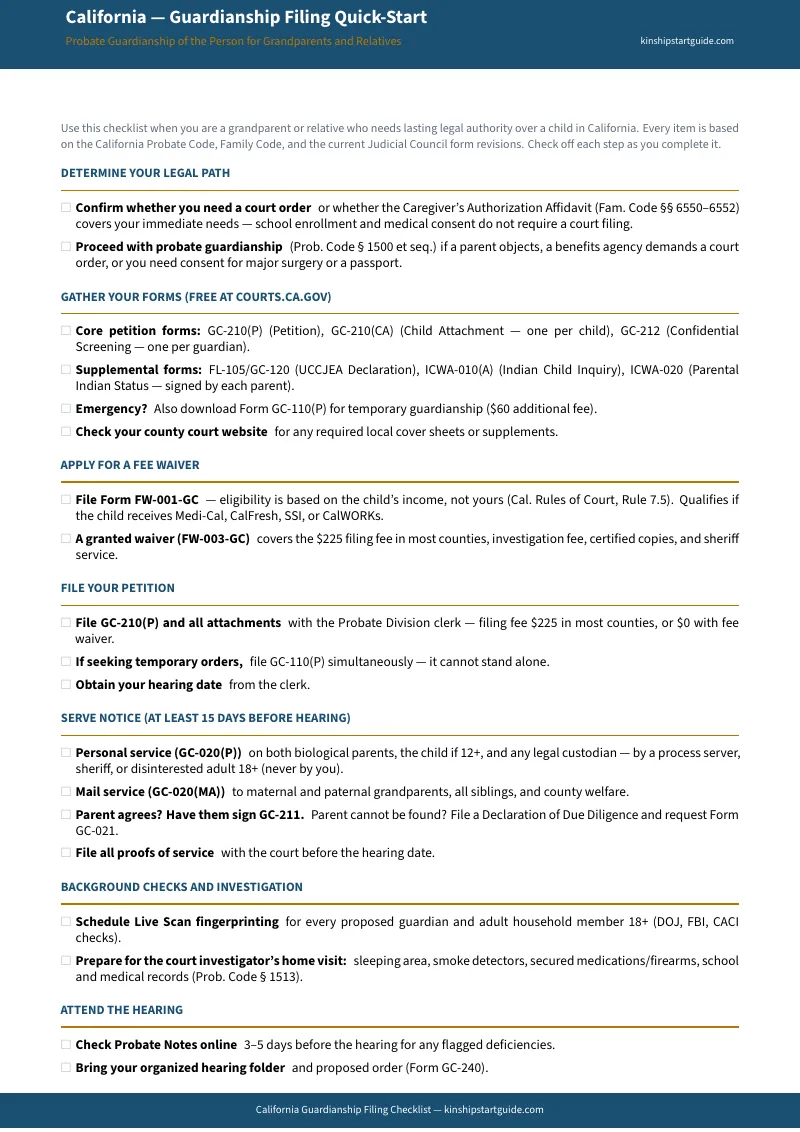
The download includes the complete 51-page court process guide, a 24-item quick-start filing checklist (also available as a free standalone download), and 7 printable standalone worksheets — a legal route decision worksheet, a form filing log, a service and due diligence tracker, a county verification worksheet, an investigator meeting checklist, a hearing folder organiser, and a post-order compliance calendar. All 9 PDFs are ready to print, fill in, and bring to the courthouse.
Full refund, no time limit. If the guide doesn't help, email [email protected] and we'll send your money back.
Get the California Kinship Court Process Roadmap →
Frequently Asked Questions
What if the rules change after I buy?
We update the guide when the rules change. Email us any time, even years later, and we'll send you the current edition free.