Your Retirement Stays Off the Table. The Child Gets the Benefits Alabama Already Set Aside.
You didn't plan to raise another child. But a phone call changed everything, and now you're stretching a fixed income across a second round of groceries, school uniforms, doctor visits, and diapers. Alabama has cash grants, food benefits, health coverage, and childcare subsidies specifically for this child — and the law says your retirement income doesn't enter the calculation. The problem is that the county DHR office won't tell you which application path keeps your Social Security, pension, or savings completely out of the eligibility audit.
The Alabama Kinship Benefits Navigator is the independent roadmap that organises every public benefit a relative caregiver can claim for a child in Alabama — program by program, form by form, with the exact documents to bring and the exact words to use when a DHR eligibility worker asks for income information they have no right to request on a non-needy relative application.
What the Guide Covers
- Child-only Family Assistance — the cash grant that ignores your income — Alabama's non-needy relative TANF pathway evaluates only the child's own income (child support, survivor benefits, trust income), not your household earnings, pension, Social Security, or savings. The guide walks you through every step of the application, explains which form sections to complete and which to skip, and shows you what to say when an intake worker defaults to the standard means-tested process that would pull your retirement into the calculation
- Kinship Guardianship Assistance Program (KinGAP) — monthly payments for relatives who take legal guardianship of a child exiting DHR foster care placement, including the fourth-degree kinship test, the six-step pathway from placement to guardianship, payment rates, and the Medicaid coverage that continues after the child leaves foster care
- SNAP household composition and deductions — SNAP counts everyone who purchases and prepares meals together, including your retirement income. The guide shows which shelter, medical, and child care deductions can bring net income under the 100% FPL test, how to file on MyDHR, and when expedited 7-day issuance applies
- ALL Kids and Medicaid enrolment — income thresholds by program tier, the income exclusion that lets a child qualify on their own income even when the caregiver earns above the limit, application routes through MyDHR and the Medicaid Agency, twelve-month continuous eligibility, and ex parte renewal rules
- Child Care Subsidy — bypassing the May 2026 waitlist — Alabama instituted a statewide waitlist for childcare subsidies effective May 8, 2026, but relative caregivers classified under "TANF — Other Relative" maintain immediate access. If you applied under a standard low-income category, you may be on the waitlist unnecessarily. The guide explains how to confirm your priority classification with your regional Child Management Agency
- WIC, school meals, and direct certification — the food programmes beyond SNAP, including WIC for children under five, free school meals, and the direct certification pathway that automatically qualifies a child receiving SNAP or Family Assistance
- Caregiver support services — the Alabama Kinship Navigator helpline, Alabama Cares respite and emergency assistance, the Kids & Kin Program, and what each one actually provides
- Appeals and Fair Hearings — what to do when a benefit is denied: the 10-calendar-day Medicaid window that preserves Aid Paid Pending (counted from the notice mailing date), the 60-calendar-day written-request deadline for Family Assistance, SNAP, and Medicaid hearings, common denial reasons and how to respond, and where to find free legal representation
Who This Is For
- Grandparents on Social Security, a pension, or disability who are paying for a grandchild out of savings they can't replace — and who need to know that the county cannot touch those savings on a non-needy application
- Aunts, uncles, older siblings, and family friends who took in a child with no notice and need to find out what the child is entitled to before the next bill arrives
- Relatives caring for a child informally who were told they need a court custody order to get benefits — they don't, and the guide shows why
- Adult children or advocates researching options on behalf of an older relative who needs clear, step-by-step instructions through the DHR application process
Why Not Just Call the County DHR Office?
You absolutely should call — with the guide open in front of you. DHR eligibility workers process applications under agency rules, but they are not required to tell you that a simpler, faster, income-protected application path exists. The non-needy relative pathway excludes your household income entirely, but intake workers routinely hand out the standard Family Assistance application by default. One wrong section pulls your pension into the eligibility audit and can trigger a denial that takes months to overturn through a Fair Hearing.
The guide doesn't replace free services — it prepares you to use them without costly mistakes. The Kinship Navigator handles referrals. Legal Services Alabama handles court proceedings. MyDHR handles the online application. The guide handles the part nobody else covers: which path protects your retirement income while getting the child every dollar Alabama law already set aside for them.
Not Right for Everyone
This guide focuses on public benefit applications and financial help. It is not legal advice, and it does not cover contested custody disputes, juvenile dependency proceedings, or whether to pursue guardianship. If you are involved in an active court case, your caseworker or a legal aid attorney is the right first step. If you or the child are in immediate crisis — facing homelessness, hunger, or a safety threat — call 211, the Alabama Kinship Navigator helpline (1-844-425-2546), or your county DHR office before anything else.
What You Get
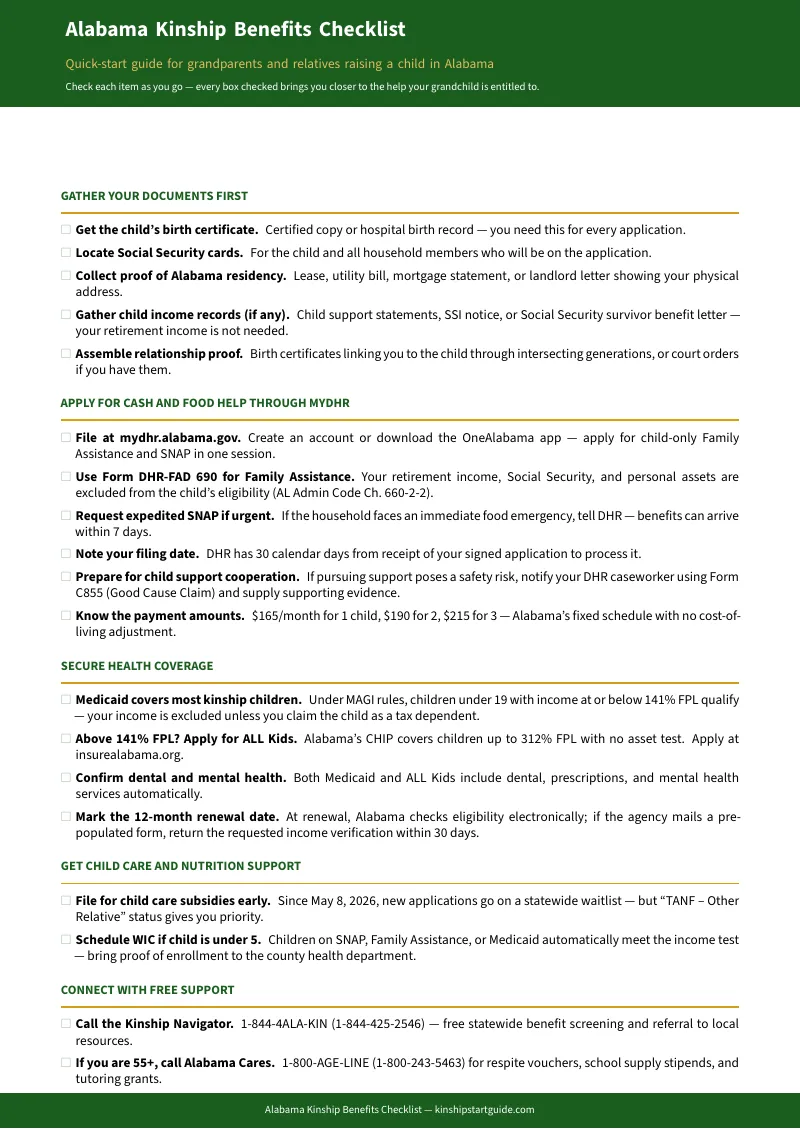
The download includes the complete 49-page guide, a 25-item quick-start checklist (also available as a free standalone download), and seven fillable worksheets: the Benefits Eligibility Screener, Document Preparation Checklist, Benefit Application Tracker, Renewal and Deadline Calendar, Agency Communication Log, Income Separation Worksheet, and Fair Hearing and Appeals Calendar — ready to print, fill in, and bring to your county DHR office.
Full refund, no time limit. If the guide doesn't help, email [email protected] and we'll send your money back.
Get the Alabama Kinship Benefits Navigator →
Frequently Asked Questions
What if the rules change after I buy?
We update the guide when the rules change. Email us any time, even years later, and we'll send you the current edition free.