
The School Won't Enrol Them. The Doctor Needs Proof. And the Court Website Has 47 Pages of Forms.
You are raising someone else's child — your grandchild, your niece, your nephew — and every agency you contact asks the same question: "Are you the legal guardian?"
You know you need a parenting order, or a guardianship order, or possibly both. But the Ministry of Justice website scatters forms across dozens of pages. Law firm articles explain the law without telling you which form to file first. Community Law has a three-week waitlist. And the court filing fee is $257 — money you may not need to spend at all, if you knew about the Regulation 7 waiver.
That is the gap this guide fills.
The Family Court Filing System — Every Step, in Order, for Non-Lawyers
The Parenting Orders and Guardianship Guide is a 48-page step-by-step filing system built specifically for grandparents and relatives who are navigating the New Zealand Family Court without a lawyer. It is not a textbook and it is not legal advice. It is the paperwork in order — from your first Family Dispute Resolution appointment to the day you walk out of the hearing with a court-sealed order.
We call it the Filing System because that is exactly what free resources don't give you. Government portals list individual forms. Charity websites explain your rights. This guide puts the forms, prerequisites, fees, exemptions and hearing steps into a single, printable sequence you can follow from your kitchen table.
What's Inside
- Which order fits your situation — parenting orders (section 48), additional guardianship (section 23), court-appointed agents (section 31), and how they work together when you need both day-to-day care and legal authority for school, medical and travel decisions
- The leave-to-apply roadmap — grandparents and relatives usually need the court's permission before they can even file. The guide walks you through section 47, the three automatic exceptions, and exactly how to complete Part 1b of the application form
- Family Dispute Resolution and Parenting Through Separation, demystified — which one you do first, how to book, what the FDR certificate looks like, the exemptions that let you skip mediation entirely, and the 12-month and 2-year validity windows you need to track
- Fee waiver instructions — the standard filing fee is $257. If you receive NZ Superannuation, Jobseeker Support, Sole Parent Support, Supported Living Payment or a Veteran's Pension, or if paying the fee would cause undue hardship, you may qualify for a full waiver under Regulation 7. The guide shows you exactly how to apply for it
- Without-notice applications — when a child is at immediate risk, you can apply for a temporary order without the other side knowing. The guide explains the threshold, the affidavit the judge needs, and what happens at the on-notice hearing that follows
- The hearing itself — what a section 133 report is, how a lawyer for the child works, what the judge will ask, consent orders when both sides agree, and the orders the court can make
- After the order — registration, enforcement if someone ignores the order, how to apply for a variation when circumstances change, and the link between your court order and Work and Income benefits
- Two worked examples — a standard-track timeline from FDR to final order, and a without-notice scenario with fee waiver arithmetic showing every cost and deadline
Who This Guide Is For
- Grandparents who have been caring for a grandchild informally and need a court order so schools, doctors and Work and Income will recognise their authority
- Aunts, uncles, older siblings and other whānau caregivers facing the same statutory hurdles under the Care of Children Act 2004
- Self-represented applicants who cannot afford or do not need a family lawyer for their particular situation
- Families where a parent has died, is imprisoned, is struggling with addiction or mental health, or has simply stopped making contact — and the caregiver needs to formalise what is already happening
Why Not Just Use the Free Resources?
You absolutely should use the free resources — this guide is designed to work alongside them, not replace them. The Ministry of Justice forms are the forms you will file. Community Law is where you get free legal advice. Grandparents Raising Grandchildren is where you find peer support.
The problem is that none of these resources gives you a sequence. The Ministry's site spreads forms across separate pages with no indication of which ones you need for your specific situation. Law firm articles explain the law in marketing language designed to persuade you to hire them. The Kaiārahi navigators at the courthouse can walk you through the process in person — but they cannot draft your affidavit or tell you whether to apply for guardianship alongside your parenting order.
The guide puts every official step into a single filing sequence, written in plain language, so you walk into each appointment and each hearing knowing exactly what you need and what comes next.
What This Guide Is Not
This is not legal advice. It does not tell you whether you will win, evaluate the merits of your case, or recommend strategies against a parent. It does not replace a lawyer for complex situations — if Oranga Tamariki is involved, if there are protection order proceedings, or if the other side has legal representation, the guide explains when and how to seek Legal Aid. It is a process guide: the forms, the fees, the deadlines, the prerequisites, in order.
Includes a Free Checklist
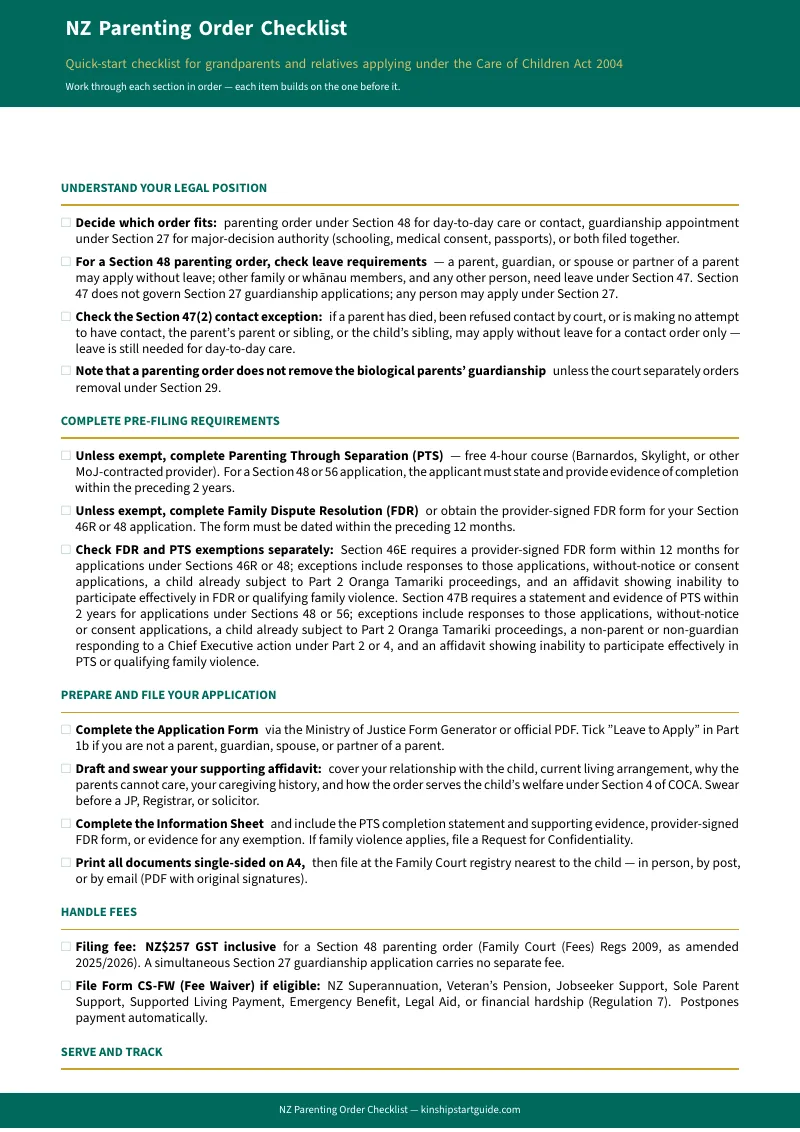
Not sure you need the full guide? Download the free NZ Parenting Order Checklist first — a two-page overview of every step from dispute resolution to hearing. If you want the detail behind each step, the full guide is here when you are ready.
Full refund, no time limit. If the guide does not help, email [email protected] and we will refund you — no questions, no deadline.
Frequently Asked Questions
What if the rules change after I buy?
We update the guide when the rules change. Email us any time, even years later, and we'll send you the current edition free.