
The school says you need a court order. West Virginia law says you don't.
You took the child in because nobody else could. Now the school registrar wants custody papers, the pediatrician wants a signed consent form, and the dentist won't see the child without "a parent or legal guardian." You're not the legal guardian. The parent can't be reached — or won't cooperate. And you have no idea which piece of paper will actually get the child through the door.
That gap between taking a child in and having the paperwork to care for them properly is where most kinship caregivers get stuck. Free government forms exist, but they come without instructions. Legal Aid's tools are excellent, but the hotline runs two hours a week. And a single wrong form — the school enrollment affidavit when you needed the medical consent affidavit, or a power of attorney when a notarised §49-2-703 affidavit was enough — means another trip, another argument with a receptionist, another week the child goes without.
The Caregiver Authority System
This guide organises West Virginia's entire consent framework into a single decision path. You start with your situation — who the child is, where the parent is, what the child needs — and end with the exact document, filled out the right way, for the right institution.
It covers six distinct consent instruments (the §49-2-703 Caregiver Consent Affidavit, the §44-10 Power of Attorney for a Minor, the temporary care agreement, an informal parent letter, the McKinney-Vento enrollment pathway, and the circuit court temporary guardianship), explains when each one works and when it doesn't, and walks you through every step from locating a notary to handling a school registrar who has never heard of the Caregiver Consent Act.
What's inside the full guide
- Line-by-line affidavit instructions — how to complete the §49-2-703 Caregiver Consent Affidavit correctly, including the detailed-attempt attestation when you can't locate the parent
- School enrollment chapter — county residency rules, §18-5-16 transfer provisions, McKinney-Vento liaison contacts, and what to say when the front desk refuses your paperwork
- Medical, dental, and mental-health consent tiers — what the affidavit covers, what it doesn't, adolescent privacy rules, and which appointments require a separate authorisation
- Special education and Hope Scholarship — how IEP and Section 504 parental rights transfer to a caregiver, and how the Hope Scholarship's education savings account works for kinship households
- Power of attorney walkthrough — when the §44-10 POA is the better tool, what powers it grants beyond the affidavit, and how to execute it so schools and doctors accept it
- Notary preparation checklist — what to bring, what not to sign in advance, and where to find low-cost or free notary services in rural West Virginia counties
- Contact-attempt log and planning worksheets — ready-to-print templates for tracking your attempts to reach the parent, organising the child's records, and managing the affidavit's one-year renewal cycle
- Guardianship decision framework — the signs that informal authority has hit its limits, the §44-10-3 temporary guardianship timeline, and where to get free legal help
- Financial benefits chapter — WV WORKS caretaker relative grants, SNAP, Medicaid, WV CHIP, and other support most kinship caregivers don't know they qualify for
Who this is for
- Grandparents, aunts, uncles, older siblings, or family friends who took in a child suddenly and need the child in school and at the doctor now
- Caregivers who were told they need a court order, full custody, or both parents' signatures — when West Virginia law provides alternatives
- Relatives who already have a consent form but aren't sure it covers dental, mental health, or specialist visits
- Family members helping an older caregiver navigate the paperwork — someone who needs plain-language steps, not raw statute text
Why not just use the free forms?
You should. The free statutory forms from the West Virginia Legislature and Legal Aid of West Virginia are the official documents — this guide doesn't replace them. What it replaces is the weeks of confusion between downloading a blank form and actually getting the child seen by a doctor or seated in a classroom. The affidavit alone has a detailed-attempt attestation clause that most caregivers don't understand, a one-year expiry most don't track, and a notarisation requirement that means you need to know what to bring and what not to sign before you walk in. Generic templates from Rocket Lawyer or Etsy miss the West Virginia–specific statutory language that schools and clinics check for. The guide puts the free forms in context — which one to use, how to complete it, what to do when an institution refuses it — so you get it right the first time.
Your purchase is risk-free
Full refund, no time limit. If the guide doesn't help, email [email protected] and we'll refund you — no questions, no deadline.
Get started now
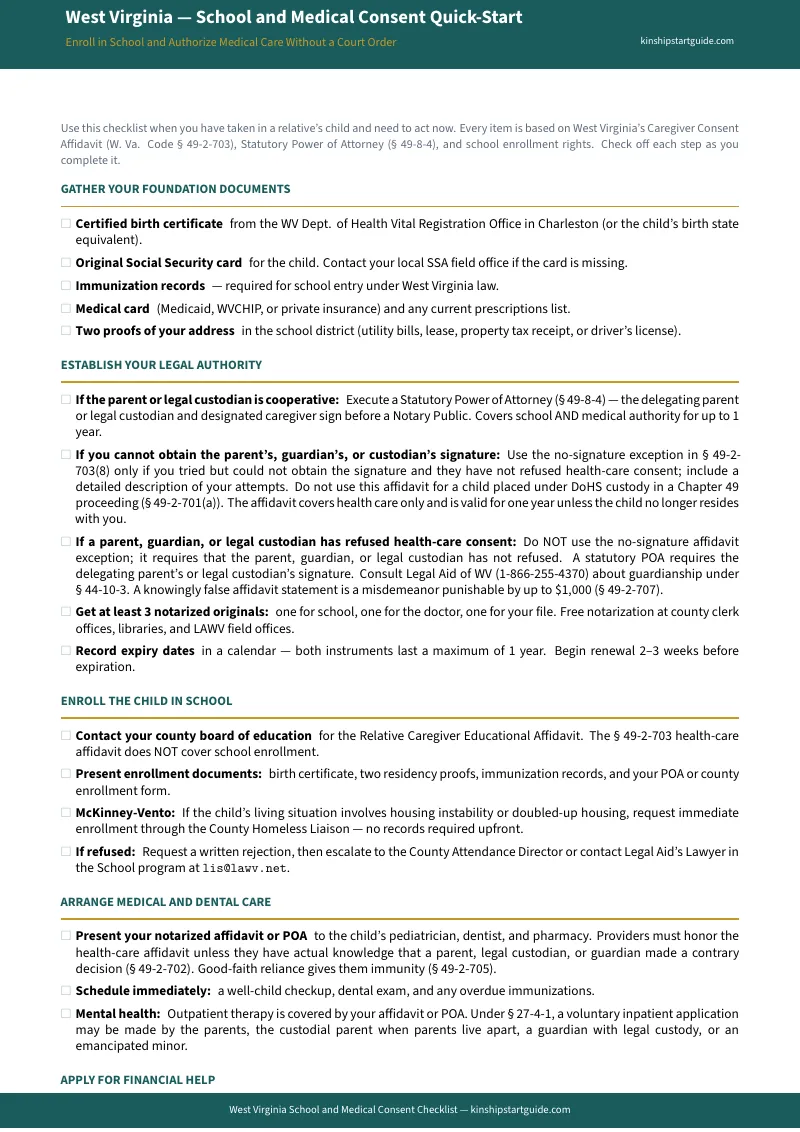
Download the free checklist to see the consent forms and steps at a glance. When you're ready for the full guide — line-by-line instructions, worksheets, refusal scripts, and the complete decision framework — get the full toolkit for and have the child's paperwork sorted this week.
Frequently Asked Questions
What if the rules change after I buy?
We update the guide when the rules change. Email us any time, even years later, and we'll send you the current edition free.