The Forms Are Free — Knowing What to Do With Them Is the Hard Part
Washington's Administrative Office of the Courts publishes every GDN M form you need for a minor guardianship. WashingtonLawHelp.org explains the law. The CLEAR hotline offers free legal guidance. These are real, valuable resources — and this guide links to all of them.
What none of them provides is the procedural sequence. The AOC website lists dozens of GDN M forms without showing which ones you file first, which ones you serve on a parent, and which ones you need only after the judge signs the order. Legal aid fact sheets explain the statute but do not include a worksheet for tracking service of process on an incarcerated parent. County court facilitators can review your packet — but they cannot select forms for you or tell you whether your situation calls for a standard petition or an emergency order. And marketplace sellers still offer packets under the old RCW 26.10 — a statute Washington repealed in 2021.
The Washington Kinship Court Navigation System
This guide closes the gap between knowing you need a court order and actually getting one. It maps every step of the minor guardianship process under Washington's Title 11 RCW — from the moment you decide you need legal authority through the day you hand certified copies of your Letters of Office to the school registrar, the pediatrician, and DSHS.
At the front, a decision framework walks you through Washington's guardianship options — a standard minor guardianship petition (GDN M 102), a short-term emergency petition (GDN M 202, up to 60 days), and an emergency motion (GDN M 206, filed alongside a full petition) — and matches your circumstances to the right path before you file anything or spend a day at the courthouse.
What's Inside
- Decision framework for guardianship type — which order fits your situation: standard minor guardianship, short-term emergency, or emergency motion filed with a full petition, with the requirements and timeline for each
- Complete GDN M form sequence — which forms to file and in what order: GDN M 102 (petition), GDN M 103 (declaration), GDN M 101 (notice of hearing), GDN M 001 (summons), and the companion forms the AOC instructions reference
- Filing fees and exemptions explained — the relative filing-fee exemption under RCW 11.130.170(3) and the GR 34 fee-waiver process, so you know which path applies before you arrive at the clerk's counter
- Service of process walkthrough — personal service requirements under RCW 11.130.195 for parents and children age 12 or older, with specific steps for serving incarcerated parents, absent parents, and parents whose address is unknown
- Background check requirements — JIS, Washington State Patrol, and DCYF checks, including how county-specific cover sheets and submission procedures vary
- Court Visitor role and preparation — who the Court Visitor is, what they assess, and how to organise your documentation before the visit
- Hearing preparation — what happens at a status conference, how to present your case, and what the court considers when deciding whether a guardianship serves the child's best interest
- Emergency orders explained — the requirements under RCW 11.130.225 for both the short-term emergency petition and the emergency motion route, including what the court must find
- Post-appointment duties — filing the Acceptance of Appointment (GDN ALL 003), obtaining certified copies of Letters of Office, presenting them to institutions, and understanding that ordinary minor guardianship Letters expire on the child's eighteenth birthday without annual renewal
- Benefits unlocked by the court order — an overview of TANF child-only grants, DSHS programmes, and health coverage available to the child, with a handoff to the companion Washington financial help guide
Printable Worksheets Included
- Filing preparation checklist — confirm every form, background check authorisation, and service recipient before you walk into the courthouse
- Notice and service-of-process tracking log — document every personal service attempt, certified mail receipt, and alternative service step, with dates and proof references the court needs
- Background-check status log — track WSP WATCH and DCYF CPS submissions and results for every required person
- Fee-waiver financial worksheet — organise the household income and expense figures required for a GR 34 fee-waiver application
- Hearing preparation worksheet — verify every procedural requirement and organise your evidence and documentation before the hearing
- Post-appointment action checklist — certified copies, school registrar visits, medical provider notifications, DSHS benefit applications, and tracking spaces for each
- Agency communication log — record every call, email, and visit to courts, DSHS, DCYF, schools, and doctors with names, titles, and what was promised
Who This Is For
This guide is for grandparents and relatives in Washington who are raising a child and need a court order — because a school, doctor, or benefits office demands legal authority that an informal declaration does not cover. It is written for people who are navigating the Superior Court system without a lawyer, in plain language, with the specific Washington forms, fees, and procedures you will actually use.
It is not legal advice, and it does not advise on the merits of any dispute with a parent. It does not cover school and medical consent procedures (that is the companion Washington School and Medical Consent Guide) or financial assistance applications (that is the companion Washington Kinship Financial Help Guide). It explains the court process — the path from deciding you need legal authority to holding a court order that schools, doctors, and agencies will accept.
Why Not Just Use the Free Forms and Websites?
The Administrative Office of the Courts publishes every mandatory GDN M form as a free PDF download. WashingtonLawHelp.org provides legal education packets, and the CLEAR hotline offers free legal intake. These resources are valuable, and this guide directs you to all of them.
What they do not provide is the procedural map. The AOC website lists forms without filing instructions — it does not tell you that an emergency motion (GDN M 206) cannot be filed without a full petition, or that the short-term emergency petition (GDN M 202) is a separate standalone path. Legal aid fact sheets explain the law's transition from RCW 26.10 to Title 11 RCW but do not include a tracking log for serving an incarcerated parent. County court facilitators can check your packet for completeness, but state law prohibits them from giving legal advice or selecting forms. National form sellers like LegalZoom charge recurring subscription fees for generic power-of-attorney templates that Washington courts will not accept in place of a GDN M petition.
This guide puts the forms, the procedures, and the preparation tools into one sequence — so you can arrive at the clerk's counter with the right forms, serve notice correctly, prepare for the hearing, and handle your post-appointment responsibilities without a second filing.
The Free Checklist
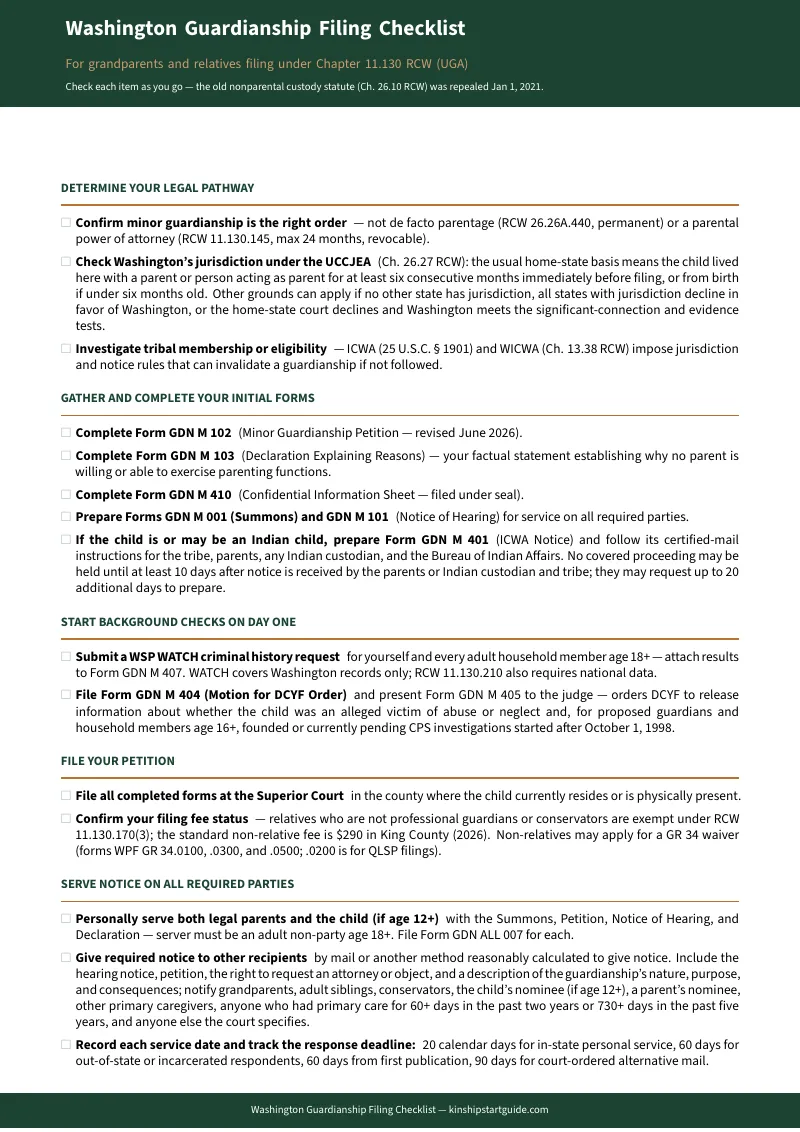
Not sure you need the full guide yet? Download the free Washington Guardianship Filing Checklist — a summary of the forms, fees, notice steps, and hearing milestones for a relative's minor guardianship case in Washington. It shows you the full timeline at a glance so you can decide what level of preparation you need.
Satisfaction Guarantee
Full refund, no time limit. If the guide is not what you expected, email [email protected] and you will receive a complete refund. The guide costs — a one-time purchase, no subscription, no recurring fees.
Frequently Asked Questions
What if the rules change after I buy?
We update the guide when the rules change. Email us any time, even years later, and we'll send you the current edition free.