
You're paying for everything out of pocket because nobody told you what the child qualifies for
A child landed in your home — maybe overnight, maybe over a weekend — and suddenly you're buying groceries for one more, paying for school supplies, figuring out health insurance, and wondering how long your savings can hold. You've heard Tennessee has programmes for grandparents and relatives raising children, but every agency has a different website, different rules, and different forms. You called one office and were told your income was too high. You tried the online portal and got lost in questions that didn't seem to apply to your situation.
Here is what most kinship caregivers in Tennessee don't realise until months into the process: most of these programmes do not count your income at all. The Families First child-only grant looks only at the child's own income — not your retirement, not your disability payments, not your wages. TennCare and CoverKids evaluate the child separately, up to 250% of the federal poverty level, even if your own income is above the adult limit. The money is there. The barrier is knowing how each programme works, what documents each agency wants to see, and which legal arrangement unlocks which payment.
The Tennessee Kinship Benefits Navigator
This guide puts every programme a relative caregiver in Tennessee can access into a single, printable document — organised not by agency, but by what you need to do and in what order. It is the guide you would want a knowledgeable caseworker to sit down and walk you through, except you can read it at your own pace, highlight the parts that apply to your situation, and bring it with you to every office visit.
It does not replace free government services and it does not guarantee any outcome. What it does is save you the weeks of phone calls, conflicting advice and wasted trips that come from trying to piece the system together on your own.
What's inside the guide
- Families First Child-Only Cash Grant — how the income exclusion works for relative caregivers, what the child qualifies for, and how to fill out the ONE DHS application so your income is correctly excluded
- DCS Relative Caregiver Program — the support services available with just a Power of Attorney, the monthly stipend that requires a court custody order, the 200% FPL income cap, and how to contact your regional contractor
- Subsidised Permanent Guardianship — who qualifies (the child must have been in DCS foster care), what it pays, and how it differs from the RCP stipend
- TennCare and CoverKids — the separate income rules for children versus adults, why the child almost certainly qualifies even if you don't, and how to apply through TennCare Connect
- SNAP food benefits — Tennessee's strict $2,000 asset test, how household composition affects eligibility, and what to bring to your appointment
- WIC — coverage for children under five and how kinship caregivers apply
- At-Risk Child Only (ARCO) Childcare — the 30-hour work or school requirement, the connection to your Families First child-only case, and how the copay is calculated
- Title III-E Respite and Support — how grandparents aged 55 and older can access respite care, support groups and supplemental services through the Area Agency on Aging
- Legal Arrangement Matrix (legal-arrangement-matrix.pdf) — a fillable chart showing what each legal status (informal care, Power of Attorney, court custody, DCS placement) unlocks across all programmes
- Child vs. Caregiver Income Separator (child-vs-caregiver-income-separator.pdf) — list your income on one side and the child's on the other, then estimate the Families First Child-Only grant
- Document and Verification Prep Checklist (document-verification-prep-checklist.pdf) — the exact paperwork each agency needs, with columns for original, copy, and where you submitted it
- Worked dollar examples — two realistic household scenarios in the 14-chapter guide showing estimated monthly benefits when programmes are combined
- Notice Tracking and Fair Hearing Timeline (notice-tracking-fair-hearing-worksheet.pdf) — 10 calendar days to keep benefits pending; 10 business days for DCS RCP/SPG; 40 calendar days for TennCare/CoverKids; 90 calendar days for Families First and SNAP
- Agency Communication Log and Contact Card — a running log of every call, plus every phone number and portal in the kit on one printable page
Who this is for
- Grandparents, aunts, uncles or older siblings raising a child in Tennessee who need to know what money and coverage the child is entitled to
- Caregivers on Social Security, SSDI or a pension who were told — or assumed — their income disqualified the child from cash assistance
- Relatives with a Power of Attorney who want to understand which additional programmes open up with a court custody order, and which don't require one at all
- Social workers, church volunteers and family friends helping a kinship family find the right agencies and fill out the right forms
Who this is not for
- Anyone seeking legal advice on whether to file for custody — this guide explains programme rules, not legal strategy. Contact the HELP4TN legal helpline (1-866-836-5726) for legal guidance.
- Anyone looking to become a licensed foster parent — the guide covers kinship care payments, not foster licensing. Contact DCS Foster Care for licensing information.
- Anyone needing help with Social Security benefits or tax credits for grandchildren — those are covered in separate, dedicated guides.
- Anyone in a food or housing emergency right now — call 211 or visit your local TDHS county office for immediate help.
Why not just use the free information?
You should. Every programme in this guide is administered by a free government agency, and every application is free to file. The HELP4TN helpline will answer legal questions at no cost. The DCS Relative Caregiver Program offers case management and support groups for free.
The problem isn't that the information doesn't exist. It's that it's spread across five agencies, three different online portals, and dozens of policy documents that were written for caseworkers, not for a grandparent who just took in a child last Tuesday. Each agency knows its own programme but can't walk you through the others. The ONE DHS portal asks income questions that make working or retired caregivers abandon the application — not realising that a child-only case works differently. The DCS website describes the Relative Caregiver Program stipend without making clear that it requires a court custody order, and that without that order you can still access every other service.
This guide connects those dots. It puts the eligibility rules, document checklists and application steps for every programme side by side, so you can see the full picture before you start making calls.
Satisfaction guarantee
Every purchase comes with a full refund, no time limit. If the guide doesn't help your situation, email [email protected] and we'll refund you — no forms, no waiting period.
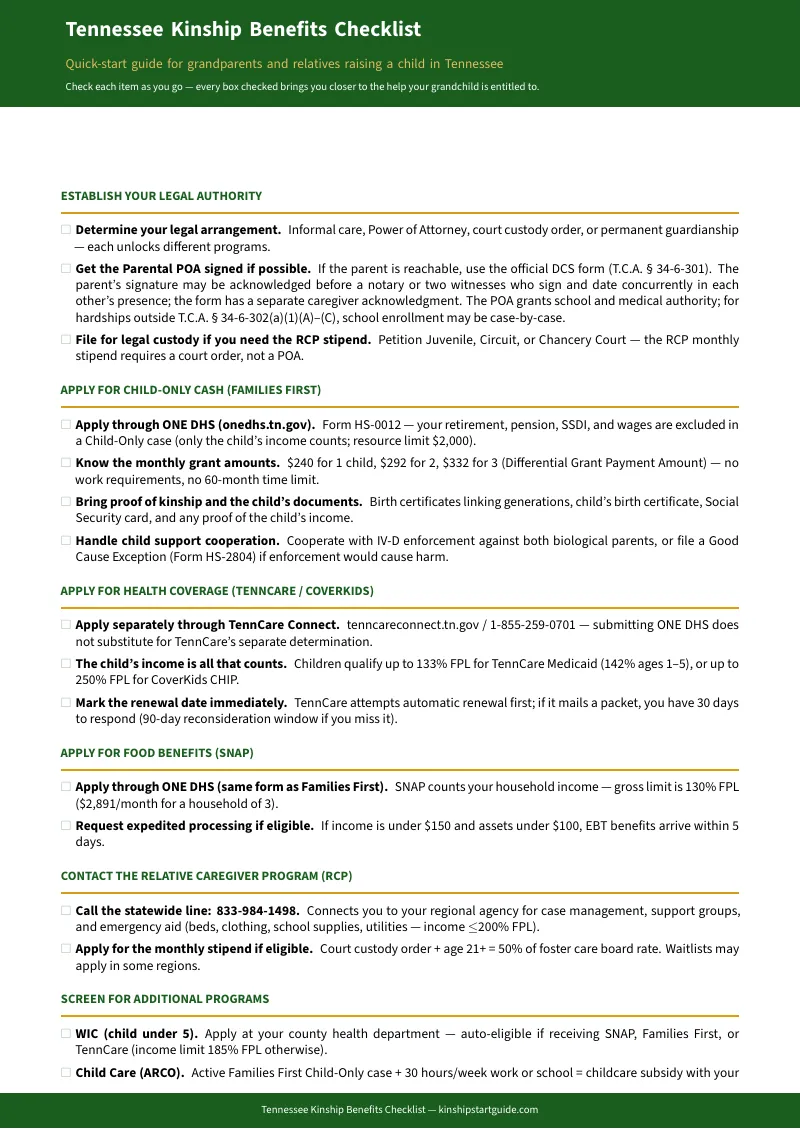
The free Tennessee Kinship Benefits Checklist is available right now, no purchase required. It lists every programme, the agency to contact and the basic documents you'll need. If that's enough to get you started, it's yours to keep.
If you want the full programme-by-programme walkthrough — the income worksheets, the document checklists, the legal arrangement matrix and the step-by-step application instructions — the complete guide is ready for you.
Get the Tennessee Kinship Financial Help Guide →
Frequently Asked Questions
What if the rules change after I buy?
We update the guide when the rules change. Email us any time, even years later, and we'll send you the current edition free.