Your Income Stays Out of It. The Child Gets the Benefits South Carolina Already Funds.
You didn't plan to raise another child. But here you are — stretching a retirement check across a second set of groceries, school fees, doctor visits, and winter coats. South Carolina has cash grants, food benefits, full health coverage, and child care subsidies specifically for this child, and the law says your income does not enter the calculation. The problem is that nobody at the county DSS office volunteered that information — and one wrong entry on Form 3800 can pull your Social Security into an eligibility test it was never supposed to touch.
The South Carolina Kinship Benefits Navigator is the independent roadmap that organises every public benefit a relative caregiver can claim for a child in South Carolina — program by program, form by form, with the exact documents to bring and the exact words to use when a caseworker asks for information they have no legal right to request on a child-only application.
What the Guide Covers
- Child-only Family Independence (TANF) cash grants — the application pathway that keeps your pension, Social Security, earned income, and savings completely out of the eligibility determination. The guide walks you through DSS Form 3800 line by line, explains how to ensure the application is processed as child-only so the child's grant depends only on income received by or for the child (child support, survivor benefits, trust income), and shows what to say if a caseworker defaults to the standard adult-included application that triggers the 24-month time limit and work requirements
- KinGAP guardianship assistance — monthly subsidies at foster care rates for relatives who take legal guardianship of a child after at least six consecutive months as a licensed kinship foster parent under SCDSS. The guide explains the licensing pathway, the six-month requirement, and why relatives who obtain private custody through Family Court without that foster care history are permanently locked out of KinGAP
- Foster care maintenance payments — the full board rate paid to relatives licensed as kinship foster parents under SC Code § 63-7-2320, including the expanded eligibility for fictive kin. The guide covers the licensing steps, background checks, home study, and how foster maintenance interacts with other benefits
- Partners for Healthy Children (Medicaid) — full health coverage where grandparent income is excluded from the child's eligibility calculation if you do not claim the child as a tax dependent. Children qualify up to 213% of the federal poverty level gross on the child's Medicaid household income, with mandatory 12-month continuous eligibility so household income changes cannot strip coverage mid-year. The guide also covers TEFRA disability Medicaid for children with qualifying conditions
- SNAP food benefits — how SNAP counts the caregiver's income when you purchase and prepare food together, the age-60 deductions (no gross-income test, uncapped shelter, medical costs over $35) that can raise the allotment, plus WIC supplemental nutrition for children under five and free school meals
- SC Voucher child care (CCAP) — how kinship caregivers access the SC Working Families Child Care Scholarship through priority exemptions that remain open despite the December 2025 application pause for the general population, including eligibility for TANF recipients, foster and kinship care placements, and children with special needs
- LIHEAP emergency energy help — crisis grants and seasonal assistance for heating and cooling costs when a child has increased the household's energy needs
- Title III-E caregiver support and the Kinship Navigator — respite care, supplemental services, and case management through the Area Agency on Aging for grandparent caregivers aged 55 and older
- Federal tax credits — the Child Tax Credit, Earned Income Tax Credit, and Child and Dependent Care Credit for relative caregivers who claim the child as a dependent
- Delegated authority under SC Code § 63-15-720 — how to execute a one-year delegation of authority so you can enrol the child in school and consent to medical care without a court order, and how it interacts with benefit eligibility
- Appeals and fair hearings — what to do when a benefit is denied, how to file DSS Form 2633 within the critical 10-day window that preserves existing benefits during the appeal, and how to prepare for a hearing
Who This Is For
- Grandparents on Social Security, a pension, or SSDI who are paying for a grandchild out of savings they cannot replace — and who need to know that the county cannot touch those savings on a child-only application
- Aunts, uncles, older siblings, and family friends who took in a child with no notice and need to find out what the child is entitled to before the next bill arrives
- Relatives who were told they need a court custody order to get benefits — they do not, and the guide shows why
- Adult children, church volunteers, or advocates researching options on behalf of an older relative caregiver who needs clear, step-by-step instructions rather than agency jargon
Why Not Just Call DSS?
You absolutely should call DSS — with the guide open in front of you. Caseworkers enforce agency rules, but they are not required to tell you that a simpler, faster, income-protected application pathway exists. SCDSS Policy Manual Vol 65 allows child-only Family Independence applications where the relative's income and assets are entirely excluded, but intake workers routinely process relatives under the standard adult-included rules by default. One wrong form subjects your pension to the state's $2,053 gross monthly income limit, triggers the 24-month time limit, and imposes work requirements that make no sense for a retired grandparent.
The guide does not replace free services — it prepares you to use them without costly mistakes. SC Legal Services handles court guardianship. SC Thrive handles screening. The guide handles the part nobody else covers: which application pathway protects your retirement income while getting the child every benefit South Carolina already funds for them.
Not Right for Everyone
This guide focuses on public benefit applications and financial help. It is not legal advice, and it does not cover contested custody disputes, juvenile dependency proceedings, or advice on whether to pursue guardianship. If you are involved in an active Family Court case, your assigned caseworker or a legal aid attorney through SC Legal Services is the right first step. If you or the child are in immediate danger, call 911 or the South Carolina child abuse hotline at 1-888-227-3487.
What You Get
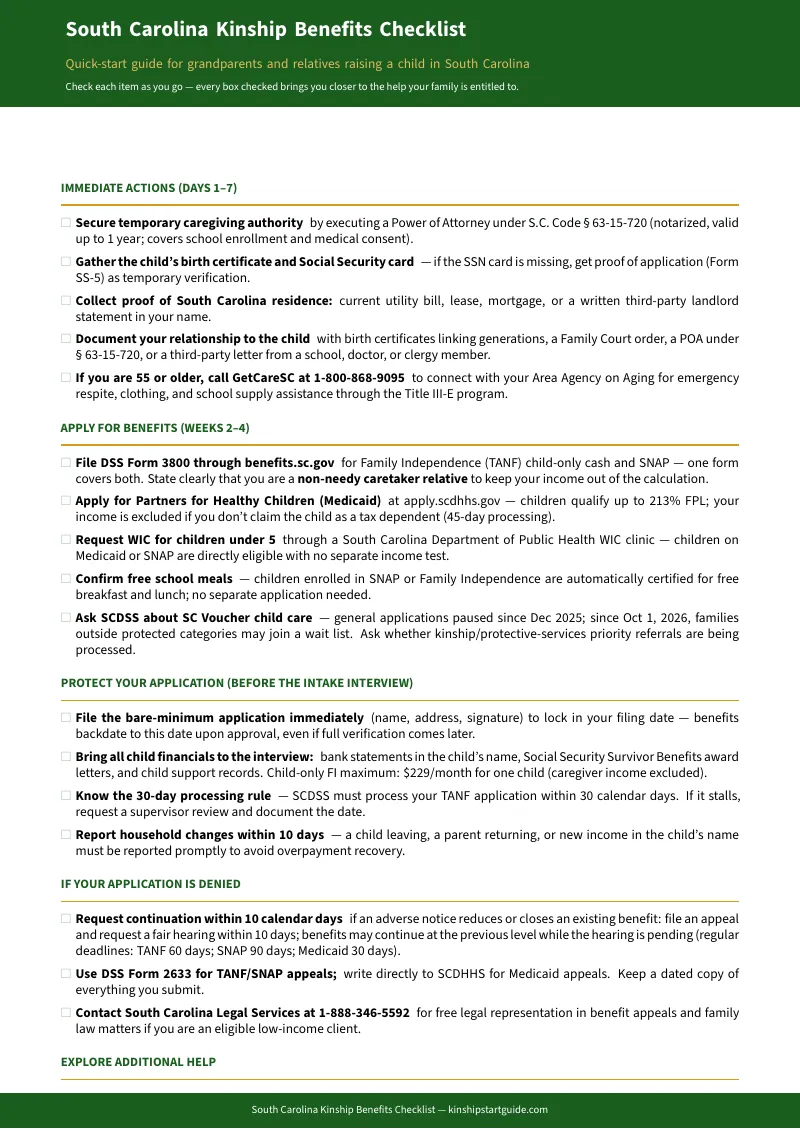
The download includes the complete 50-page guide, a two-page quick-start checklist (also available as a free standalone download), and seven fillable worksheets: the Benefits Eligibility Quick-Reference Worksheet, Document Preparation Checklist, Application Submission Log, Agency Communication Log, Annual Renewal Calendar, Caregiving Arrangement Comparison Matrix, and Agency Contact Directory — ready to print, fill in, and bring to your county DSS office.
Full refund, no time limit. If the guide does not help, email [email protected] and we will send your money back.
Get the South Carolina Kinship Benefits Navigator →
Frequently Asked Questions
What if the rules change after I buy?
We update the guide when the rules change. Email us any time, even years later, and we'll send you the current edition free.