The school wants a court order. The doctor wants custody papers. Rhode Island law says you may need neither — but it won't hand you a form.
You took in a child — maybe your grandchild, a niece, a nephew, or the child of a friend who can't be there right now. The reasons are painful and private, and you didn't have weeks to prepare. What you had was overnight.
Now the child needs to start school. Needs a doctor's appointment. Needs immunizations before anyone will process the enrollment. And every front desk you walk up to asks for paperwork you don't have — court orders, custody documents, "official guardianship forms" that sound like they require a lawyer and a judge.
Here's the part most caregivers don't discover until they've already been turned away: Rhode Island has no statutory caregiver authorization affidavit. Most states give relatives a single form, backed by statute, that delegates school and medical authority without a courtroom. Rhode Island doesn't. The generic "Rhode Island Caregiver Authorization Affidavit" templates sold online by national legal sites are modeled on other states' laws — and they are routinely rejected by school offices and medical providers here.
That gap is where the Rhode Island Consent Navigation System comes in. It maps every consent instrument the state actually recognizes, shows you exactly when each one applies, and gives you the statutory citations to present at the front desk when someone tries to tell you the law requires more than it does.
What the Consent Navigation System Covers
The guide walks you through every consent path Rhode Island law provides, and shows you exactly when to use each one:
- Parent Consent Statement — because Rhode Island has no standard form, you draft this yourself. The guide includes step-by-step drafting instructions: what to include, which parent signs, when both parents need to sign under RIGL § 33-15.1-1(a), whether to notarize (yes — even though it's not legally required), how to set an expiration term, and what happens when the parent revokes it
- School Enrollment Under RIGL § 16-64-1 — the statute that lets you enroll a child in your district's schools without a court order when you act in loco parentis due to parental illness, family break-up, abandonment, or death. The guide explains what "substantial reason other than attending that district's schools" means, what to bring to the enrollment office, and how to invoke the RIDE August 2023 Residency Memorandum that bars districts from demanding court guardianship
- Medical and Dental Consent — Rhode Island draws a hard line at age sixteen. Under RIGL § 23-4.6-1, a teenager aged sixteen or older consents independently. Below sixteen, you generally need a parent signature or a court order. The guide maps both sides of that line: parent consent letters for routine care, probate court when a parent is unreachable, and emergency care exceptions that apply regardless
- Probate Guardianship (PC-2.1 and PC-2.2) — when informal instruments stop working, Rhode Island's 39 municipal probate courts handle minor guardianship petitions. The guide walks you through the filing: the PC-2.2 Minor Guardianship form, the temporary guardianship petition, the 14-day personal service requirement, how much to expect in filing fees, and when to use probate court instead of Family Court
The Consent Gap — and Why Generic Templates Don't Work Here
National legal platforms sell "Rhode Island Minor Power of Attorney" forms built on the state's general power of attorney statute (RIGL § 18-16-2). That statute provides a financial and general-purpose short form — it was not designed as a dedicated child care delegation instrument. When you hand one of these to a school registrar or clinic intake coordinator, the response is predictable: "This isn't a guardianship order."
Meanwhile, the $40-to-$50-per-month subscription legal sites bury the actual cost behind a free trial, deliver forms with no Rhode Island statutory context, and leave you no better off at the school office than you were before. Etsy and Gumroad sellers offer $5–$15 "Temporary Guardianship Agreements" that have no state citations and often don't even acknowledge that under Rhode Island law, only a municipal probate court or Family Court judge can grant legal guardianship.
The guide doesn't sell you a form that doesn't exist. It shows you what Rhode Island actually provides — and gives you the language, the citations, and the step-by-step protocols to make those instruments work at the institutions that matter.
When the Front Desk Says No
School districts across Rhode Island routinely demand court custody orders that RIGL § 16-64-1 does not require. Medical offices refuse to see a child because "you're not the parent." Enrollment clerks in Providence, Pawtucket, Central Falls, and Woonsocket run aggressive residency audits that can stop a legitimate kinship placement cold.
The guide includes a refusal escalation protocol — with statutory citations referencing RIGL § 16-64-1, § 16-64-6, and the RIDE August 2023 Residency Memorandum — that you can present to a reluctant registrar or principal. If the district still refuses, the protocol walks you through the appeal to the Commissioner of RIDE, who has statutory authority to issue interim orders directing immediate school admission while the dispute is resolved.
Who This Is For
- A grandparent who has taken in a grandchild and needs to get that child into school and to the doctor — this week
- An aunt, uncle, older sibling, or family friend caring for a child whose parent is incarcerated, in treatment, deployed, or unable to be present — and who needs to know exactly which documents Rhode Island recognizes
- A caregiver who has been told — incorrectly — that they need a court custody order to enroll a child in school or schedule a doctor's appointment
- A family helper or adult child buying this on behalf of an older relative who needs clear, printable instructions they can follow step by step
- Anyone who needs to get a child under sixteen to a doctor and the parent isn't available to sign
Why Not Free Resources?
Rhode Island's official forms and statutes are free, and the guide links directly to them. The Office of Healthy Aging runs a Grandparents as Caregivers Program through the YMCA in the greater Providence area. Rhode Island Legal Services offers free legal help for income-eligible families. The guide doesn't replace any of that — it bridges the gap between knowing the help exists and knowing how to use it when you're sitting in an enrollment office at 8 a.m. with a child who needs to start school today.
Free resources give you raw statutes and blank court forms. They don't walk you through drafting a parent consent statement with no state template to follow. They don't explain the RIGL § 16-64-1 school enrollment path in plain language with a step-by-step protocol. They don't map the age-sixteen medical consent line and what to do on either side of it. They don't distinguish a parent consent letter from a probate guardianship petition — or tell you when the simpler option stops being enough. And they don't include the planning tools that keep every document, deadline, and contact organized in one place.
What You Get
- The complete guide — 13 chapters covering the consent gap, parent consent statements, school enrollment under RIGL § 16-64-1, medical consent and the age-sixteen line, teenager privacy and self-consent at sixteen, when informal authority isn't enough and how to go to probate court, benefits the child may be entitled to (RI Works, SNAP, Medicaid through RIte Care), childcare and travel, special education and IDEA rights, five worked family scenarios, ICWA provisions, and the worksheets that keep every form and deadline in one place
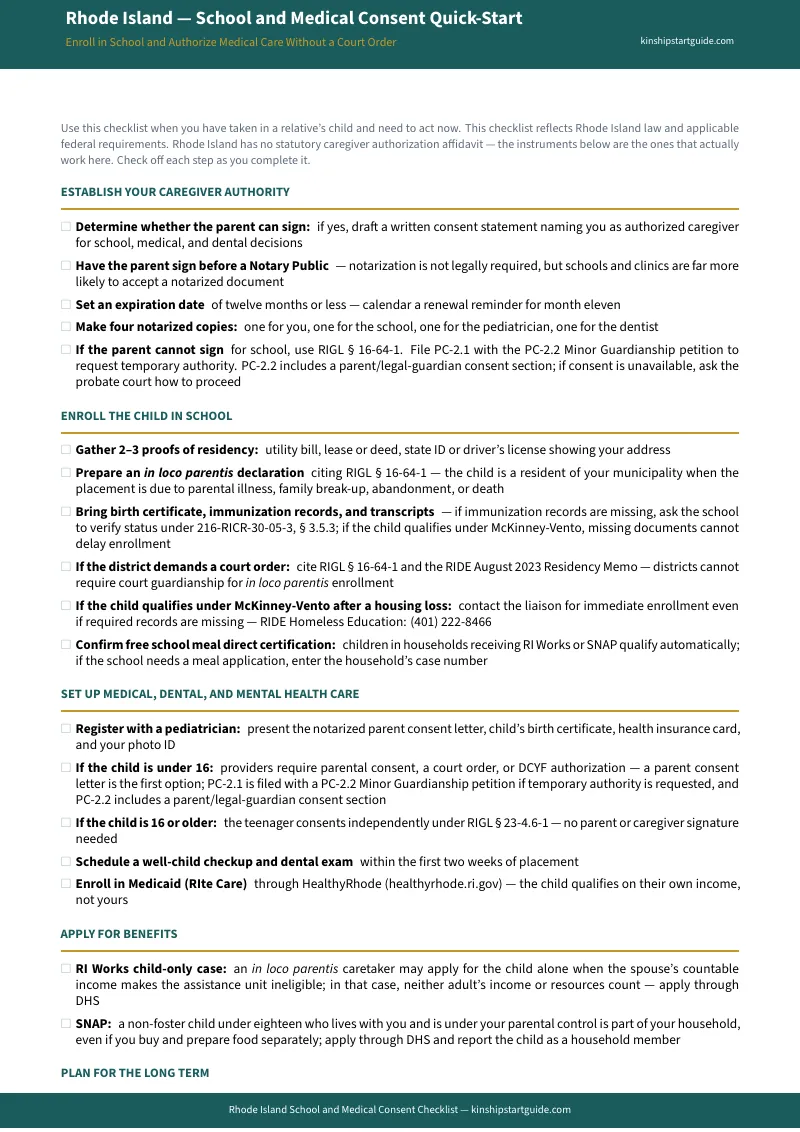
- The quick-start checklist — a two-page printable summary of 24 consent, enrollment, medical, benefits, and planning steps across five sections
- Seven printable planning tools — a school enrollment preparation checklist, a parent consent letter template, a medical intake folder checklist, an institutional refusal log, a probate court filing checklist, a benefits application tracker, and an agency communication log so every document you hand in and every response you receive has a paper trail
Satisfaction Guarantee
Full refund, no time limit. If the guide doesn't help you navigate your situation, email [email protected] and we'll refund every penny — no forms, no waiting period, no questions.
A Child Shouldn't Wait for a Court Date to See a Doctor
Rhode Island didn't write a single statewide form for kinship caregivers — but it did write statutes that protect the children they care for. The guide shows you how to use those statutes, and what to do when someone at a front desk tries to tell you they don't apply.
Download includes the 42-page guide, the two-page checklist, and seven printable planning tools. Instant access after purchase.
Already have the free checklist? The full guide goes deeper — step-by-step instructions for drafting a parent consent statement with no state form to follow, the RIGL § 16-64-1 school enrollment protocol, the medical consent framework for children under and over sixteen, the probate guardianship filing process through your municipal court, five worked family scenarios, a refusal escalation protocol with statutory citations, benefits eligibility for the child, special education rights, and the chapter-by-chapter walkthrough that turns "I think this is right" into "I know exactly what to do."
Frequently Asked Questions
What if the rules change after I buy?
We update the guide when the rules change. Email us any time, even years later, and we'll send you the current edition free.