
Your Pension Stays Untouched. The Child Gets the Cash Rhode Island Already Set Aside.
You didn't plan to raise another child. But here you are — stretching a Social Security check or a pension across a second round of groceries, school clothes, doctor visits, and winter boots. Rhode Island has cash grants, food benefits, full health coverage, and childcare subsidies specifically for this child, and the law says your income doesn't enter the calculation. The trouble is that nobody at DHS volunteered that information when you called.
The Rhode Island Kinship Benefits Navigator is the independent roadmap that organises every public benefit a relative caregiver can claim for a child in Rhode Island — program by program, form by form, with the exact documents to bring and the exact words to use when an intake worker defaults to the wrong application.
What the Guide Covers
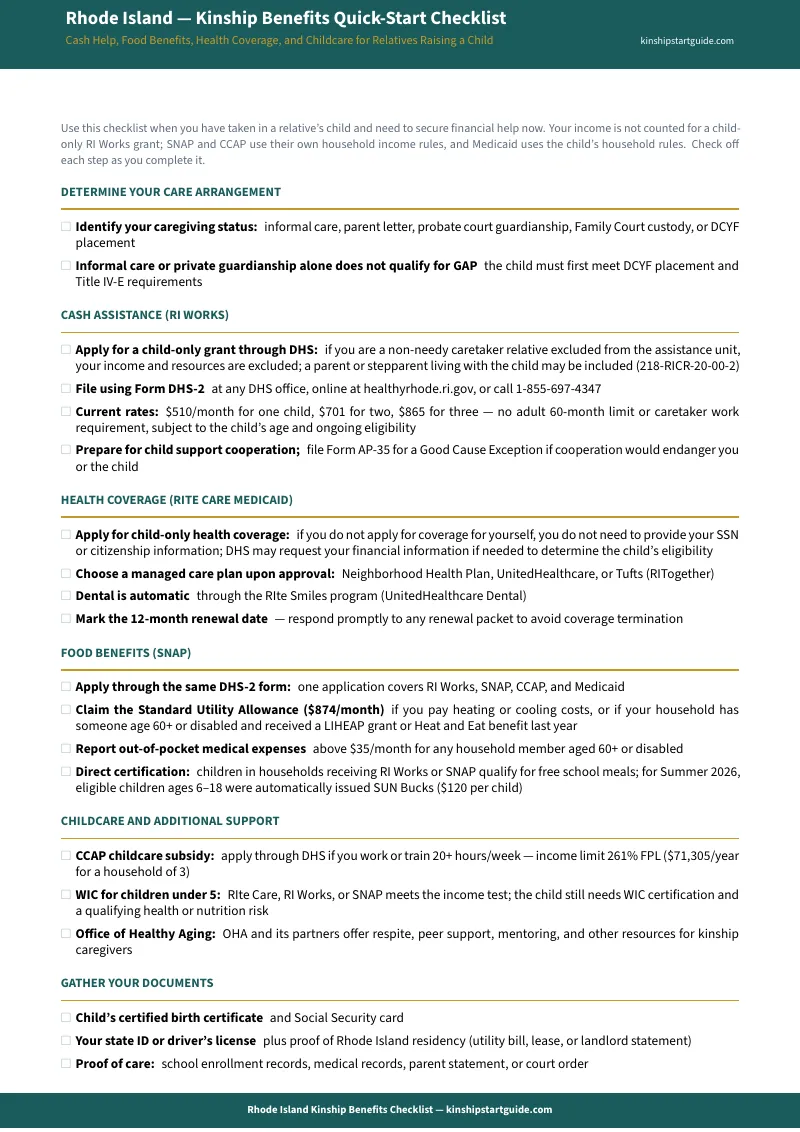
- RI Works child-only grants (Form DHS-2) — the application pathway that keeps your pension, Social Security, savings, and property completely out of the eligibility determination. The guide walks you through every section, explains the child's income and resource rules, and shows you exactly how to request the non-needy caretaker relative pathway if a caseworker hands you the standard means-tested application instead
- DCYF Kinship Guardianship Assistance Program (GAP) — monthly payments at foster care rates for relatives with legal guardianship after a formal DCYF placement. The guide explains the Title IV-E eligibility requirements, the six-month licensed foster care prerequisite, and how GAP connects to the child's Medicaid coverage
- SNAP food benefits with the Standard Utility Allowance — how to claim the $874/month utility allowance if you pay heating or cooling costs, the medical expense deduction for household members aged 60 or older, and how to structure the SNAP household so the child receives the correct benefit amount
- RIte Care Medicaid using MAGI non-filer rules — when a relative caregiver does not claim the child as a tax dependent, Medicaid evaluates the child as a separate household unit. Your income, assets, and Social Security number stay out of the calculation entirely, and the child qualifies for full health and dental coverage
- Child Care Assistance Program (CCAP) — subsidised childcare for working or training caregivers with income up to 261% of the Federal Poverty Level. The guide covers the provider directory, the requirement that the provider cannot live in the same home as the child, and the application process through DHS
- Title III-E caregiver support through the Office of Healthy Aging — respite care grants, caregiver counselling, and case management for relatives aged 55 and older, funded under the National Family Caregiver Support Program. These services fill the gap that cash benefits don't touch: the caregiver's own wellbeing
- WIC nutrition support and school meals — eligibility pathways for children under five through WIC, and automatic qualification for free school meals when the household already receives RI Works or SNAP
- Fair hearing appeals (Form OHHS-121) — what to do when a benefit is denied or reduced, how to file an appeal, the timelines that apply, and how to maintain benefits while your case is pending
Who This Is For
- Grandparents on Social Security, a pension, or disability income who are paying for a grandchild out of savings they can't replace — and who need to know that DHS cannot count those savings on a child-only application
- Aunts, uncles, older siblings, and family friends who took in a child with little or no notice and need to find out what the child is entitled to before the next bill arrives
- Relatives who were told they need a court order or guardianship to get benefits — they don't for most DHS programs, and the guide shows why
- Adult children or advocates researching options on behalf of an older relative caregiver who needs clear, step-by-step instructions they can bring to the office
Why Not Just Call DHS?
You absolutely should call DHS — with the guide open in front of you. Caseworkers process applications according to agency rules, but they are not required to tell you that a simpler, asset-protected application pathway exists. Rhode Island regulations let non-needy relative caregivers apply for child-only grants where their income and assets are excluded entirely, but intake staff routinely hand out the standard application by default. One wrong form pulls your pension into the eligibility test and can lead to a denial that takes weeks to overturn through an administrative hearing.
The guide doesn't replace free services — it prepares you to use them without costly mistakes. Legal aid handles court guardianship. HealthyRhode handles the online application. The guide handles the part nobody else covers: which path protects your retirement income while getting the child every dollar Rhode Island law already set aside for them.
Not Right for Everyone
This guide focuses on public benefit applications and financial help. It is not legal advice, and it does not cover contested custody disputes, juvenile dependency proceedings, or recommendations on whether to pursue guardianship. If you are involved in an active court case, your assigned caseworker or a legal aid attorney is the right first step. If you or the child are in immediate crisis — facing homelessness or a safety threat — call 211 before anything else.
What You Get
The download includes the complete 45-page guide, a quick-start checklist (also available as a free standalone download), and seven printable planning worksheets — an eligibility worksheet, a document-gathering checklist organised by program, an application tracker, an agency communication log, a benefit renewal calendar, a monthly budget worksheet, and a SNAP calculation worksheet. Print what you need, fill it in, and bring it to your DHS office.
Full refund, no time limit. If the guide doesn't help, email [email protected] and we'll send your money back.
Get the Rhode Island Kinship Benefits Navigator →
Frequently Asked Questions
What if the rules change after I buy?
We update the guide when the rules change. Email us any time, even years later, and we'll send you the current edition free.