The School Said No. The Doctor's Office Wants a Court Order. Neither of Them Is Right.
You took in a child because nobody else was going to — and now every office you walk into asks for paperwork you do not have. The school registrar wants a custody order before they will enroll the child. The pediatrician's office will not schedule a visit without "legal documentation." The dentist hands you a form designed for divorced parents, not for a grandparent raising a grandchild because the parent is in treatment, in prison, or simply gone.
North Dakota does not have a simple caregiver authorization affidavit like some states. Instead it has a set of narrower legal tools — a six-month power of attorney, a separate medical consent statute, and federal enrollment protections — each covering a different situation. The problem is that nobody at the school or the clinic explains which one applies when, and the free court form comes with no instructions for what to do when someone refuses to accept it.
The North Dakota Caregiver Consent Navigator is the independent guide that organises every consent pathway available to a relative raising a child in North Dakota — form by form, statute by statute, with the exact steps to take when an administrator demands a court order you do not need.
What the Guide Covers
- Minor Power of Attorney under N.D.C.C. § 30.1-26-04 — the free court form that lets a parent delegate care authority to you for up to six months. The guide explains who must sign, how to execute it before a notary or clerk of court, what it covers (routine medical, dental, day-to-day care), what it cannot cover (adoption, marriage, guaranteed school enrollment in your district), and how to handle the two-parent problem when only one parent is available
- Statutory medical consent under N.D.C.C. § 23-12-13 — the separate priority-based consent pathway that lets an adult relative authorise medical, dental, and mental health care when a parent is unable to provide informed consent. No signed document from the parent is required. The guide explains the statutory priority list, the conditions that activate it, and when to use it instead of or alongside the POA
- McKinney-Vento school enrollment — federal law that requires immediate public school enrollment for children in unstable housing, even without birth certificates, immunisation records, or proof of residency. The guide explains the eligibility criteria, how to request the district's McKinney-Vento liaison, and how to use these protections when a registrar demands a court order
- School enrollment without McKinney-Vento — the documents needed for standard enrollment, how the Attorney General's residency opinion affects which district the child attends, and when open enrollment under N.D.C.C. Ch. 15.1-31 is the right path
- Institutional refusal scripts — step-by-step response protocols for when a school, doctor, dentist, or pharmacy refuses to accept the power of attorney or questions your authority. Includes calm written templates, escalation steps, and supervisor-request language that de-escalates without threatening
- Six-month expiration tracking — a renewal log that flags the POA expiration date, reminds you when to coordinate a new signature with the parent, and explains when serial renewals start drawing institutional scrutiny and guardianship becomes the better route
- Medical consent authority summary — a printable one-page summary you hand to the clinic intake desk, covering your consent authority under the POA or the statutory priority list, the treatment categories each statute covers, and what to say if the clinic insists on a signed form from the parent
- When the POA is not enough — an honest comparison of the power of attorney against court guardianship under Chapter 27-20.1, including what guardianship adds (binding legal authority, guaranteed institutional acceptance) and what it costs (court petition, possible attorney fees), plus how to start a free guardianship application through Kinship-ND's legal cost funding
Who This Is For
- Grandparents, aunts, uncles, older siblings, and family friends who are raising a child in North Dakota without a court order — and who need the school and the doctor to recognise their authority now, not after a six-month court process
- Caregivers whose power of attorney was refused by a school registrar, doctor's office, or dentist — and who need a calm, specific response that cites the right statute
- Relatives who are not sure whether the parent needs to sign anything, or whether the separate medical consent statute covers their situation without a POA
- Adult children or community advocates researching options on behalf of an older relative caregiver who needs clear, printable instructions
Why Not Just Download the Free Court Form?
You absolutely should — and the guide links directly to it. The free Minor POA form from ndcourts.gov is the foundation of most informal kinship arrangements in North Dakota. But the form arrives with a one-page instruction sheet that says, in its own words, that third parties are not legally required to accept it.
That is where most caregivers get stuck. The form does not explain what to do when the school refuses to enrol the child. It does not mention McKinney-Vento. It does not explain the separate medical consent statute that works without any parental signature. It does not track the six-month expiration or help you decide when to stop renewing and pursue court guardianship instead.
The guide does not replace free resources — it organises them into an order that works when you are standing at the registration desk with a child who needs to start school tomorrow.
Not Right for Everyone
This guide covers school enrollment, medical consent, and the consent forms that make daily life work for a relative raising a child without a court order. It does not provide legal advice. It does not advise on contested custody disputes, recommend whether to pursue guardianship over the other parent's objection, or promise that any institution will accept any document. If you are involved in an active court case, a legal aid attorney is the right first step — the guide lists how to reach Legal Services of North Dakota for free help.
What You Get
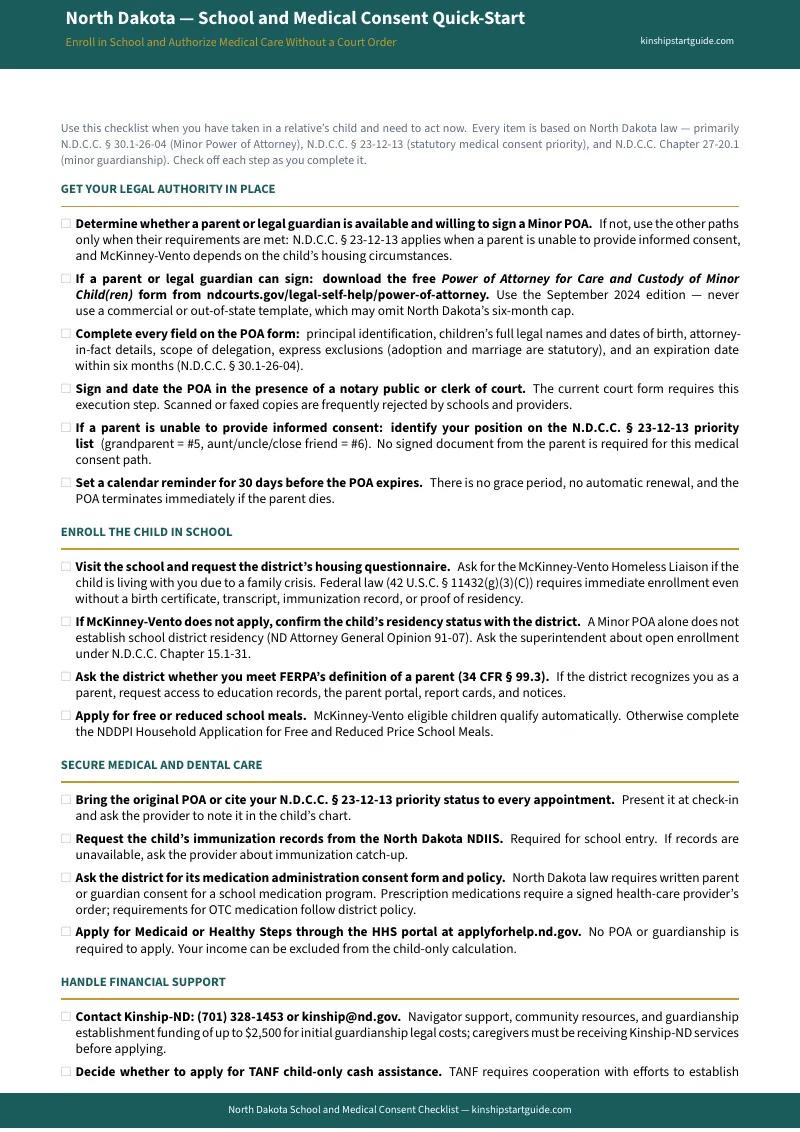
The download includes the complete guide, a quick-start checklist (also available as a free standalone download), a signer availability flowchart, a school enrollment cover sheet, a medical consent authority summary, a power of attorney execution checklist, a six-month renewal tracker, an agency communication log, and institutional refusal response templates — nine printable PDFs ready to fill in and bring to the school or clinic.
Full refund, no time limit. If the guide does not help, email [email protected] and we will send your money back.
Get the North Dakota Caregiver Consent Navigator →
Frequently Asked Questions
What if the rules change after I buy?
We update the guide when the rules change. Email us any time, even years later, and we'll send you the current edition free.