Four legal paths. Two courts. One wrong choice costs you months in the wrong courtroom.
You took in a child — a grandchild, a niece or nephew, the child of someone who can't be there right now. You didn't plan this. What you had was a phone call and an overnight bag. For weeks or months, informal care worked. Then the school said bring a court order. The benefits office said file a petition. The pediatrician said she needed documentation before she could treat. And suddenly you needed legal authority you'd never thought about, in a court system you'd never navigated, with forms you'd never seen.
Here's what makes New York different from most states: you don't just pick between custody and guardianship. You choose between four distinct legal instruments — nonparent custody under FCA Article 6, minor guardianship under SCPA Article 17, standby guardianship under SCPA § 1726, and a parental designation under GOL § 5-1551 — filed in two different courts with different fees, different standing requirements, and different consequences for the parents. Filing the wrong petition in the wrong court doesn't just waste your filing fee. It wastes months of preparation, notice to parents, and emotional energy.
The Court Process Navigation System in this guide does one thing: it takes every scattered piece of New York's kinship court process — the standing rules, the forms, the courts, the background checks, the notice requirements, the hearing — and puts it in the order you actually need it. Not a textbook. Not a form packet. A step-by-step roadmap that starts with "which order fits my situation" and ends with "what to do the day the court signs the order."
What's Inside the Guide
- Court Routing Worksheet — three intake questions map your situation to the right court (Family Court vs. Surrogate's Court) and the right order type (nonparent custody vs. guardianship). Filing in Family Court costs $0. Filing in Surrogate's Court costs $20. Choosing wrong means starting over with a new petition, new notice to parents, and new waiting time.
- Standing rules by relationship — before a New York court considers who would be the better caregiver, you must prove you have standing. Grandparents have a specific statute (DRL § 72(2)) with a 24-month benchmark. Aunts, uncles, and siblings follow the general extraordinary-circumstances standard. Great-grandparents are excluded from the grandparent statute entirely. The guide explains what each relative must prove and how courts have interpreted these requirements.
- Document Readiness Checklist — every record you need before your first visit to the clerk's office: certified birth certificates, death certificates, existing orders, residency proof, paternity acknowledgments, and translations. Missing one document delays your petition.
- Service of Process Log — tracks who was served, when, where, and by whom. Service disputes can delay contested proceedings by months. The log includes the steps for serving an incarcerated parent at a correctional facility and for filing a motion for service by publication when a parent cannot be found.
- Background checks and investigations explained — the Statewide Central Register check (OCFS-3909), the national criminal-history checks for KinGAP applicants, and what to expect from a court-ordered home study by DSS or the Probation Department
- Hearing Preparation Organizer — a binder checklist for court day: original petition, proof of service, certified records, evidence packets, caregiving timeline, and witness contact information. Walk into the courtroom with everything organized, not scattered in a grocery bag.
- Emergency and temporary orders — when a child is in immediate danger, New York allows temporary orders of custody and emergency guardianship petitions. The guide explains which situations qualify, the expedited procedures available, and the statutory time limits before a full hearing must take place.
- Post-Order Task Tracker — after the judge signs the order, you need certified copies for the school, the doctor, and the benefits office. You can file for Child-Only TANF, apply for child support against both biological parents, and enroll the child in school and medical care. The tracker covers each step.
- Modification, relocation, and UCCJEA rules — what happens when a parent wants the child back, when you need to move out of state, or when the child turns 18. A custody or guardianship order is not permanent — the guide explains the circumstances under which it can be changed or ended, and the continuing-jurisdiction rules that govern multi-state situations.
- Agency Communication Log — a dated record of every call and visit with the court clerk, DSS, OCFS, the Kinship Navigator, Legal Aid, and every other agency. Benefits processing and enforcement actions take months. A documented paper trail prevents lost progress.
Who This Is For
- A grandparent, aunt, uncle, or older sibling who has been caring for a child informally and now needs a court order — because a school, a doctor, or a benefits office demands one
- A relative whose arrangement with the parent worked until it didn't — the parent reappeared unexpectedly, entered treatment, was arrested, or passed away — and who now needs lasting legal authority that survives a parent's later objection
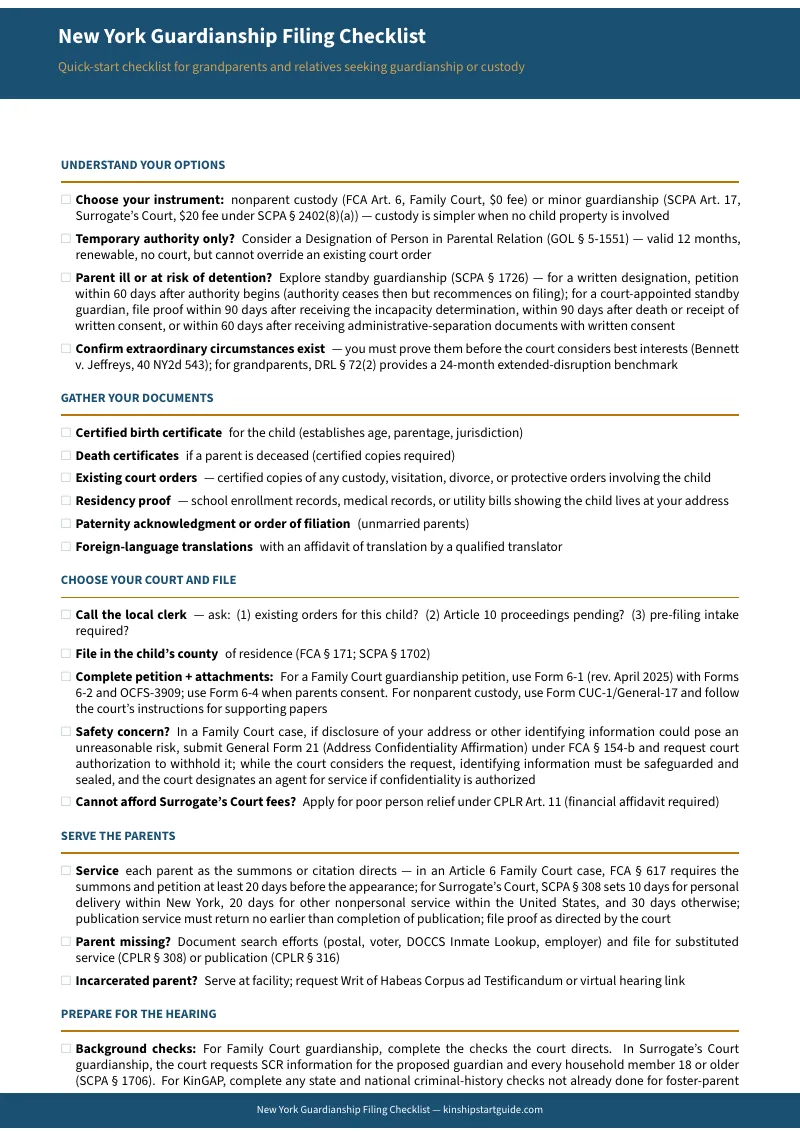
- A caregiver who has the free filing checklist but doesn't know whether to file for custody or guardianship, which court to file in, or how to prove standing
- A family helper or adult child buying this on behalf of an older relative who needs clear, step-by-step instructions for navigating the court process without a lawyer
Why Not Free Resources?
The court forms are free, and we link directly to them in the guide. Family Court charges $0 to file a custody or guardianship petition. The NYS Kinship Navigator (877-454-6463) provides telephone support and legal referrals. LawHelpNY publishes authoritative guidance on kinship care. Legal Aid may represent you for free if you qualify. The guide doesn't replace any of that — it bridges the gap between having the forms and knowing what to do with them.
Free resources give you Form 6-1. They don't walk you through the standing requirements you must satisfy before the court will hear your case. They don't explain when to file in Family Court versus Surrogate's Court, or why the wrong choice means starting over. They don't give you a service of process log for tracking notice to parents — including the steps for serving someone in a correctional facility. They don't prepare you for the home study, the background check, or the hearing. And they don't cover what happens after the order: the certified copies, the school enrollment, the benefits applications, the child-support petition, and the modification rules that govern the order for years to come.
Satisfaction Guarantee
Full refund, no time limit. If the guide doesn't help you navigate your situation, email [email protected] and we'll refund every penny — no forms, no waiting period, no questions.
A Court Order Shouldn't Require a Law Degree
New York built a system that lets relatives file for custody and guardianship without an attorney. The system works — but only if you know which instrument to choose, which court to file in, how to prove standing, and what every form requires before you walk up to the clerk's window. The guide puts all of that in one place.
Download includes the full 14-chapter guide, the quick-start filing checklist, and standalone printable worksheets — court routing, document readiness, service of process log, hearing preparation organizer, post-order task tracker, and agency communication log. Instant access after purchase.
Already have the free checklist? The full guide goes deeper — standing rules and case law, court routing logic, line-by-line filing instructions, service of process procedures, hearing preparation, emergency orders, post-order steps, and the modification and relocation rules that govern your order for years.
Frequently Asked Questions
What if the rules change after I buy?
We update the guide when the rules change. Email us any time, even years later, and we'll send you the current edition free.