
The Forms Are Free. Knowing Which Ones to File Is What Costs You Three Months.
Every Missouri circuit court form is public. Every statute is online. And none of that helps when you're sitting in the probate clerk's office with your grandchild beside you, a stack of petition pages you're not sure you filled in correctly, and no clear answer to the question that actually matters: did you even need to file this guardianship petition, or would a power of attorney under RSMo § 475.602 have given you everything the school and the pediatrician require — with no court, no filing deposit, and no hearing?
The Missouri Kinship Court Process Roadmap is the independent guide that answers that question first, then walks you through whichever route fits — from non-court delegations through probate guardianship, third-party custody, standby guardianship, and emergency orders — step by step, with printable worksheets for tracking notice, preparing your evidence, and staying in compliance after the judge signs your order.
What the Guide Covers
- Legal route decision framework — a structured comparison of the Minor Power of Attorney (RSMo § 475.602), the Relative Caregiver Affidavit (RSMo § 431.058), probate guardianship under Chapter 475, and third-party custody under RSMo § 452.375, so you pick the right path before you spend a filing deposit or commit to a court calendar
- Minor Power of Attorney walkthrough — who can sign one, what authority it grants, the standard one-year limit (with the active-duty military exception), parent revocation rights, and why it cannot be used to consent to termination of parental rights
- Probate guardianship petition assembly — the petition forms available from your circuit court clerk, item-by-item completion notes, and a cause-of-petition phrasing guide for common scenarios (incarceration, treatment, abandonment, death)
- Filing deposits and fee waivers — how deposits vary by circuit (from roughly $100 uncontested to $500+ when formal service is required), and how to file a motion to proceed In Forma Pauperis under RSMo § 514.040 when you cannot afford the costs
- Notice and service of process — who must receive written notice, how to serve parents personally or by mail, what to do when a parent cannot be found (including service by publication), and a due diligence search tracking log you can print and fill in
- Background screening — what RSMo § 475.050 requires, where the Family Care Safety Registry fits into screening, what local checks may be needed, and what to do if a concern appears on your record
- Emergency and temporary orders — when an emergency appointment under RSMo §§ 475.060.3 and 475.075.15 is available, the legal standard for immediate action, and how the process differs from a standard guardianship petition
- The hearing — what happens in the probate courtroom, how to present your case without a lawyer, what to expect if a parent objects, and how the judge evaluates the child's best interest
- Post-order duties — obtaining certified copies of Letters of Guardianship, reporting obligations, obtaining child support from parents, relocation rules, and how a guardianship can be modified or terminated
- Benefits after guardianship — a routing guide to TANF Child-Only grants, MO HealthNet for Kids, SNAP, and the Subsidized Guardianship Program (which requires the child to have been in the custody of the Children's Division, Division of Youth Services, Department of Mental Health, or a licensed child-placing agency), with cross-references to the companion Missouri financial help guide for full program-by-program instructions
6 Printable Worksheets — Each a Standalone PDF
- Filing-and-Notice Tracker — log every service attempt on parents, certified mail return receipts, publication dates, and pre-hearing deadlines from the day you file through the hearing
- Hearing Evidence Checklist — a checklist of every document you need in the courtroom, with columns for original/copy status and submission dates
- Post-Order Compliance Calendar — track reporting deadlines, benefit renewal dates, and key milestones from the day you receive your Letters of Guardianship
- Agency Communication Log — record every phone call, email, and office visit with courts, agencies, schools, and medical providers so you have a clear record if someone later claims they told you something different
- Benefits Application Tracker — track the status of every benefits application (TANF, MO HealthNet, SNAP, child support) with application dates, follow-up dates, and decision status
- Diligent Search Documentation Worksheet — document every step of your search for an absent parent, organized by method with date, result, and evidence columns, to support the affidavit or verified statement your circuit requires for a publication request
Who This Is For
- Grandparents who have been caring for a grandchild informally and now need a court order because a school, doctor, or benefits office has refused to accept anything less
- Aunts, uncles, adult siblings, and other relatives who took in a child after a parent became unavailable — and need to understand the court process and local attorney requirements before filing
- Relatives who aren't sure whether they need a court filing at all — the guide's decision framework compares non-court delegations against guardianship and custody so you don't spend a filing deposit prematurely
- Adult children, community advocates, or kinship navigator staff helping an older caregiver understand the circuit court system
Why Not Just Use the Free Court Forms?
You should. Missouri circuit courts publish petition packets, and many clerks will hand you the forms in person. MO KIN-4-KID (1-833-KIN-4-KID) provides free telephone navigation and connects caregivers with local resources. Regional legal aid organizations — Legal Services of Eastern Missouri, Legal Aid of Western Missouri, Mid-Missouri Legal Services, and Legal Services of Southern Missouri — offer free help to qualifying families. These resources are listed in the guide, and they should be your first stop if you qualify.
What none of these resources do is put it all in order for your specific situation. The court clerk will accept your petition; they can't tell you whether a power of attorney would have been enough, or that your notice to the father's last known address doesn't meet the due diligence standard. The state navigator can explain your options; they can't draft your petition, track your local circuit's fee schedule, or hand you a worksheet for documenting your search for a missing parent. And no free resource gives you a printable evidence checklist for the hearing, a compliance calendar for the year after the order is signed, or a benefits tracker for the applications you'll file once you have your Letters of Guardianship.
The guide organizes the process around decisions — what to file, when, in what order, and what happens at each step — so you spend your energy on the child, not on figuring out which circuit court webpage has the next piece of the puzzle.
Not Right for Everyone
This guide is not legal advice and does not replace a lawyer. It explains how the court process works for self-represented petitioners; it does not advise you on whether to file or predict what a judge will decide. If a parent is actively contesting your petition and you expect a trial, consult a family law attorney — the guide covers what a contested hearing looks like, but strategic litigation advice is beyond its scope. If the child is in immediate danger, call 911 or the Missouri Child Abuse Hotline at 1-800-392-3738.
What You Get
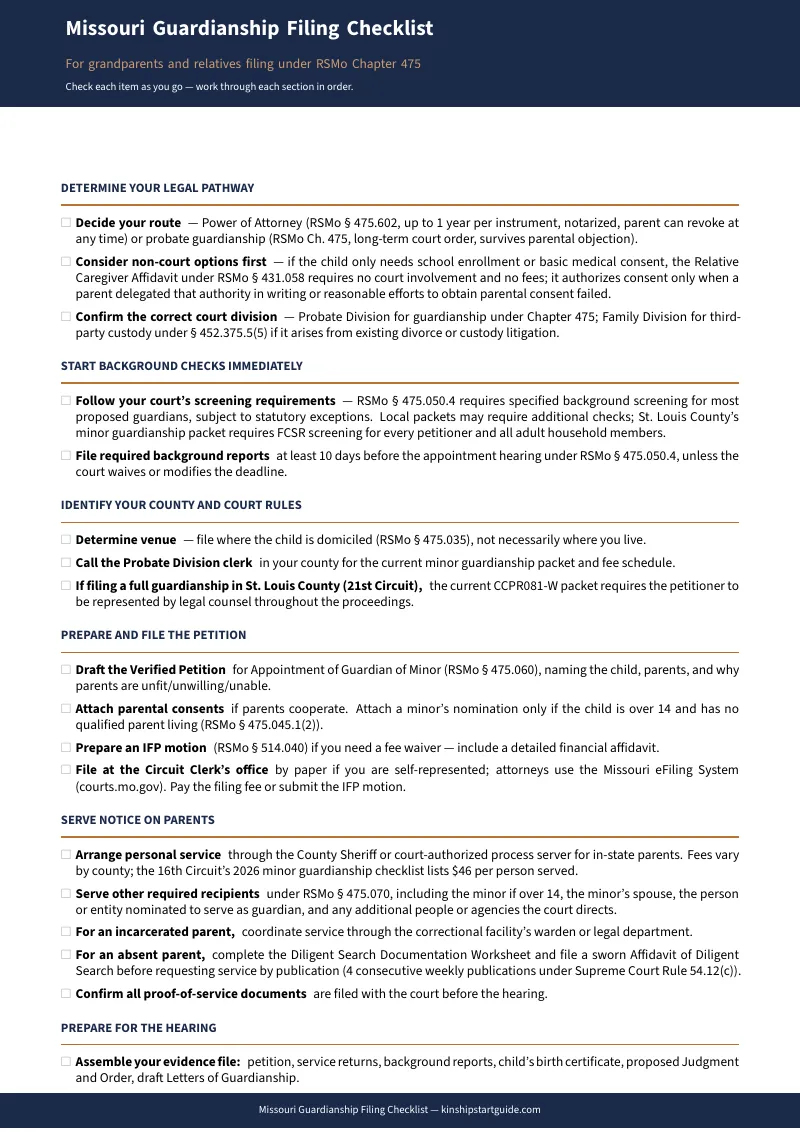
The download includes the complete 46-page court process guide, a 26-item quick-start filing checklist (also available as a free standalone download), and 6 printable standalone worksheets — a filing-and-notice tracker, a hearing evidence checklist, a post-order compliance calendar, an agency communication log, a benefits application tracker, and a diligent search documentation worksheet. All PDFs are ready to print, fill in, and bring to the courthouse.
Full refund, no time limit. If the guide doesn't help, email [email protected] and we'll send your money back.
Get the Missouri Kinship Court Process Roadmap →
Frequently Asked Questions
What if the rules change after I buy?
We update the guide when the rules change. Email us any time, even years later, and we'll send you the current edition free.