
The school wants paperwork you don't have. The clinic won't see the child without a parent's signature. And Mississippi just repealed the only statutory POA for minors.
You've been raising your grandchild or a relative's child for a few days — maybe a few weeks — and every institution asks for proof you can make decisions. The school registrar needs a residency affidavit. The pediatrician's front desk says they can't schedule the child without parental consent. You searched for "Mississippi power of attorney for minor child" and found templates that reference a statute the state repealed in July 2026.
Here's what nobody at the counter will tell you: Mississippi gives grandparents and adult relatives more everyday medical authority than almost any other state. Under § 41-41-3, a grandparent can walk into a clinic and consent to treatment for the child without any paperwork at all — the statute puts grandparents in the consent hierarchy by name. The problem is that most front-desk staff have never heard of it, and when you don't know the citation, you get sent home.
The Mississippi Consent Authority Toolkit — four pathways, one clear process
Mississippi law gives relatives raising a child four routes to caregiving authority: the statutory medical consent hierarchy, the MDE residency verification for school, a private parental power of attorney, and formal Chancery Court guardianship. The rules are scattered across three separate titles of the Mississippi Code, the State Board of Education's administrative rules, and the individual policies of 144 school districts — and nobody has put them in one place.
The School and Medical Consent for Grandparents and Relatives in Mississippi guide organises all four pathways into a single system: which instrument fits your situation, how to execute it, and exactly what to say when you present it. It is — a one-time purchase with no subscription, no recurring fees, and a full refund if it doesn't help, no time limit.
What's inside
- The § 41-41-3 medical consent hierarchy in plain language — how Mississippi statute names grandparents and adult siblings as authorised consent-givers by priority order, the exact wording to present at a clinic counter, the limits for elective surgery and mental health, and why this pathway needs no notary, no parent signature, and no court order
- School enrollment step by step — what Mississippi districts actually require under MDE Rule 68.1, the two-proof residency standard, Form 121 immunisation, the in loco parentis affidavit that Jackson Public Schools and other districts accept, and what to say when a registrar demands a court order
- Private parental power of attorney — the replacement pathway after the July 2026 repeal of Title 93 Chapter 31: who signs, notarisation, which powers to list so the document survives a school registrar's scrutiny, and the renewal calendar
- Parent unavailable decision tree — what to do when a parent is incarcerated, in treatment, unreachable, or deceased: which consent instruments still work, when McKinney-Vento gives the child immediate enrollment, and the point where court guardianship becomes the better route
- Medical, dental, and mental health consent — the full § 41-41-3 framework for routine and emergency care, dental designation forms, the strict limits on minor mental health treatment consent, and the age thresholds where a Mississippi teenager can consent on their own
- Medicaid, CHIP, and health coverage — how to get the child covered through access.ms.gov while paperwork is still in progress, caretaker-relative eligibility, and the difference between treatment consent and insurance enrollment
- MDCPS placements vs. private kinship care — what changes when the Department of Child Protection Services places the child with you, how agency custody affects your authority, and when the agency's involvement actually strengthens your position at the school or clinic
- McKinney-Vento, IDEA, and FERPA rights — immediate enrollment when the child's housing is unstable, special education authority for a caregiver without custody, and how FERPA handles educational records for a non-parent
- The GAP Act guardianship path (§ 93-20-201) — the decision tree for Chancery Court guardianship, emergency 60-day orders under § 93-20-207, the pro se petition forms from the Administrative Office of Courts, and filing costs
- Six printable worksheets — school enrollment preparation sheet, medical visit intake checklist, document expiration and renewal tracker, POA renewal calendar, agency communication log, and administrative refusal response sheet — each a separate PDF you can print and fill in
- Mississippi free-help directory — direct intake numbers for Catholic Charities' Kinship Navigator Programme, the Mississippi Access to Justice Commission, the Volunteer Lawyers Project, and the Division of Medicaid
Who this is for
You are a grandparent, aunt, uncle, older sibling, or family friend in Mississippi who has taken in a child — often overnight — because a parent is dealing with addiction, is incarcerated, is seriously ill, or simply cannot care for the child right now. You don't have a court order. The child needs to be in school and seen by a doctor, and every office you've called has asked for something you don't know how to produce.
This guide is for the person at the kitchen table trying to figure out where to start. It is not legal advice, it is not connected to any court or agency, and it does not take sides in any family dispute.
Why not free resources?
Mississippi has some excellent free programmes — and this guide lists every one of them with intake numbers and eligibility details. Catholic Charities' Kinship Navigator covers designated counties, the Access to Justice Commission runs periodic free guardianship clinics, and the Division of Medicaid helpline can walk you through an application.
But here's what the free resources don't do: they don't put the four consent pathways in order, explain which one fits your specific situation, and tell you what to say at the counter when someone insists on a court order. State statute text on Justia gives you the law but not the process. School district handbooks explain their own residency rules but not how they interact with § 41-41-3 or a private POA. Legal aid clinics run on waiting lists and limited schedules. And the commercial form generators — LegalZoom, US Legal Forms, Legal Templates — still sell "Mississippi Minor Power of Attorney" templates based on the statute the state repealed in 2026, at monthly subscription prices of $15 to $50.
The guide is a one-time purchase that covers the actual Mississippi process from start to finish, updated for current law.
Satisfaction guarantee
If the guide doesn't help your situation, email [email protected] for a full refund, no time limit. No hoops, no questions you'd rather not answer. The guide either helps or it doesn't.
The first school morning shouldn't be this hard
You didn't choose this. A child arrived and the paperwork didn't come with them. But Mississippi does give relatives real authority to handle school and medical decisions — the forms and the process exist. They are just buried across state statutes, district policies, and agency portals that were never written for someone in your shoes. This guide puts them in one place, in plain language, with the exact steps to get the child enrolled and seen by a doctor.
Get the Mississippi School & Medical Consent Guide →
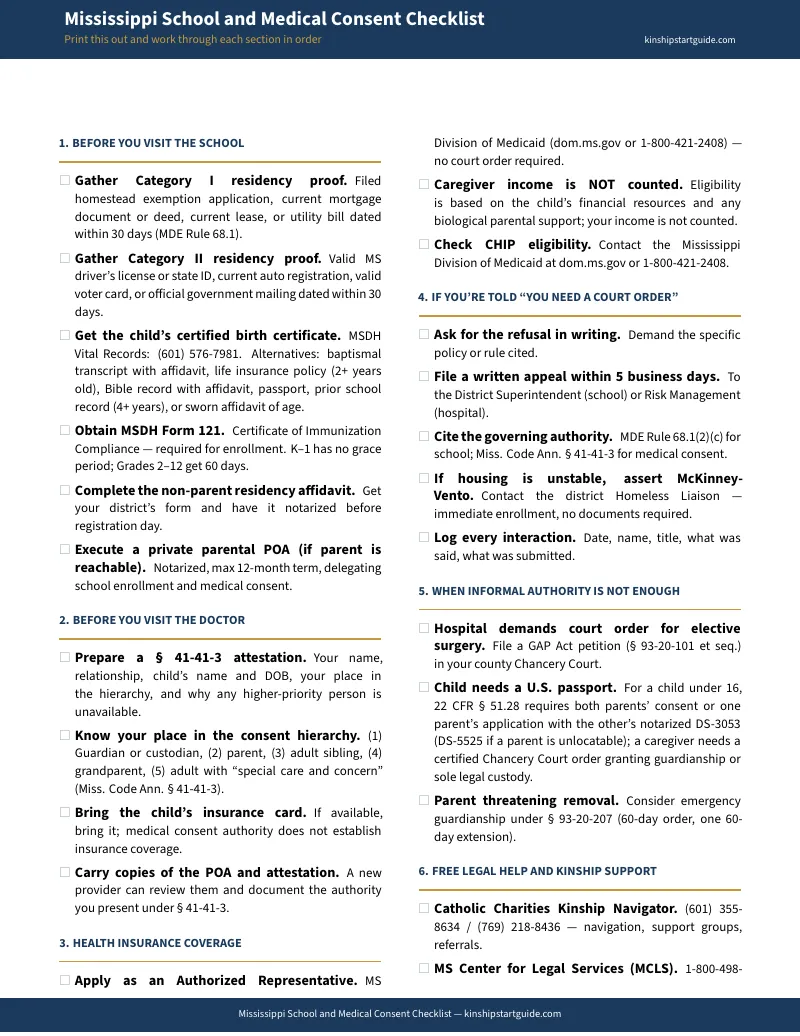
A free checklist is also available — it covers what documents you need and which offices to call, so you can see the scope before deciding whether the full guide is right for you.
Frequently Asked Questions
What if the rules change after I buy?
We update the guide when the rules change. Email us any time, even years later, and we'll send you the current edition free.