You Are Already Paying for Everything — The Child May Be Entitled to Help You Have Not Applied For
You did not plan for this. A grandchild or a relative's child arrived in your home, and overnight you became responsible for food, clothes, school supplies, childcare, and doctor visits — on a budget that was built for one or two people, not a growing child.
You have probably searched for help already. Maybe you called the state office and sat on hold. Maybe you started an MI Bridges application and gave up when it asked for your income — convinced your pension or Social Security would disqualify the child. Maybe someone mentioned "foster care payments" and you backed away because you are not a foster parent and you do not want to become one.
Here is what almost nobody tells you clearly: Michigan runs a child-only cash grant that does not count a single dollar of your income. Under BEM 210, the state evaluates only the child's income and assets. Your retirement, your savings, your home — all excluded. And that grant is just one of at least six programs designed for exactly your situation.
The Michigan Kinship Benefits Navigator
This is not a list of programs with phone numbers. It is a complete navigation system — the step-by-step instructions, program comparison tables, worked dollar examples, and printable planning tools that turn a confusing web of state agencies into a clear path forward.
The guide was built around one problem: relative caregivers in Michigan lose benefits they are entitled to because no single source explains how all the programs connect, whose income counts for which program, or what to do when a caseworker asks for the wrong documents. The Michigan Kinship Benefits Navigator puts every answer in one place.
What Is Inside
- FIP Child-Only Grant walkthrough — how to apply through MI Bridges as an ineligible grantee so your income is excluded, with the exact radio-button sequence and document list that prevents the portal from demanding your wage stubs
- Program Household Rules Matrix — a single reference table showing whose income counts for FIP, FAP, Medicaid, MIChild, and CDC, because each program defines "household" differently and getting it wrong means a denial
- Worked dollar examples using real payment standards — actual monthly amounts calculated from RFT 210 tables for one child, two children, and three children, including how child support pass-through disregards affect the final number
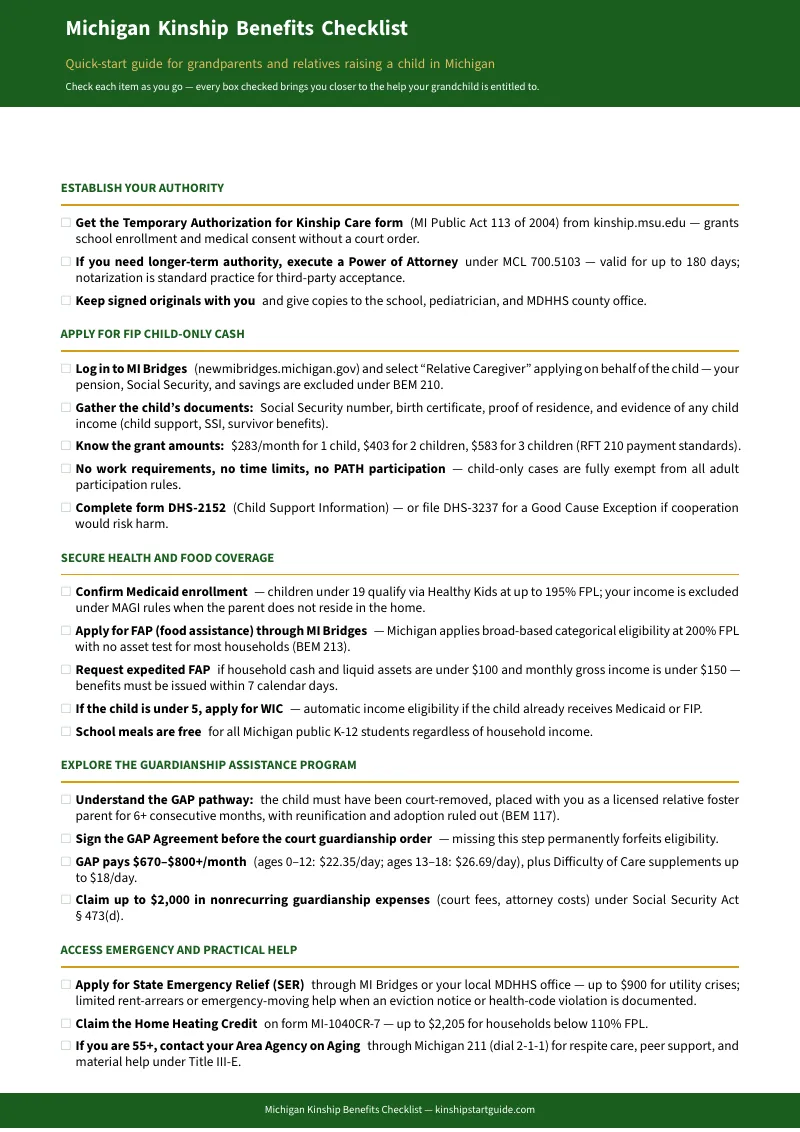
- Guardianship Assistance Program (GAP) decision guide — the licensing timeline, the six-month placement requirement, daily rate calculations ($22.35/day for ages 0–12, $26.69/day for ages 13–18), and Difficulty of Care supplements, so you can see whether the GAP pathway is worth pursuing alongside the immediate FIP grant
- Food assistance, health coverage, and childcare in one chapter each — FAP expedited processing rules, Healthy Kids enrollment for children under 19, WIC automatic eligibility when the child already receives FIP, and CDC childcare subsidy application steps
- Deadline and Renewal Tracker — a printable log for application decisions, semi-annual reports, recertifications, and every Notice of Case Action, with the 12-day Aid Continuing window and 90-day appeal deadline clearly marked
- Document Gathering Checklist — organized by program (FIP, FAP, Medicaid, GAP, CDC, appeals) so you walk into every agency appointment with every piece of paper they will ask for
- Benefits Eligibility Screener and Agency Communication Log — a fill-in worksheet to identify which programs the child likely qualifies for, plus a dated tracking sheet for every caseworker interaction that becomes your evidence at a hearing
- Emergency and seasonal help — State Emergency Relief (SER) for utility crises, Home Heating Credit on form MI-1040CR-7, and Area Agency on Aging respite care for caregivers age 55 and older
- Free resource directory — MSU Kinship Care Resource Center (1-800-535-1218), Michigan Legal Help, local MDHHS office finder, and 211 referral lines, because free help exists and you should use it alongside this guide
Who This Guide Is For
- Grandparents raising a grandchild on a fixed income who need to know what the child qualifies for without risking their own retirement benefits
- Aunts, uncles, older siblings, and other relatives who took in a child suddenly and are paying out of pocket for everything
- Adult children or family friends helping an elderly relative navigate the system — buying this guide so they can work through applications together
- Kinship caregivers who started applying through MI Bridges but abandoned the application because the portal seemed to require their personal income information
- Relative caregivers who received a denial or benefit reduction and need to understand the appeal process before a deadline passes
Why Free Resources Are Not Enough on Their Own
The MSU Kinship Care Resource Center runs a free helpline and peer groups — and you should call them. Michigan Legal Help publishes self-help court forms. MI Bridges processes applications. Each one handles its own piece. But none of them shows you how those pieces connect.
The KCRC helpline cannot fill out your MI Bridges application or represent you at a hearing. Michigan Legal Help focuses on court filings, not executive branch benefit applications. MI Bridges asks you to select the right category but does not explain what "ineligible grantee" means or why it matters. MDHHS administrative manuals (BEM, BAM, RFT) contain the answers, but they run hundreds of pages in policy language written for caseworkers.
This guide translates those manuals into plain language, connects the programs in the order you actually need them, and gives you printable tools to track everything — so you spend your time with your grandchild, not lost in a system that was not designed for civilians to navigate alone.
Your Purchase Is Risk-Free
Full refund, no time limit. If the guide does not help you, email [email protected] and the refund is processed — no questions, no forms. Applying for state benefits is always free regardless of this guide. The direct contact information for every free public service is included in the guide and on this website.
The child is entitled to this help. You just need to know how to ask for it the right way.
Get the Michigan Kinship Benefits Navigator →
Frequently Asked Questions
What if the rules change after I buy?
We update the guide when the rules change. Email us any time, even years later, and we'll send you the current edition free.