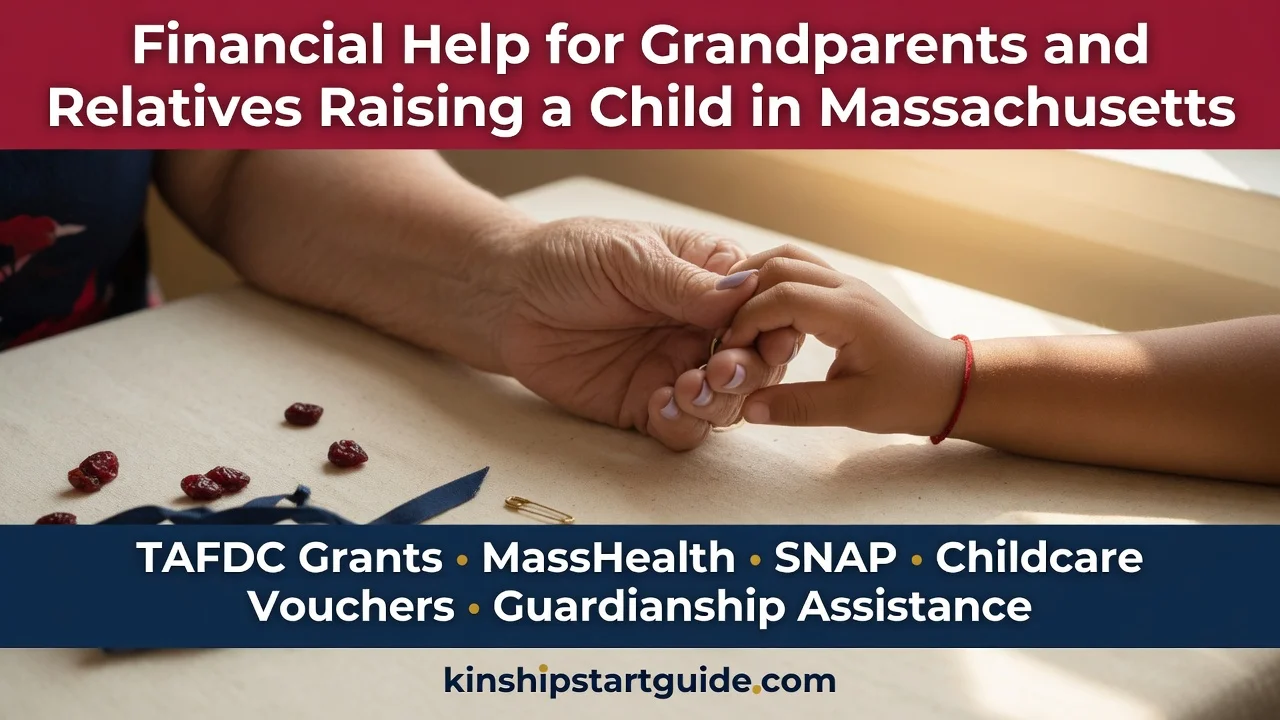
You're raising someone else's child on your own retirement money — and Massachusetts has cash, food, health coverage, and childcare set aside for that child. The problem is finding it all before your savings run out.
A grandchild moves in after a phone call you didn't expect. Within a week the grocery bill doubles. Within a month you're buying school clothes, co-pays, and winter boots on a Social Security check that was already tight. The state has programs designed for exactly this situation — a cash grant that doesn't count your income, health coverage that doesn't count your pension, food benefits, childcare vouchers — but the agencies that run them don't talk to each other, and nobody at DTA is going to hand you a single list of everything the child is entitled to.
You call the Department of Transitional Assistance and get a 40-minute hold. A caseworker asks for your bank statements — even though your income isn't supposed to count. You hang up confused about whether you even qualify. MassHealth has a separate application. The childcare voucher goes through a different agency entirely. And the Guardianship Assistance Program? That's a third agency, DCF, with its own rules about who qualifies. Each office gives you a piece. None of them gives you the whole picture.
The Massachusetts Kinship Benefits Roadmap
This guide puts every benefit, every agency, and every application step into one document — in the order you actually need them. It connects the five programs that matter most to relative caregivers raising a child in Massachusetts: the TAFDC child-only grant (where your retirement income and assets are completely excluded from the eligibility calculation), SNAP food benefits (where the household rules work differently), MassHealth for the child, EEC childcare vouchers through a DTA referral, and the DCF Guardianship Assistance Program for relatives who've taken legal guardianship after a child welfare case.
Instead of calling five agencies and hoping each one mentions the others, you get a single roadmap that shows which program counts your income and which doesn't, what documents each office actually accepts when you don't have a court order, and how to sequence your applications so approval on one program triggers a referral to the next.
What's Inside
- TAFDC child-only grant walkthrough — the application process from start to approval, including exactly which income and assets DTA excludes for non-parent relative caregivers (spoiler: all of yours), the documents to bring to your first interview, and what to do if a caseworker incorrectly asks for your bank statements
- SNAP household strategy — why SNAP counts your income when TAFDC doesn't, how the separate-purchase-and-prepare rules work, and the documentation that supports a separate food benefit household for the child
- MassHealth enrollment — how to get the child covered using child-only household rules that don't count a grandparent's income, including automatic enrollment through TAFDC and the standalone application path
- EEC childcare voucher referral — the exact steps to get a no-fee childcare voucher through your DTA caseworker when you're receiving a child-only grant and working or in approved training, and why the voucher survives even if your cash case closes
- Guardianship Assistance Program eligibility — who qualifies (prior DCF case required), how GAP payments compare to foster care rates, and how GAP interacts with TAFDC and other benefits
- Caregiver Authorization Affidavit walkthrough — how to use the M.G.L. Chapter 201F affidavit for school enrollment and medical consent without a court order, and when it stops being enough
- Document-Gathering Checklist — every document you need for every agency, organized by program, including the informal proof of relationship (pediatric records, school emergency contacts, landlord letters) that DTA accepts when you don't have a guardianship order
- Agency Intake Preparation Worksheet — a fill-in sheet for your first DTA, MassHealth, EEC, or DCF visit: have / need / where to get each verification item
- Benefits Eligibility Screener — a program-by-program checklist that helps you identify which benefits the child qualifies for based on your care arrangement (informal, affidavit, guardianship, or DCF placement)
- Benefits Tracker — case numbers, monthly amounts, and recertification dates for TAFDC, SNAP, MassHealth, EEC, GAP, and WIC in one place
- Renewal Calendar — approval dates, recert windows, and mid-year reporting duties so a missed notice does not close the case
- Appeal Deadline Calculator — write the notice mailing date, then fill the Aid Pending clock (10 calendar days) and the hearing clock (90 calendar days at DTA, 60 at MassHealth, 30 at DCF and EEC)
- Agency Communication Log — a printable tracker for every call, office visit, and caseworker interaction, so you have a paper trail when something goes wrong
Who This Is For
- Grandparents on a fixed income who are paying for a grandchild's daily expenses out of retirement savings and need to know which programs won't count their pension or Social Security against the child's eligibility
- Aunts, uncles, and older siblings who took in a child with little notice and are overwhelmed by the number of agencies, forms, and deadlines involved in getting the child covered
- Relatives caring for a child informally who were told they need a court order before they can apply — they don't, for most programs, and the guide explains exactly which ones
- Adult children and community advocates helping an older relative navigate the system, including Kinship Navigator staff and Family Resource Center workers who need a structured reference
Why Not Just Use the Free State Resources?
Everything in this guide is based on publicly available Massachusetts regulations and agency procedures. You can find the individual rules yourself — on mass.gov, MassLegalHelp, DTA's online portal, DCF's website, and EEC's childcare referral directory. Nobody is hiding the information.
The problem is that it's scattered across five agencies, dozens of web pages, and hundreds of pages of regulatory language written for caseworkers, not for a grandparent who just wants to know what the child is entitled to. DTA explains TAFDC but doesn't mention EEC vouchers. MassHealth enrollment pages don't explain the TAFDC income exemption. The Kinship Navigator helpline is excellent for referrals but can't walk you through every program's application rules in a single call.
This guide does one thing those resources can't: it puts every program, every income-counting rule, every document requirement, and every cross-agency referral into one chronological sequence. You read it once, gather your documents once, and go to your appointments prepared.
Satisfaction Guarantee
Full refund, no time limit. If the guide doesn't help you navigate the system, email [email protected] and you'll get your money back.
Get Started
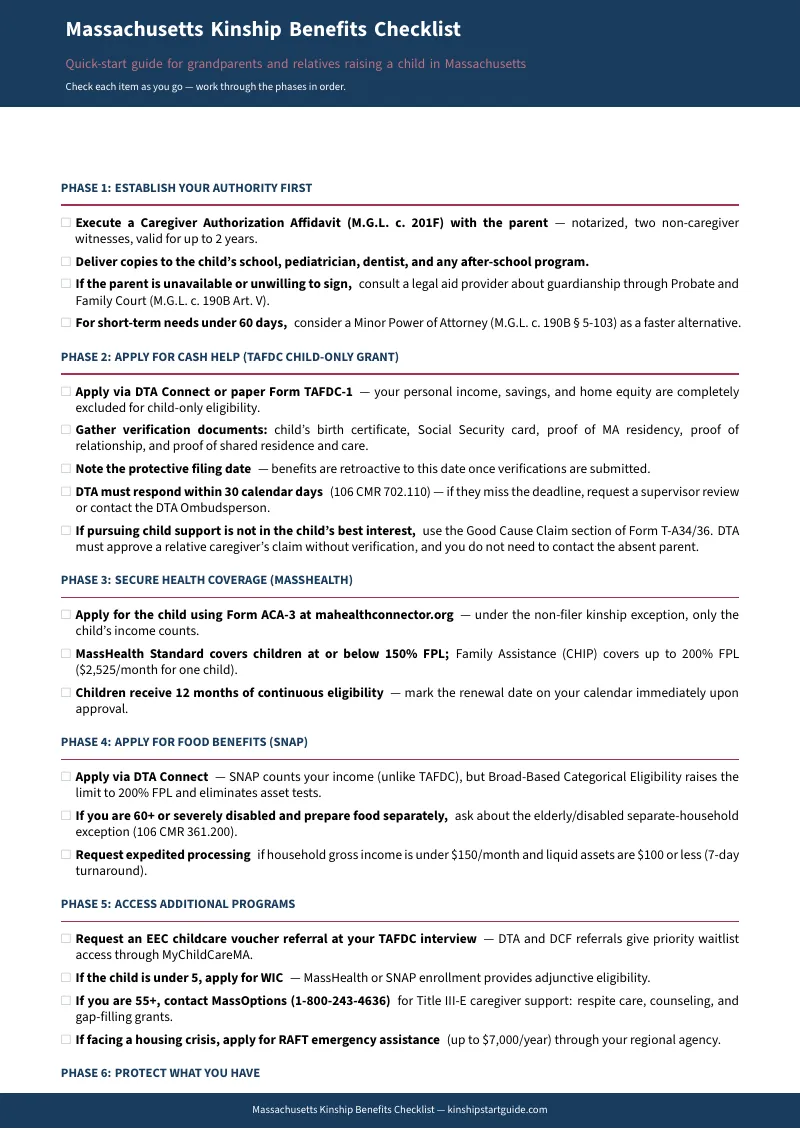
Download the free checklist to see which benefits to check and which agencies to contact. When you're ready for the full application walkthrough, document checklists, and tracking worksheets, get the complete guide — for less than the cost of one missed day at a DTA office.
Frequently Asked Questions
What if the rules change after I buy?
We update the guide when the rules change. Email us any time, even years later, and we'll send you the current edition free.