
Your Retirement Stays Out of It. The Child Gets the Money Maine Already Set Aside.
You didn't plan to raise another child. But here you are — stretching a Social Security check across a second round of groceries, winter coats, doctor visits, and school supplies. Maine has cash aid, food benefits, health coverage, and childcare help earmarked for this child, and state rules say your income doesn't enter the calculation. The problem is that nobody at the Office for Family Independence volunteered that information.
The Maine Kinship Benefits Navigator is the independent roadmap that organises every public benefit a relative caregiver can claim for a child in Maine — program by program, form by form, with the exact documents to bring and the exact sections to complete so your pension, Social Security, and savings stay out of the child's eligibility math.
What the Guide Covers
- TANF child-only grants — how a nonparent specified relative is excluded from the assistance group so only the child's own income determines the grant, including the tax-dependent rule (claiming the child counts half the need standard as unearned income) and the 2021 amendment that eliminated full-family cash sanctions so the child's portion is always protected
- MaineCare under MAGI rules — the non-filer household composition that keeps a caregiver's income out of the child's eligibility determination, qualifying the child for full health coverage based on the child's income alone
- SNAP food supplement household rules — how non-parent relatives can establish a separate SNAP household for the child when they purchase and prepare food separately, so your retirement income isn't counted against the child's food benefits
- Child Care Affordability Program (CCAP) — childcare assistance while you work, attend school, or train, with eligibility rules for retired guardians and the provider options available (licensed programmes, adults, or relatives)
- HOPE Program — tuition, books, childcare, and transportation assistance for caretaker relatives enrolled at least half-time in post-secondary education or training, with income at or below 225% of the Federal Poverty Level
- Title 22 § 4038-D permanency guardianship subsidies — negotiated payments up to the cost of foster care for children who were in DHHS child protective custody, with up to $2,000 in legal expense reimbursement and the option to continue the subsidy to age 21 for qualifying disabilities or educational needs
- Temporary Delegation of Parental Powers (18-C § 5-127) — how the 12-month power of attorney provides school and medical authority without a court order, and why it does not automatically unlock state cash benefits
- Fair Hearing appeals — what to do when a benefit is denied, how to request a Fair Hearing within the 30-day window, and what the Department's options are for waiving or extending that deadline
Who This Is For
- Grandparents on Social Security, a pension, or SSI who are paying for a grandchild out of savings they can't replace — and who need to know that OFI cannot count those savings on a child-only application
- Aunts, uncles, older siblings, and family friends who took in a child with no notice and need to find out what the child is entitled to before the next bill arrives
- Relatives who were told they need a court guardianship to get benefits — they don't for the core programmes, and the guide shows why
- Adult children or advocates researching options on behalf of an older relative caregiver who needs clear, step-by-step instructions
Why Not Just Call OFI or 211?
You absolutely should call — with the guide open in front of you. OFI caseworkers manage large caseloads and are restricted to answering questions about their specific programme. They won't walk you through how TANF, SNAP, MaineCare, and CCAP interact, or tell you which form sections to skip so your income stays out of the child's case. 211 and Adoptive and Foster Families of Maine (AFFM) provide crisis support and peer connections, but neither supplies a printed document-gathering checklist organised by programme or a recertification tracker you can bring to your next appointment.
The guide doesn't replace free services — it prepares you to use them without costly mistakes. Pine Tree Legal Assistance handles legal questions. MyMaineConnection handles the online application. The guide handles the part nobody else covers: which path protects your retirement while getting the child every dollar Maine law already set aside for them.
Not Right for Everyone
This guide focuses on public benefit applications and financial help. It is not legal advice, and it does not cover contested custody disputes, child protective proceedings, or advice on whether to pursue guardianship. If you are involved in an active court case, your caseworker or a legal aid attorney is the right first step. If you or the child are in immediate crisis — facing homelessness or a safety threat — call 211 or AFFM before anything else.
What You Get
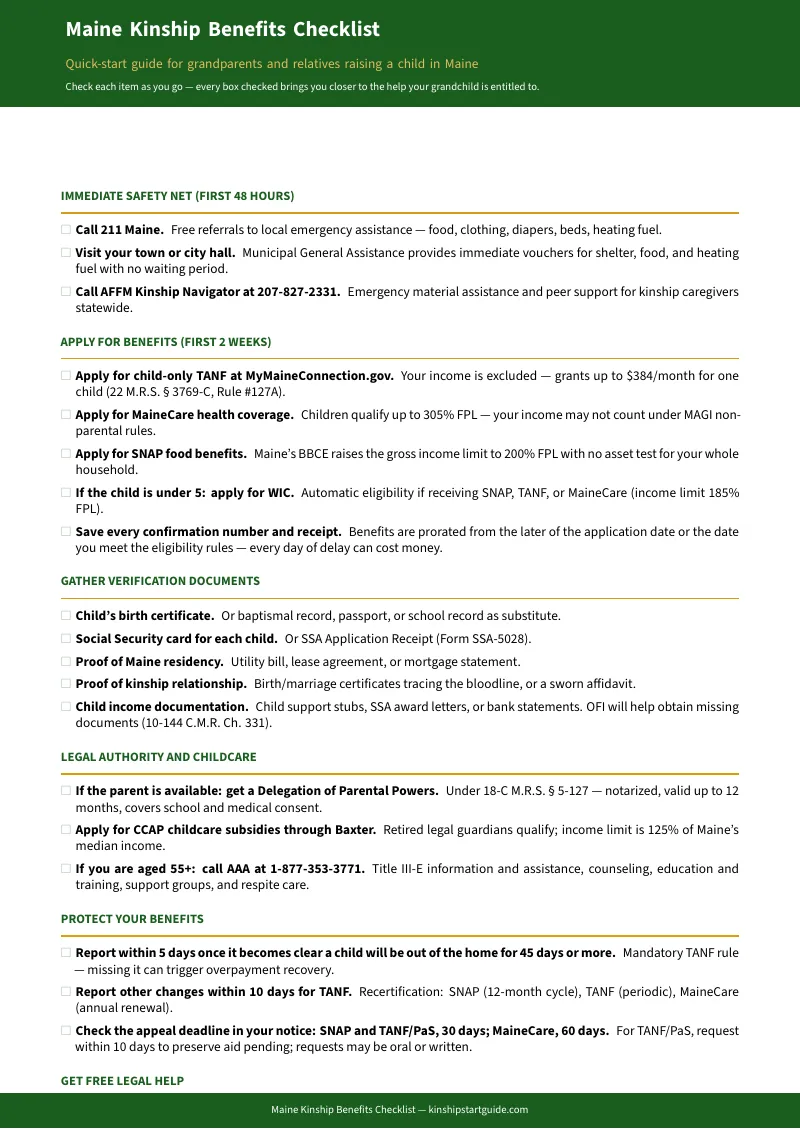
The download includes the complete 52-page guide, a quick-start checklist (also available as a free standalone download), an arrangement-to-benefit matrix mapping your legal situation to the programmes you can apply for, a master document-gathering checklist organised by programme, a caseworker communication log, a navigator call preparation sheet, and a recertification and appeal deadline tracker — ready to print, fill in, and bring to your regional OFI office.
Full refund, no time limit. If the guide doesn't help, email [email protected] and we'll send your money back.
Get the Maine Kinship Benefits Navigator →
Frequently Asked Questions
What if the rules change after I buy?
We update the guide when the rules change. Email us any time, even years later, and we'll send you the current edition free.