The school wants a court order. The clinic wants custody papers. Iowa law requires neither for most of what you need — but only if you follow the right path.
You took in a child — maybe your grandchild, a niece, a nephew, or the child of a close friend who can't be there right now. The reasons are painful, and you didn't have time to prepare. What you had was a phone call and an overnight bag.
Now the child needs to start school. Needs a doctor's appointment. Needs a dentist. And every front desk you walk up to asks for paperwork that sounds like it requires a lawyer, a judge, or a parent who isn't available.
Here's what most Iowa caregivers don't realise: Iowa has an Authority Navigation System built into its statutes and education rules that lets you handle school enrollment and medical care without a court hearing — but the system has a structural gap that trips up nearly everyone. Iowa has no standalone caregiver authorization affidavit. Unlike California or Florida, there is no single form a relative can sign on their own that compels a school or clinic to recognise their authority. Everything depends on knowing which instrument fits your situation — an informal parental authorization letter, school residency enrollment, emergency care provisions, or a Chapter 232D guardianship petition — and using it correctly.
What the Authority Navigation System Covers
The guide walks you through every consent instrument and enrollment pathway Iowa recognises for a caregiver without a court order, and shows you exactly when to use each one:
- Iowa's authority spectrum — the five mechanisms Iowa law recognises for non-parental authority, from an informal parental letter through a Chapter 232D guardianship order, laid out in a comparison table with who can use each, the duration, and the scope of authority it grants
- Rule 8.39 Form 2 — and why it is not what you think — the Affidavit of Parental Consent is a court exhibit, not a standalone document. The guide explains what it actually does, where it fits in the guardianship petition process, and why presenting it directly to a school or clinic wastes your time
- School enrollment and residency — how Iowa Code § 282.1 lets a child enroll in the district where they physically reside, what documents to bring, what the district cannot legally demand, immunization requirements and provisional enrollment, and the McKinney-Vento protections that bypass standard requirements entirely
- Medical and dental consent tiers — emergency care that needs no authorisation at all, routine care with a parental authorization letter (voluntarily accepted), what to do when a provider refuses, and the prescription pickup rules under HIPAA
- Mental health consent after HF 2523 — the July 2026 changes to Iowa Code § 601.1 that require parental consent for minor mental health treatment, the statutory exceptions where a minor can consent independently (substance abuse under § 125.33, emergency psychiatric holds), and privacy protections under Chapter 228
- Insurance, benefits, and cash assistance — Iowa Medicaid and Hawki enrollment for the child, the FIP child-only grant, school meal eligibility, and subsidized guardianship assistance
- The court guardianship path — when informal authority stops being enough, how to file a consensual guardianship under § 232D.203, the non-consensual path under § 232D.301, the 30-day emergency ex parte order, background checks, ongoing obligations, and ICWA requirements
When the School or Clinic Says No
School registrars across Iowa routinely demand court-ordered guardianship decrees before they will enroll a child. Pediatric offices refuse to see a child without "custody documentation" that no statute requires for enrollment. These refusals aren't malicious — they come from risk-averse institutional training and unfamiliarity with Iowa's residency enrollment rules. But they stand between a child and the care that child needs right now.
The guide includes step-by-step escalation procedures — citing the exact Iowa Code sections, Iowa Administrative Code Chapter 33 provisions, and Iowa Department of Education residency guidance — that you can use when a reluctant registrar or clinic manager insists on documentation the law does not require. The worksheets give you a written record of every conversation, every refusal, and every document you presented.
The Gap That Catches Everyone
For civilian families in Iowa — no military deployment, no existing court order — there is nothing between an informal parental letter and a full court guardianship. Iowa Code Chapter 633B financial powers of attorney deal only with property and money. They grant no authority over a child's healthcare, education, or person. This means the informal letter is your starting point when a parent is cooperative, and a Chapter 232D petition is your path when a parent is absent, incarcerated, or cannot be found.
The guide maps this gap clearly, so you know exactly where you stand and what your options are — instead of spending weeks trying to make a document work that Iowa law does not recognise.
The Side-by-Side Decision Table
Should you use an informal authorization letter, a school residency enrollment, or a Chapter 232D guardianship petition? The guide includes a comparison table that lays out the authority each instrument grants, who needs to sign, whether court involvement is required, how long it lasts, and when the simpler option stops being enough. Most caregivers discover they can handle school and routine medical care without the courthouse. Some learn they need the court sooner than they thought. Either way, you stop guessing.
Who This Is For
- A grandparent, aunt, uncle, or older sibling who has taken in a child and needs to get that child into school and to the doctor — this week
- A caregiver who tried to enrol a child and was turned away because they didn't have a court order — and wants to know whether that refusal was correct
- A relative who has a cooperative parent available to sign paperwork and wants to know exactly which documents Iowa recognises and how to execute them properly
- A caregiver dealing with an absent, incarcerated, or uncooperative parent who needs to understand the non-consent enrollment and court guardianship paths
- A family helper or adult child buying this on behalf of an older relative who needs clear, step-by-step instructions
Why Not Free Resources?
Iowa HHS Kinship Navigator Services are free, Iowa Legal Aid provides legal representation and advice, and the Senior Legal Hotline serves Iowans aged 60 and older. The guide links directly to all of them. It doesn't replace any of that — it bridges the gap between knowing those resources exist and knowing what to do when you're standing at a school registration desk right now.
Free resources tell you that school districts cannot demand guardianship for enrollment. They don't give you the School Enrollment Checklist with the specific documents your district expects. They don't include the Clinic Intake Preparation Worksheet that organises everything a provider needs at the first appointment. They don't explain the difference between Rule 8.39 Form 2 (a court exhibit) and a parental authorization letter (an informal delegation) — a distinction that wastes weeks when caregivers present the wrong document. And they don't walk you through the court guardianship path, mental health consent after HF 2523, insurance and benefits, the documentation binder system, or the scenario walkthroughs showing how the rules apply when a parent is in treatment, in prison, has died, or cannot be found.
What You Get
- The complete guide — 13 chapters covering Iowa's authority spectrum, Rule 8.39 Form 2, school enrollment and residency, special education and FERPA, medical and dental consent tiers, mental health consent after HF 2523, insurance and benefits (Medicaid, Hawki, FIP, school meals, subsidized guardianship), everyday authority (driver's permits, childcare, travel), the documentation binder system, the court guardianship path (consensual, non-consensual, emergency ex parte), ICWA, scenario walkthroughs, and the resource directory
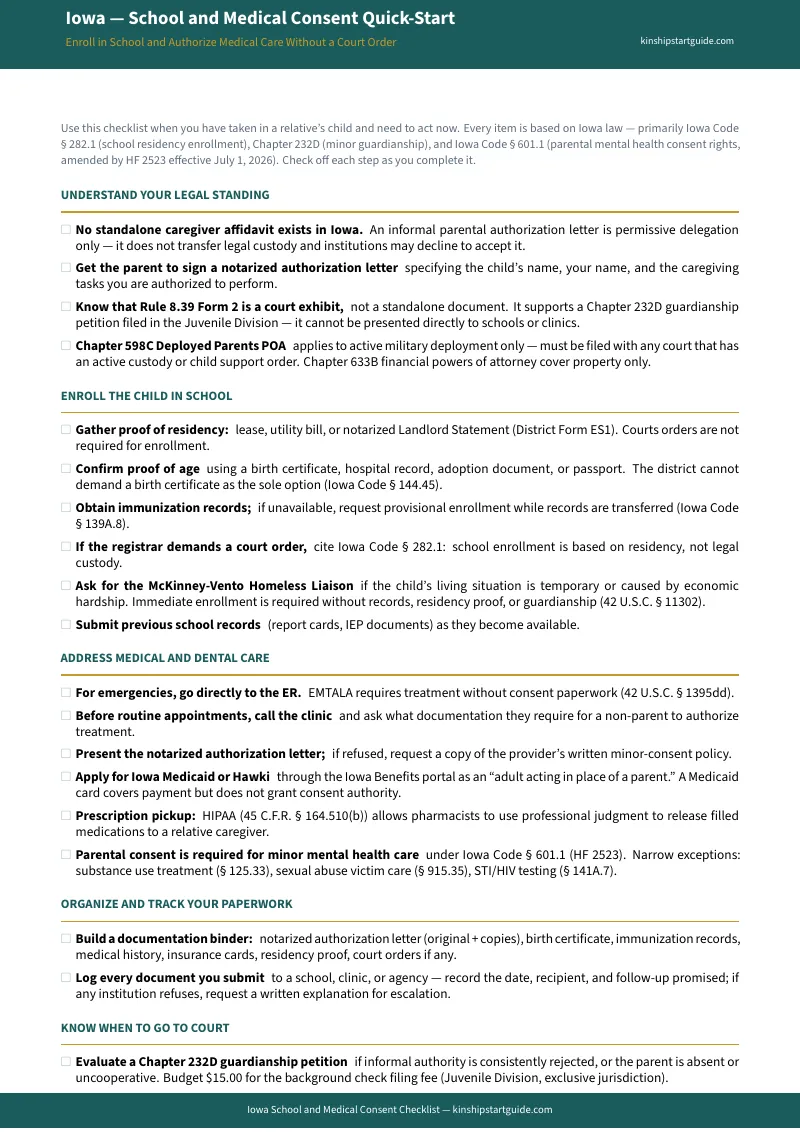
- The quick-start checklist — a printable 25-item summary of the forms, enrollment documents, and contact numbers you need in the first 72 hours
- Six standalone printable worksheets — the School Enrollment Checklist, Clinic Intake Preparation Worksheet, Authority Spectrum fridge sheet, Documentation Distribution Log, Institutional Refusal Log, and Agency Communication Log
Satisfaction Guarantee
Full refund, no time limit. If the guide doesn't help you navigate your situation, email [email protected] and we'll refund every penny — no forms, no waiting period, no questions.
A Child Shouldn't Wait for a Court Date to See a Doctor
Iowa's enrollment and consent rules exist so they don't have to. The guide shows you how to use them — every form, every enrollment step, every conversation — so the paperwork never stands between a child and the care that child needs.
Download includes the full 13-chapter guide, the 25-item quick-start checklist, and six standalone printable worksheets. Instant access after purchase.
Already have the free checklist? The full guide goes deeper — Iowa's authority spectrum explained instrument by instrument, the Rule 8.39 Form 2 clarification that stops you wasting time on the wrong document, medical consent tiers and the HF 2523 mental health changes, the court guardianship path when informal authority is not enough, benefits and insurance eligibility, and the scenario walkthroughs that turn "I think this is right" into "I know exactly what to do."
Frequently Asked Questions
What if the rules change after I buy?
We update the guide when the rules change. Email us any time, even years later, and we'll send you the current edition free.