
Your Pension Stays Out of It. The Child Gets the Cash Aid Arkansas Already Provides.
You didn't plan to raise another child. But here you are — absorbing the cost of groceries, diapers, doctor visits, school supplies, and childcare on a budget that was built for one person, not two. Arkansas has cash grants, food benefits, and full health coverage earmarked for this child, and the law says your pension and retirement savings are not part of the calculation. The problem is that nobody at the county DHS office explained that a Child-Only TEA grant ignores your income completely — and one wrong answer on the Access Arkansas portal can route your case through standard TEA rules that count every dollar you have.
The Arkansas Kinship Benefits Navigator is the independent roadmap that organises every public benefit a relative caregiver can claim for a child in Arkansas — program by program, form by form, with the exact documents to bring and the exact steps to follow so a county caseworker processes your application under the rules that protect your retirement income.
What the Guide Covers
- Child-Only TEA cash grants — the Transitional Employment Assistance pathway that excludes your pension, Social Security, SSI, and all personal assets from the child's eligibility determination. The guide explains how child-only units work, the $513 net income limit that applies only to the child's own income, the maximum monthly grant amounts by household size ($162 for one child up to $457 for eight or more), and the Access Arkansas application steps that keep your case coded as child-only instead of standard TEA
- ARKids First health coverage — two tiers of children's health coverage: ARKids A (Medicaid, Title XIX) and ARKids B (CHIP, Title XXI), with the income thresholds for each, the application process through Access Arkansas or a paper DHS-1171 form, and what happens when the child ages out or the household income changes
- DCFS Subsidized Guardianship Program — ongoing monthly payments for relatives who assume legal guardianship of a child in DCFS care, with the mandatory sequence that most caregivers learn about too late: the child must be formally placed by the Division of Children and Family Services, the relative must be licensed as a provisional relative foster home for the required period, and only then can subsidized guardianship payments begin. The guide maps the licensing requirements, the timeframe modified by Act 363 of 2023, and what the Guardianship Assistance Program (GAP) covers
- SNAP food benefits — the household composition rules that determine whether your income is counted. Unlike Child-Only TEA, SNAP requires all people who purchase and prepare food together to be included in the same household, which means a grandparent's Social Security often pushes the household over the limit. The guide explains the separate-household exception, the application strategy, and the income thresholds
- CCDF childcare vouchers — the Child Care and Development Fund subsidy program for working relative caregivers and those participating in TEA work activities, with the application process through the Office of Early Childhood and the income limits that apply
- Title III-E National Family Caregiver Support Program — respite care, supplemental services, and support group referrals available through your local Area Agency on Aging, including how to request kinship navigator services
- DHS appeals and fair hearings — what to do when a benefit is denied, reduced, or terminated, how to file Form DHS-1200 with the Office of Appeals and Hearings, the 30-calendar-day appeal window, and the critical 10-calendar-day deadline to keep benefits active while your appeal is processed
- Informal care vs. DCFS placement — which benefits require a court order, which ones don't, how an informal arrangement differs from a DCFS-supervised placement for benefit eligibility purposes, and when contacting DCFS is necessary versus when it introduces complications you didn't need
Who This Is For
- Grandparents on Social Security, SSI, a pension, or a fixed retirement income who are paying for a grandchild out of savings they can't replace — and who need to know that Arkansas cannot count those savings on a Child-Only TEA application
- Aunts, uncles, great-grandparents, older siblings, and other relatives who took in a child with no notice and need to find out what the child qualifies for before the next bill arrives
- Relatives caring for a child informally who were told their retirement income disqualifies the child from cash assistance — it doesn't under child-only rules, and the guide explains exactly how to apply
- Adult children or family helpers researching benefit options on behalf of an older relative raising a grandchild in Pulaski County, Benton County, Washington County, or rural Arkansas
Why Not Just Call DHS?
You absolutely should call DHS — with the guide open in front of you. County caseworkers process specific incoming applications, but they are not trained to act as holistic benefit advisors across cash aid, food, health coverage, childcare, and court-connected programs. A SNAP caseworker will not explain that a separate Child-Only TEA grant evaluates only the child's income. An intake worker who processes your TEA application as a standard household unit instead of a child-only case will count your pension, and when the math fails, you'll walk out believing the child doesn't qualify for help that was designed for exactly this situation.
The guide doesn't replace free services — it prepares you to use them without costly mistakes. Legal Aid of Arkansas handles court guardianship. Area Agencies on Aging offer kinship navigator support groups. Access Arkansas processes the applications. The guide handles the part nobody else covers: which path protects your retirement income while getting the child every dollar Arkansas already set aside for them.
Not Right for Everyone
This guide focuses on public benefit applications and financial help. It is not legal advice, and it does not cover contested custody disputes, dependency-neglect proceedings, termination of parental rights, or advice on whether to pursue guardianship in Circuit Court. If you are involved in an active court case, a legal aid attorney is the right first step. If you or the child are in immediate crisis — facing abuse, neglect, or a safety threat — call the Arkansas Child Abuse Hotline (1-800-482-5964) before anything else.
What You Get
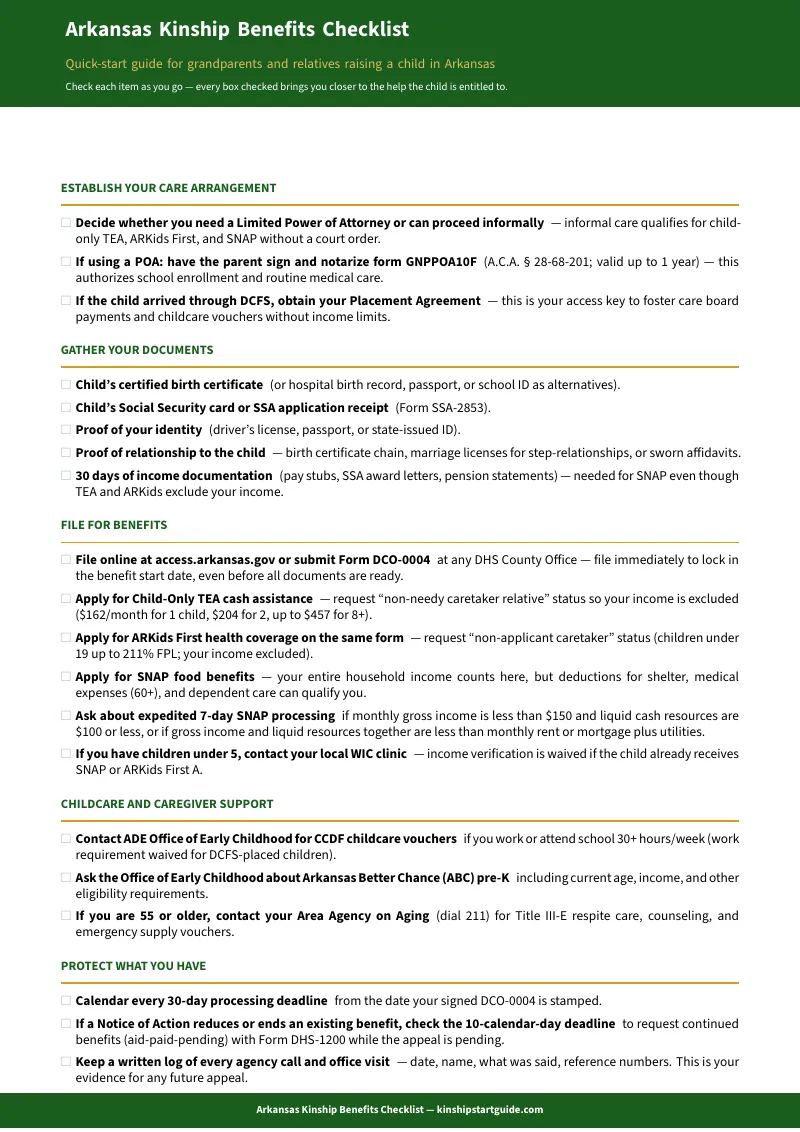
The download includes the complete guide, a quick-start checklist (also available as a free standalone download), and eight printable planning tools: a benefit eligibility worksheet, a master document binder checklist for every agency visit, a benefits-by-arrangement comparison showing what's available under informal care versus guardianship versus DCFS placement, an application and renewal tracker, an appeal deadline tracker for Form DHS-1200 with the 10-day and 30-day windows, an agency communication log, a monthly budget planner, and a verified Arkansas agency contact directory — ready to print, fill in, and bring to your appointment.
Full refund, no time limit. If the guide doesn't help, email [email protected] and we'll send your money back.
Get the Arkansas Kinship Benefits Navigator →
Frequently Asked Questions
What if the rules change after I buy?
We update the guide when the rules change. Email us any time, even years later, and we'll send you the current edition free.