
Your Retirement Stays Out of It. The Child Gets the Help Alaska Already Provides.
You didn't plan to raise another child. But here you are — stretching a pension or Social Security check across a second round of groceries, winter coats, doctor visits, and school supplies in one of the most expensive states in the country. Alaska has cash grants, food benefits, and full health coverage specifically for this child, and the law says your income doesn't enter the calculation. The problem is that the Division of Public Assistance won't tell you that unless you already know which form to ask for.
The Alaska Kinship Benefits Navigator is the independent roadmap that organises every public benefit a relative caregiver can claim for a child in Alaska — program by program, form by form, with the exact documents to bring and the steps to take when an intake worker hands you the wrong application.
What the Guide Covers
- Child-only ATAP cash grants — the application pathway that treats the child as a separate assistance unit and excludes every dollar of the caregiver's pension, Social Security, wages, and savings from the eligibility determination. The guide walks you through the child-only rules under 7 AAC 45.335 and shows you how to avoid the full-household form that pulls your finances into the calculation
- Denali KidCare health coverage — comprehensive Medicaid for children, with income limits at 203% of the federal poverty level for uninsured children (177% for children with existing insurance), plus the 5% disregard. The guide explains how to apply through the Alaska Connect portal or Form GEN-50C and what to do when parental income records are unavailable
- SNAP food benefits with Alaska's rural adjustments — how to navigate the household-unit rules for multi-generational homes, the separate-purchase strategy for relatives who keep their food budget apart from the child's, and Alaska's three geographic cost tiers (Urban, Rural 1, Rural 2) that increase benefit amounts in high-cost areas
- CCAP childcare subsidies — the PASS II pathway for families transitioning from ATAP and the PASS III pathway for families who haven't received ATAP, administered by regional entities like Alaska Family Services. The guide covers the application process and employment or training requirements
- OCS guardianship assistance — monthly payments for relatives who become court-appointed guardians of children previously in OCS custody. The guide explains the eligibility requirements, including the hard-to-place finding and the rule that the subsidy agreement must be approved before the guardianship is finalised
- Emergency relief for unlicensed relatives — the $500-per-child monthly payment available for up to two months when OCS places a child with an unlicensed relative, plus the Special Needs Hotline for emergency beds, clothing, and supplies
- Native Family Assistance Programs — the parallel tribal TANF programs administered by regional consortia such as AVCP, Tanana Chiefs Conference, Bristol Bay Native Association, and Maniilaq Association, with independent cash assistance rules and local village navigators
- Fair Hearing requests and recertification tracking — what to do when a benefit is denied or miscalculated, how to request an administrative Fair Hearing, and a calendar for tracking 6-month and 12-month recertification deadlines so benefits don't lapse
Who This Is For
- Grandparents on Social Security, a pension, or SSI who are paying for a grandchild out of savings they cannot replace — and who need to know that DPA cannot touch those savings on a child-only application
- Aunts, uncles, older siblings, and family friends who took in a child with no warning and need to know which benefits the child can receive before the next bill comes due
- Relatives in rural or off-road communities who need clear instructions for submitting applications through the Alaska Connect portal, by mail, or through a village navigator at their regional tribal consortium
- Relatives caring for a child informally who were told they need a court guardianship order to get help — they don't for the core programs, and the guide shows which ones are available without any court filing
- Adult children or advocates researching options on behalf of an older relative caregiver who needs clear, programme-by-programme instructions
Why Not Just Call the Division of Public Assistance?
You absolutely should call — with the guide open in front of you. Caseworkers process applications, but they are not required to tell you that a simpler pathway exists for non-needy relative caregivers. The child-only ATAP rules let you file an application that keeps your entire financial life out of the eligibility test, but if you don't specifically request that pathway, you may be handed the standard household application by default. One wrong form can pull your pension into the calculation and trigger a denial that takes weeks to overturn through a Fair Hearing.
The guide doesn't replace free services — it prepares you to use them without costly mistakes. Legal aid handles court guardianship. The Alaska Connect portal handles the online application. VOA Alaska Kinship Care handles case management and emergency relief. The guide handles the part nobody else covers: which path protects your retirement income while getting the child every benefit Alaska law already provides.
Not Right for Everyone
This guide focuses on public benefit applications and financial help. It is not legal advice, and it does not cover contested custody disputes, juvenile dependency proceedings, or whether to pursue guardianship. If you are involved in an active court case, your assigned caseworker or a legal aid attorney at Alaska Legal Services Corporation is the right first step. If you or the child are in immediate crisis — facing homelessness or a safety threat — call 211 or the OCS Centralized Intake Line before anything else.
What You Get
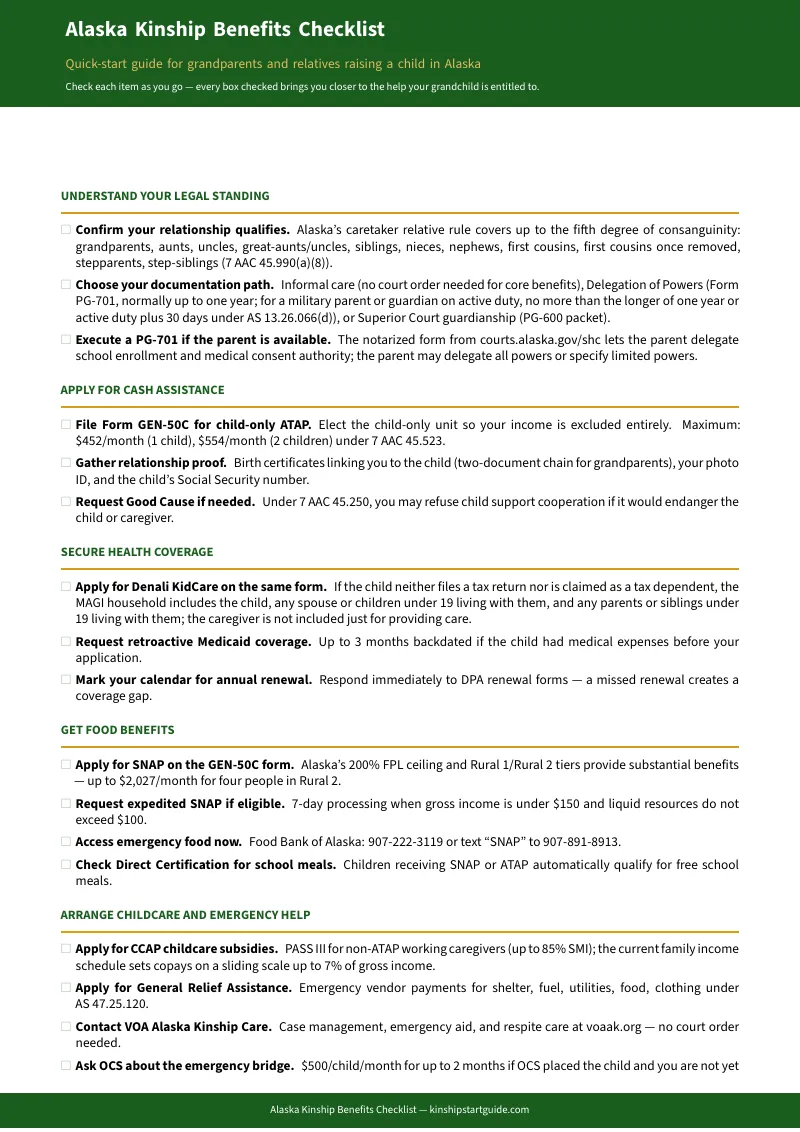
The download includes the complete guide, a quick-start checklist (also available as a free standalone download), a benefits eligibility screener, a caseworker communication log, a document-gathering checklist organised by programme, a Fair Hearing tracker, and a regional contact directory covering DPA offices, tribal consortium navigators, VOA Alaska, and Alaska Legal Services Corporation — ready to print, fill in, and bring to your agency appointment.
Full refund, no time limit. If the guide doesn't help, email [email protected] and we'll send your money back.
Get the Alaska Kinship Benefits Navigator →
Frequently Asked Questions
What if the rules change after I buy?
We update the guide when the rules change. Email us any time, even years later, and we'll send you the current edition free.