
The school wants proof. The GP wants authority. The social worker said "get an order." Nobody told you what that means.
A child arrived at your door — your grandchild, your niece, your nephew — because a parent couldn't cope. Addiction, prison, illness, death: the reasons are painful and they happened fast. Now you're raising this child, but the primary school won't accept your signature on a permission slip. The GP surgery says they can't register the child without formal consent authority. The benefits office wants a court order before they'll pay anything into your account. A social worker mentioned a Section 11 order, or maybe a kinship care order, but the conversation ended before anyone explained which court handles it, what forms you need, or how much it costs.
Meanwhile, you've been told the child might need to leave the Children's Hearing system, that there's money the local authority could pay once you have the right order, and that you should "speak to a solicitor" — but nobody has mentioned that many family law solicitors in Scotland no longer accept legal aid cases.
The Kinship Court Navigator: every court step, council track and fee exemption in one printable folder
The Kinship Care Orders in Scotland process guide gathers everything the Scottish Government, the Sheriff Court service, the legal aid board, and the kinship charities explain across dozens of separate web pages and policy documents into a single step-by-step household binder. It is built around what we call the Kinship Court Navigator — a structured set of printable worksheets, trackers, and checklists that organise every stage of the application from working out which order you need, through lodging the Initial Writ in the Sheriff Court, to exercising your new parental rights with schools, doctors, and the passport office.
This is not legal advice, and it is not a government publication. It is an independent process guide written in plain English for grandparents and relatives who are navigating the Sheriff Court process — whether you're acting without a solicitor or using the guide as an organiser alongside legal representation.
What's inside
- Dual-track roadmap — the court application and the council support application run on separate tracks, and most carers don't realise until one stalls the other; the roadmap lays out both timelines side by side so you can see which steps depend on which and avoid the weeks-long delays that come from doing them in the wrong order
- Initial Writ explained — what the document needs to contain, who you name as a defender, where to lodge it, and what happens after you serve it on the other parties, explained for someone who has never been inside a Sheriff Court
- Court fee and legal cost decision tree — the Sheriff Court fee is currently £185, but you may owe nothing; the decision tree maps SCTS fee exemptions (Form C18) alongside local authority Part 13 legal cost assistance so you can see whether the court, the council, or both should be covering your costs
- Legal aid reality check — SLAB eligibility thresholds, how to apply, and what to do when you can't find a solicitor who takes legal aid cases, including how to ask the Law Society of Scotland for help locating one
- Social work assessment preparation worksheets — structured sheets for organising your household budget, the child's daily routine, their schooling and health needs, your care history, and your support network, so you walk into the social worker's visit with clear answers instead of scrambling for paperwork
- Hearing preparation guide — what happens at a Child Welfare Hearing and a proof hearing, what the sheriff is looking for, what interim orders can protect the child in the meantime, and how to prepare if you're representing yourself
- Post-order authority checklist — once the order is made, you need to register your new parental rights and responsibilities with the school, the GP surgery, the benefits office, and HM Passport Office; the checklist covers every notification step so nothing falls through the cracks
- Application checklist — a master tracking sheet for every identity document, care history record, financial document, and form you need to assemble before filing
- Free helpline directory — Kinship Care Advice Service Scotland (KCASS, 0808 800 0006), Scottish Child Law Centre (0131 667 6333), Clan Childlaw (0808 129 0522), Citizens Advice Scotland, and the Law Society of Scotland solicitor finder
Who this is for
- Grandparents who need lasting legal authority. A parent can't care for the child because of addiction, imprisonment, illness, or death. The child lives with you. You need an order that gives you parental rights and responsibilities without adopting — and you need the schools, doctors, and benefits offices to recognise that authority.
- Relatives blocked by paperwork walls. The school, GP, or benefits office wants proof of your authority. You've been managing informally, but informal care isn't enough any more and you need to understand which court order fits your situation in Scotland.
- Carers navigating the Children's Hearing system. The child is currently looked after, and a social worker has suggested a Section 11 order as a route to permanence and local authority financial support. You want to understand what the court process involves and what kinship care assistance you could unlock.
- Relatives who can't find a solicitor. Legal aid solicitors in your area aren't taking family cases. You need to understand the Sheriff Court process well enough to act as a party litigant — or at least to prepare thoroughly before instructing someone.
- Helpers researching on someone's behalf. You're the adult child, niece, or family friend doing the online research because a grandparent is too overwhelmed or not confident navigating government websites. You need clear, printable materials you can hand over.
Why not just use the free information?
The free information is excellent — and the guide links to all of it. The Scottish Government publishes Part 13 guidance on kinship care assistance. mygov.scot has overview pages on kinship carers' rights. The Scottish Courts and Tribunals Service publishes fee exemption forms. KCASS, the Scottish Child Law Centre, and Clan Childlaw all run free helplines.
What none of them do is put all of those pieces into a single, structured, printable sequence that a stressed relative can follow from start to finish without toggling between the government guidance (written for social workers, not grandparents), the court service website (which publishes fee schedules but doesn't explain how to prepare an Initial Writ), and five charity helplines that each cover a different slice of the process. The guide does that assembly work for you — and adds the preparation worksheets, dual-track roadmap, and decision trees that no free resource currently offers in a printable format.
If you have a social worker who is walking you through every step, or a solicitor who is handling the court paperwork, the free resources may be everything you need. The guide is for people who are organising the process themselves.
Your purchase is protected
If the guide isn't useful to you, email [email protected] for a full refund, no time limit. No forms, no questions, no hassle.
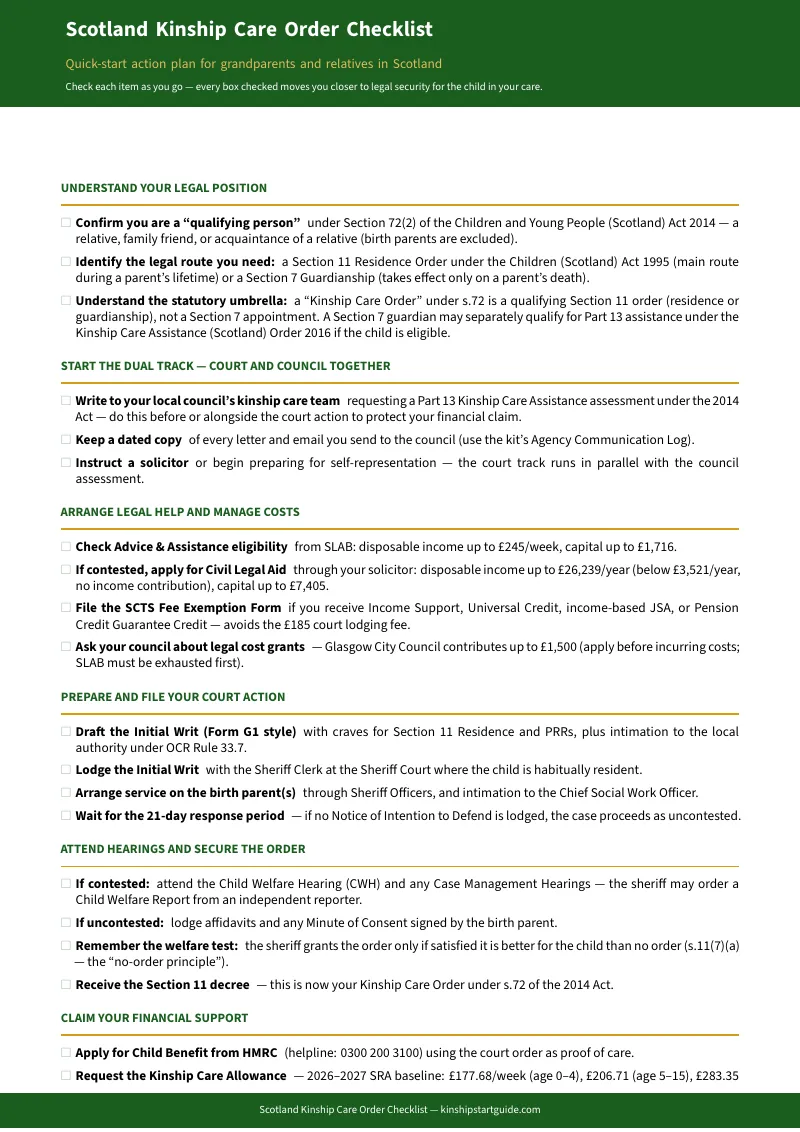
The free checklist is available immediately with no purchase required — it covers the main milestones and links to every free helpline and official resource.
Get the full Kinship Court Navigator — the complete process guide, worksheets, trackers, and decision trees — and start organising the application tonight.
Frequently Asked Questions
What if the rules change after I buy?
We update the guide when the rules change. Email us any time, even years later, and we'll send you the current edition free.