The school wants proof. The GP wants a letter. The benefits office wants an order. You just want someone to explain the process.
You stepped in when a child needed you — and now every official body wants paperwork you've never heard of. Form C100, Form C2, MIAMs, Cafcass, the FHDRA. It feels like the system was built for solicitors, not grandparents sitting at a kitchen table trying to do the right thing.
Free information exists, but it's scattered across government portals, charity factsheets and solicitor blogs that each cover one piece of the puzzle. Stitching it together yourself means hours of research and the constant worry that you've missed a step or found an outdated form.
The Family Court Filing System — every step, every form, one document
This guide is an independent process manual that puts the entire child arrangements order application into a single, printable sequence. It is not legal advice, it does not predict what the court will decide, and it has no connection to HMCTS or any government body. What it does is show you exactly what happens at each stage — from deciding whether you need the court's permission, right through to using the order at schools, GPs and benefits offices once you have it.
Every chapter follows the court's own timeline, so you read the next section when the next step arrives.
What's inside
- Permission decision map — a clear flowchart showing whether you can apply directly or need to file Form C2 for leave, based on the three automatic-entitlement exceptions in the Children Act 1989. Saves you from filing the wrong combination of forms and paying avoidable fees.
- Form C100 permission walkthrough — if you need the court's leave, the guide shows how to include your permission request on Form C100 itself so one application and one fee covers everything, instead of filing a separate Form C2.
- MIAM exemption evidence checklist — a structured list of the statutory exemptions (domestic abuse, child protection involvement, urgency, disability, imprisonment) with the exact evidence each requires, so you can prove an exemption to the mediator rather than paying for a session you may not need.
- EX160 fee-help eligibility overview — walks you through the income-based and benefit-based tests for Help with Fees so you know before you pay whether the £270 court fee might be waived or reduced.
- Cafcass call preparation log — a structured template for organising the facts Cafcass asks about during the initial safeguarding telephone call, so you can present the child's situation clearly instead of scrambling to remember details under pressure.
- FHDRA hearing preparation guide — explains what happens at the First Hearing Dispute Resolution Appointment, what the judge expects, and how to organise your court binder so every document is findable when you need it.
- Post-order administrative binder — ready-to-use templates for presenting your child arrangements order to schools, GP surgeries and the DWP, covering enrolment, medical consent, Child Benefit and Universal Credit.
- Wales-specific chapter — covers Cafcass Cymru procedures, bilingual form options and Welsh-language court rights so you're not left guessing where the process differs.
- Financial support directory — explains local authority discretionary payments, the Kinship Zones pilot (April 2026, seven council areas in England), Child Benefit, Universal Credit and Guardian's Allowance — who qualifies, how to claim, and which payments are restricted to certain areas.
Who this guide is for
- Grandparents, aunts, uncles, older siblings and family friends in England or Wales who are caring for a child and need a formal legal arrangement
- Relatives who have been asked by a school, GP or benefits office to prove their authority over a child
- Kinship carers handling the application without a solicitor — whether by choice or because they cannot afford one
- Family members supporting a relative through the process (filling in forms, organising paperwork, researching the steps)
Who this guide is not for
- Immediate safeguarding emergencies — if a child is in danger right now, call the police on 999 or your local authority's emergency duty team. This guide covers scheduled court applications, not emergency protection orders.
- Public law care proceedings — if children's services have started care proceedings under Section 31, you need specialist legal advice (usually covered by legal aid). The guide covers private law applications by relatives, not local authority proceedings.
- Scotland, Northern Ireland or international cases — the law in this guide applies to England and Wales only. Different rules apply elsewhere.
Why not free resources?
GOV.UK gives you the blank forms. Kinship and Advicenow publish helpful factsheets. The Family Rights Group runs an advice line. All of these are genuinely useful, and the guide links to every one of them.
What none of them does is put the whole process in order. The government portal has the C100 form but no guidance on the narrative sections. Charity factsheets explain permission but not how to include a permission request on Form C100 itself. Advice sites cover MIAMs without an evidence checklist for exemptions. You end up with a dozen browser tabs open and no clear idea of what comes next.
The guide puts the forms, deadlines, exemptions, fee-help routes, Cafcass preparation and hearing structure into one document, in the order you'll need them. It's the difference between having all the puzzle pieces and having the completed picture.
Satisfaction guarantee
Full refund, no time limit. If the guide isn't what you needed, email [email protected] and you'll get your money back — no form, no explanation required.
The guide costs less than fifteen minutes of a solicitor's time. It won't replace a solicitor for complex disputes, but it will show you every administrative step so you know what's coming, what to prepare, and where to find help if you need it.
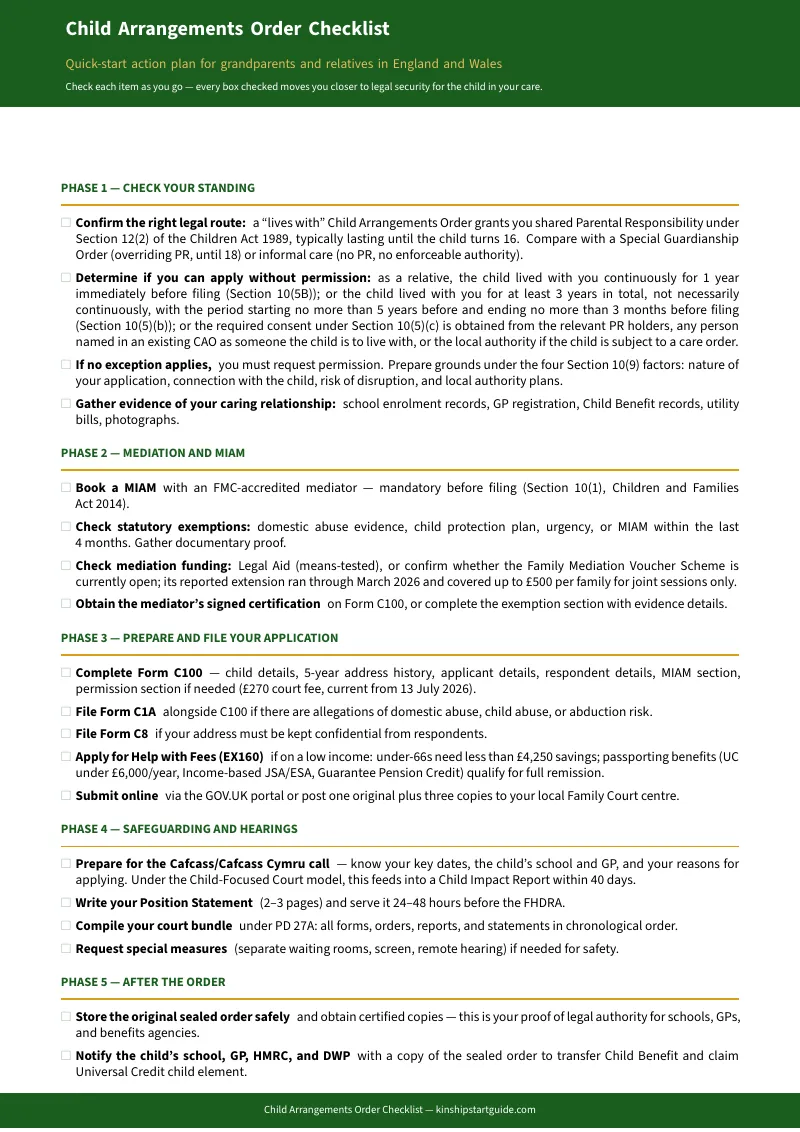
Already downloaded the free checklist? The full guide picks up where the checklist stops — from a one-page overview to a 51-page process guide plus 9 standalone printable worksheets covering every stage from permission to benefits claims.
Frequently Asked Questions
What if the rules change after I buy?
We update the guide when the rules change. Email us any time, even years later, and we'll send you the current edition free.