Three Agencies Hold the Money. One Wrong Decision Locks It Out.
You didn't plan to raise another child on a pension. But the child is here, the groceries doubled, and the school keeps sending notes about fees you hadn't budgeted for. British Columbia has real money for this child — the Extended Family Program pays up to or more each month in tax-exempt, pension-neutral maintenance — and it sits across three agencies that don't share a single application form. The Ministry of Children and Family Development runs the provincial payments. The Canada Revenue Agency handles the federal and provincial tax benefits. The Ministry of Social Development manages legacy programs. Nobody at any of these offices hands you a map of everything the child qualifies for.
Worse, the type of care arrangement you're in right now — informal, Extended Family Program, court order, or private Family Law Act guardianship — determines which payments the child can access. A well-meaning lawyer who recommends private FLA guardianship as the "simpler" route may not mention that this path permanently excludes the child from $1,549.20 to $1,726.33 per month in MCFD out-of-care maintenance. That's over $18,000 a year lost to a form you didn't need to sign.
The BC Kinship Financial Help Navigator is the independent preparation guide that organises every payment, benefit, and allowance a relative raising a child in British Columbia can claim — programme by programme, form by form, with the documents to gather before every appointment, the screening checks you need to pass, and the care-arrangement comparison that shows exactly what each pathway opens and closes financially.
What the Guide Covers
- Extended Family Program maintenance — the primary provincial payment for relatives raising children under a voluntary CFCSA Section 8 agreement. $1,549.20 per month for children aged 0–11 and $1,726.33 for ages 12–19, fully tax-exempt and pension-neutral. The guide walks you through the four-step EFP assessment pipeline — preliminary assessment, CRRA criminal record check and Prior Contact Check, Safe Home Assessment, and the tri-party written plan — so you know what to expect at each stage
- Court-ordered out-of-care placements — interim custody (CFCSA s. 35(2)(d)), temporary custody (s. 41(1)(b)), and permanent transfer of custody (s. 54.01, s. 54.1). Same maintenance rates as EFP, different legal authority. Permanent transfer does not cut off the money — this is one of the most common misunderstandings in BC kinship care
- Canada Child Benefit and BC Family Benefit transfer — how to become the primary caregiver for CCB and BCFB using CRA Form RC66, the supporting documents the CRA accepts when a biological parent won't cooperate, the income thresholds and maximum payment amounts, and the single-parent supplement for sole caregivers
- The Family Law Act guardianship trap — why a private FLA guardianship order makes you the legal guardian but excludes the child from all MCFD out-of-care maintenance. The guide explains the financial consequences before you sign anything
- Enhanced Out-of-Care supports — additional funding for children with complex developmental, mental health, or trauma-related needs, from Team Leader authorizations up to $1,000 per year to Director-level approvals for specialized in-home support or respite funding
- Disability supports — the Disability Tax Credit, Child Disability Benefit, and BC Children and Youth with Support Needs programme, including the transition to the new provincial disability supplement
- Childcare assistance — the Affordable Child Care Benefit through the My Family Services Portal and the Child Care Fee Reduction Initiative that applies regardless of income
- Legacy CIHR programme — rules for grandfathered recipients enrolled before March 31, 2010, and the transition pathway to current programmes for caregivers who find dead links searching for CIHR
- Indigenous kinship supports — how Delegated Aboriginal Agencies administer the same financial rates with culturally specific assessment processes and community involvement protocols
Who This Is For
- Grandparents on a fixed income — OAS, GIS, CPP, a private pension — who are paying for a grandchild's food, clothes, school costs, and childcare out of savings they did not plan to spend
- Aunts, uncles, older siblings, and family friends who took in a child with little notice and need to find out what the child is entitled to before the next round of bills
- Relatives in informal care who have been told they need a court order before they can get financial help — in many cases, an EFP agreement is a better and faster first step
- Adult children, supportive relatives, or community social workers researching benefit options on behalf of an elderly family member raising a grandchild
- Indigenous kinship caregivers working with a Delegated Aboriginal Agency who need to understand how EFP and federal benefits interact with agency-specific processes
Why Not Just Call MCFD?
You absolutely should call — with the guide open in front of you. MCFD social workers handle large caseloads and don't always explain the full financial picture. They won't tell you how the Canada Child Benefit interacts with your EFP maintenance, or that the BC Family Benefit is calculated and paid automatically alongside the CCB, or that the child might also qualify for disability supplements. They handle the provincial side; the federal side is a separate phone call to a separate agency with separate forms.
Community resources are invaluable but fragmented. The Parent Support Services Society of BC runs the Kinship Care Help Line (1-855-474-9777) and offers peer support, but they don't provide application toolkits. Legal Aid BC explains the law but doesn't give you tracking logs. The CRA website hosts Form RC66 but says nothing about what to do when a biological parent disputes the transfer. BC government pages describe the Extended Family Program but omit the tax implications and don't mention the CIHR program that older caregivers may still be searching for. The guide puts these threads together in one place so you know what to ask for, what forms to bring, and what to do when something goes wrong.
Not Right for Everyone
This guide covers financial benefit applications and administrative preparation. It is not legal advice, and it does not cover the merits of any custody dispute, litigation strategy, or whether you should pursue guardianship. If you need guidance on BC's guardianship or custody process, the British Columbia Guardianship and Custody Process Guide covers the court forms, fees, and steps separately. If you or the child are in immediate danger, call 1-800-663-9122 (BC's Helpline for Children) before anything else.
What You Get
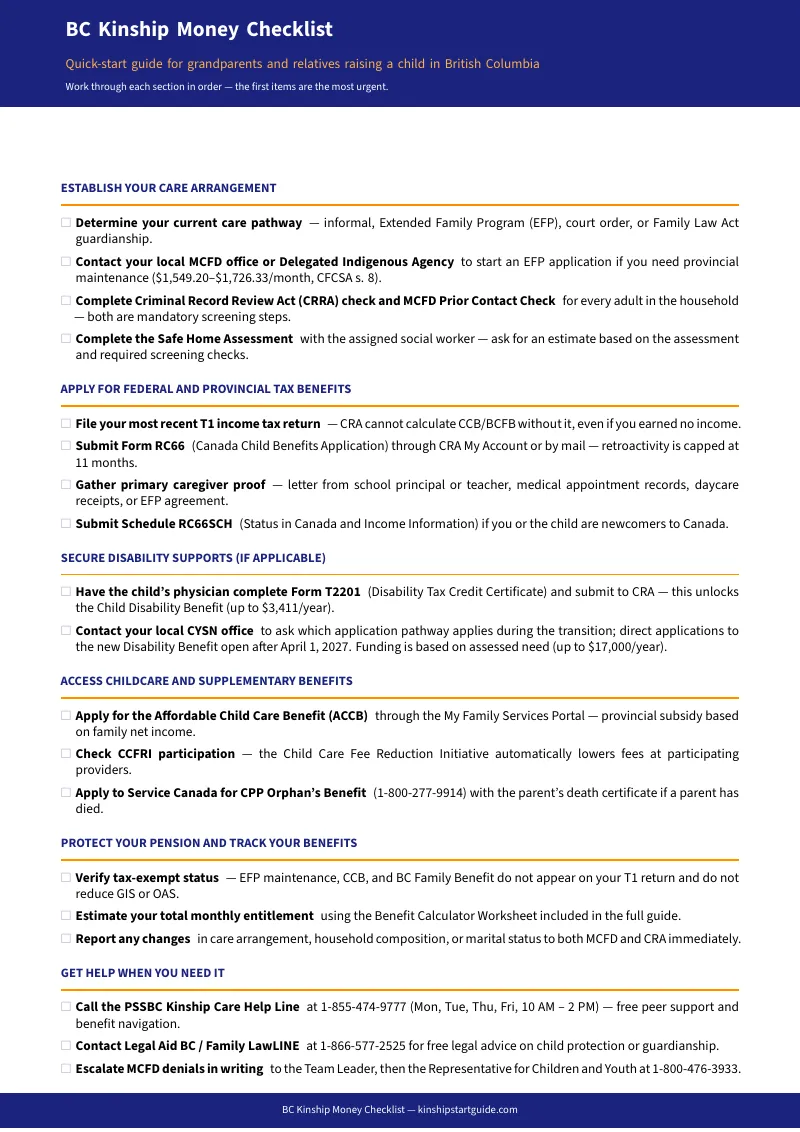
The download includes the complete guide covering every programme, rate, and application process, a quick-start checklist (also available as a free standalone download), and seven printable worksheets — a care-arrangement comparison sheet, a benefit calculator worksheet, a document-gathering checklist, a CRA benefit transfer checklist, an agency communication log, an application tracking log, and an escalation letter template — separate PDFs you can keep in a binder alongside the child's school and medical records.
Full refund, no time limit. If the guide doesn't help, email [email protected] and we'll send your money back.
Get the BC Kinship Financial Help Navigator →
Frequently Asked Questions
What if the rules change after I buy?
We update the guide when the rules change. Email us any time, even years later, and we'll send you the current edition free.