You're raising a child you didn't plan for, and nobody told you the state and federal systems run on completely separate rules
A grandchild arrived at your door last week — or a niece, or a great-nephew. The parent is in crisis, and the child is living with you now. You've already bought shoes, school shirts, bedding and a week's worth of groceries, all from a pension that was barely covering one person. Someone mentioned DCP payments, someone else mentioned Centrelink, and a neighbour told you to call Grandcarers SA. What nobody explained is that the Department for Child Protection's Carer Support Payments are only for approved carers under statutory court orders — and that informal carers like you are locked out of every state payment entirely.
The financial help available to a kinship carer in South Australia comes from two separate systems that do not talk to each other. The federal one — Services Australia, which runs Centrelink — pays Family Tax Benefit, Child Care Subsidy and a handful of other entitlements to anyone who can prove primary care of a child, regardless of court orders. The state one — DCP, the Department for Education, SA Health and DHS — operates its own payments, concessions and enrolment rules, each with its own eligibility threshold. Apply to DCP first when your arrangement is informal and you waste weeks chasing a payment you were never eligible for. Call the general Centrelink line without the right documents and you're back at the end of the queue.
The SA Carer Navigation System: five agencies, one guide, no confusion
The Support for Grandparents and Kinship Carers in South Australia guide takes the information scattered across hundreds of separate Services Australia, DCP, DHS, Department for Education and SA Health pages and puts it into a single step-by-step reference. At its core is the SA Carer Navigation System — a care-arrangement decision tree that shows you exactly which payments each legal status unlocks, whether they come from Centrelink or from DCP, and what documents you need for each, so you never spend another fortnight filling in forms at the wrong agency or missing a payment the child was entitled to from the start.
This is not benefits advice, and it is not a government publication. It is an independent guide written in plain English for grandparents and relatives who need to find every payment and service the child qualifies for, understand how the two systems interact, and get the applications right the first time.
What's inside
- Care-arrangement decision tree — a printable reference showing what informal carers, those with federal parenting orders, statutory guardianship (Chief Executive) placements, and Long Term Guardians (Specified Person) can each claim, from which agency, and what changes when your status changes
- DCP Carer Support Payments explained — fortnightly base rates by age bracket, Special Needs Loadings (Levels 1 through 4), incidental payment requests for school camps and therapeutic costs, start-up grants, and the post-18 Supported Family-Based Care over 18 program — plus a clear explanation of the formal-versus-informal boundary so you understand exactly why DCP says no to informal carers and where the money comes from instead
- Centrelink for non-parent carers — Family Tax Benefit Parts A and B, Parenting Payment Single for principal carers under 14, Additional Child Care Subsidy (ACCS) Grandparent providing up to 100 hours of subsidised care per fortnight at up to 120% of the hourly rate cap, Double Orphan Pension, Carer Allowance and Carer Payment, the Foster Child Health Care Card, and the principal carer exemption from mutual obligation
- Proof-of-care preparation worksheet — the specific documents you need to establish non-parent care with Services Australia when you have no court order, what evidence to compile when a birth parent refuses to sign a declaration, and a tiered evidence checklist from strongest to weakest
- 1800 245 965 Adviser Line phone script — a step-by-step call preparation guide for the Grandparent, Foster and Kinship Carer Adviser Line, so you know exactly what to ask and what to have in front of you, turning a frustrating call into an approved claim
- School enrolment without a court order — how to enrol a child in a South Australian school as a non-parent carer, what evidence principals will accept, how to apply for School Card fee relief (Form A for government schools, Form F for non-government), and how the process differs from enrolment by a parent
- Medical consent and Medicare — how to add a child to your Medicare card or get a separate card in the child's name, and how to manage routine medical consent under the Consent to Medical Treatment and Palliative Care Act 1995 (SA) without parental signatures
- State household concessions — the Cost of Living Concession ($270.60/year), SA Energy Bill Concession, SACEDO electricity and gas discounts, water and sewerage rate concessions, and the Emergency Electricity Payment Scheme (up to $800) — all mapped by concession card type
- Aboriginal and Torres Strait Islander kinship care — the Aboriginal and Torres Strait Islander Child Placement Principle under the Children and Young People (Safety) Act 2017 (SA), how informal cultural care arrangements interact with government form requirements, and the additional support services available
- Appeals and internal review — how to challenge a rejected Centrelink decision through internal review and the Administrative Review Tribunal, with timeframes and what to prepare
- Claim and payment tracker — a fillable ledger for recording claims lodged, payments received, decision outcomes, and renewal dates across Centrelink, DCP and DHS
- SA free-help directory — direct phone numbers and hours for Grandcarers SA (08 8212 1937), the Legal Services Commission Helpline (1300 366 424), Connecting Foster and Kinship Carers SA, CARL (13 14 78), 13YARN (13 92 76), and Lifeline (13 11 14)
Who this is for
- Grandparents who just took on a grandchild. The child arrived suddenly. You're covering everything on a fixed pension. You need to know what the child qualifies for and where to apply — before you spend another fortnight paying for everything yourself.
- Relatives told "DCP can help" but turned away. You called DCP or looked up the Carer Support Payment and were told you're not eligible because your arrangement is informal. You need to know what you can claim through Centrelink and the state concessions instead.
- Informal carers navigating without a caseworker. You have no DCP placement, no assigned caseworker, and no one telling you what to do next. You need a single reference that puts every payment, concession, and application step in one place.
- Aboriginal and Torres Strait Islander families navigating kinship care. You're caring for a child through cultural and community obligations and need guidance on entitlements without engaging child protection casework or risking the child being placed with strangers.
- Helpers researching on someone's behalf. You're the adult child, niece, or family friend doing the online work because the grandparent raising the child is too exhausted to navigate government websites. You need a single document you can print and hand over.
Why not just use the free information?
The free information is good — and the guide links to all of it. Services Australia explains Family Tax Benefit. DCP publishes kinship care eligibility criteria. Grandcarers SA runs peer support groups and an intake helpline. The Department for Education publishes the School Card policy.
What none of them do is put Centrelink, DCP, DHS, Education and SA Health side by side and show you how one system affects the other, or explain clearly that informal carers are excluded from every state DCP payment and what to do instead. Family Tax Benefit is on one website. DCP allowances are on another. School Card is on a third. Medicare card changes are on a fourth. The concessions system is on a fifth. If you're on the Age Pension raising a grandchild informally, trying to work out whether you should be calling Centrelink or DCP first and what documents each one needs — good luck assembling the full picture from half a dozen government portals while you're also doing the school run, the medical appointments and the grocery shopping.
The guide does that assembly. It puts every payment, every agency interaction, and every form into one sequence, organised by your care arrangement. If a Centrelink social worker or a Legal Aid solicitor is already coordinating everything for you, the free resources are probably enough. This guide is for people doing the navigation themselves.
Your purchase is protected
If the guide isn't useful to you, email [email protected] for a full refund, no time limit. No forms, no questions, no hassle.
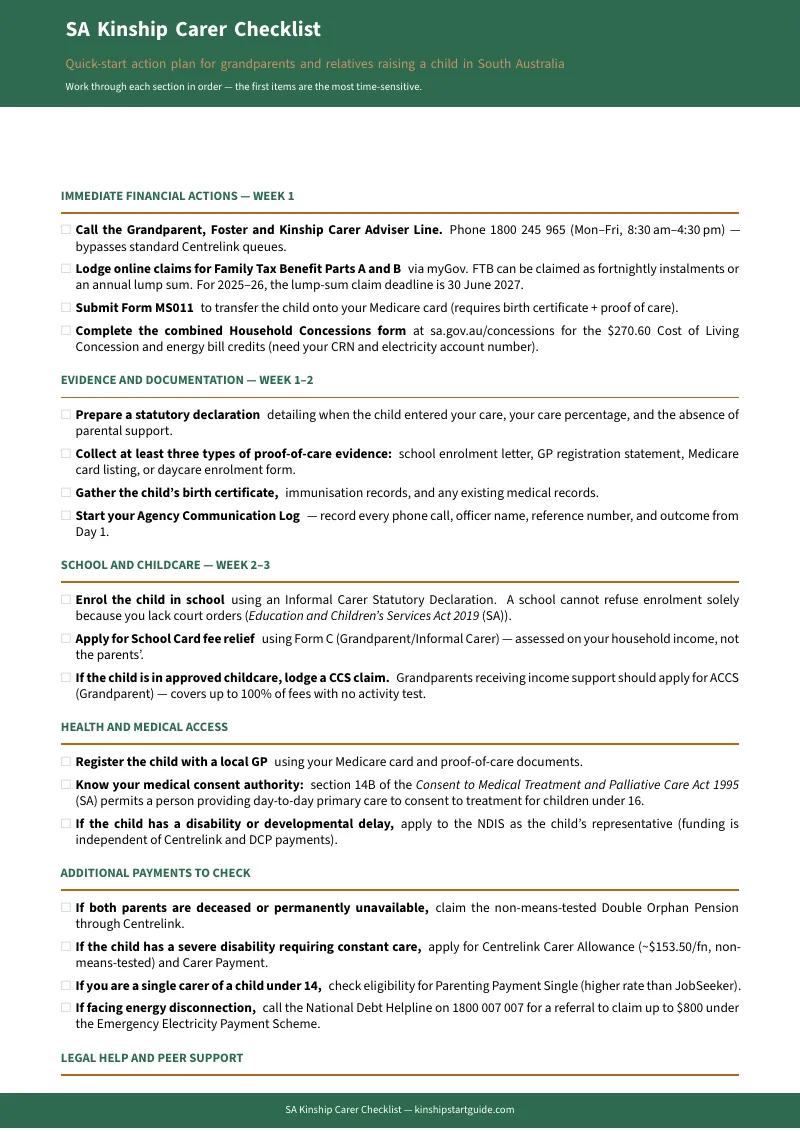
The free checklist is available immediately with no purchase required — it lists the main payments, which agency administers each, the key form names, and the helpline contacts.
Get the full SA Carer Navigation System — the complete 46-page guide plus printable standalone worksheets including the decision tree, proof-of-care checklist, phone preparation script, claim tracker, and free-help directory — and find out tonight what the child you're raising is entitled to.
Frequently Asked Questions
What if the rules change after I buy?
We update the guide when the rules change. Email us any time, even years later, and we'll send you the current edition free.