The school wants custody papers. The clinic won't see the child. Wisconsin law says you need neither — if you have the right form signed correctly.
You took in a child. Maybe it was your grandchild, a niece, a nephew, or the child of someone you love who can't be there right now. The circumstances are painful and private, and you didn't have weeks to plan. What you had was overnight.
Now the child needs to start school. Needs a dentist. Needs a pediatrician. And every front desk you walk up to asks for documents that sound like they require a judge, a lawyer, or a parent who isn't available.
Here's what most Wisconsin caregivers don't discover until after the first rejection: Wisconsin has a Delegation and Enrollment Framework — a set of statutory instruments that let you handle school registration, medical consent, and everyday authority without ever filing a court petition. Form GF-223 under Wis. Stat. § 48.979 works when a parent can cooperate. The Thayer residency doctrine works when you can prove the child lives with you. McKinney-Vento works when the child's housing situation qualifies. And each instrument has specific signature rules, duration limits, and renewal mechanics that generic online templates get wrong — including the widely repeated claim that Wisconsin requires notarisation, which the statute itself does not.
What the Delegation and Enrollment Framework Covers
The guide walks you through every consent mechanism Wisconsin recognises for a caregiver without a court order, and shows you exactly when to use each one:
- Form GF-223 — Power of Attorney Delegating Parental Power (Wis. Stat. § 48.979) — the parent-signed delegation instrument. The guide covers who must sign (and why the joint legal custody rule catches more families than anything else), how to execute the form step by step, what it authorises (school enrollment, routine medical, dental, day-to-day care), the default one-year duration, the five things no POA can ever authorise in Wisconsin, and exactly how to renew before your authority lapses. This track requires a cooperating parent.
- School enrollment under the Thayer doctrine — the enrollment pathway that works even when no parent is available to sign. Under Wisconsin constitutional law and the Supreme Court precedent in State ex rel. School-District Board v. Thayer, a child is a resident of the district where they physically live and sleep — not where the birth parents live, and not where a custody order points. No court order required. The guide includes the complete document list for the registrar's office and what to say when a clerk demands guardianship papers the law doesn't mention.
- McKinney-Vento federal protections — when the child's housing situation is unstable or doubled-up, federal law requires immediate enrollment with no birth certificate, no immunisation records, no proof of address, and no questions about legal custody. The guide explains how to identify the local district's Homeless Liaison and what they are legally required to do.
- Alternative Open Enrollment (Wis. Stat. § 118.51) — seven specific criteria let a caregiver apply outside the standard February-to-April window, including when a child is placed with a relative or when a child's residence changes due to family crisis. The guide maps each criterion to the situations kinship caregivers actually face.
- Medical and dental consent — how the GF-223 delegation extends to routine paediatric checkups, immunisations, specialist referrals, prescriptions, and dental appointments. Plus the critical sequence: having a BadgerCare Plus card is not the same as having legal authority to consent to treatment — and a clinic can legally turn you away with one but without the other.
- Teen mental health consent under Chapter 51 — Wisconsin's dual-consent framework for outpatient mental health treatment for minors aged 14 and older. Both the parent or caregiver and the minor must consent, and if either refuses, a County Mental Health Review Officer can be petitioned. Assembly Bill 112, which proposed letting either party consent alone, failed in March 2026. The guide explains the current rules, the substance use exception for minors 12 and older, and what dual consent means for you at the therapist's intake desk.
- Special education protections — IDEA and Section 504 rights for children in kinship care, including when you qualify as the child's educational decision-maker, how to request an evaluation, and the surrogate parent appointment process when no parent is available.
When the School or Doctor's Office Says No
Wisconsin school districts routinely demand guardianship orders the state's own enrollment statutes don't require. Front-desk staff at paediatric offices refuse to see a child because the caregiver's name isn't on the insurance card. Enrollment clerks ask for documents that appear nowhere in DPI guidance.
The guide includes the School District Enrollment Worksheet with statutory references for every document — what to bring, the law that supports it, and what to cite if they ask for more. You also get the Medical Consent Checklist for the first clinic visit, the Thayer doctrine citation to hand the registrar, and a Refusal and Escalation Log — a dated record of every time a school or clinic asks for something the law doesn't require, with a column for the staff member's name, what they demanded, and the statute that overrides them.
The Instrument Comparison Decision Tree
Should you use the Power of Attorney, the Thayer residency route, McKinney-Vento protections, or a court guardianship petition? The kit includes a one-page Instrument Comparison Decision Tree that starts with your situation — is the parent cooperating? does the parent hold sole or joint custody? is the child living with you? is the housing stable? — and leads you to the right instrument. Most caregivers discover they can skip the courthouse entirely. Some learn they need the court sooner than they expected. Either way, you stop guessing.
Who This Is For
- A grandparent, aunt, uncle, or older sibling who has taken in a child and needs to get that child into school and to the doctor — this week
- A family friend who isn't technically a relative and needs to understand the one-year court-filing threshold for non-relative agents
- A caregiver managing a one-year Power of Attorney who needs to track the expiration date and coordinate renewal signatures with a cooperating parent
- Anyone who was turned away by a school or clinic and told they need "custody papers" — and wants to know whether that's actually true under Wisconsin law
- A family helper or adult child buying this on behalf of an older relative who needs clear, step-by-step instructions in a readable format
Why Not Free Resources?
The Wisconsin Family Connections Center (WiFCC) runs a free statewide kinship navigator, and we include their phone number in the guide. Legal Action of Wisconsin and Judicare Legal Aid offer free legal help for eligible families. The Wisconsin Court System publishes Form GF-223 at no cost. The guide doesn't replace any of that — it bridges the gap between knowing these resources exist and knowing how to use them at 7:30 a.m. when the school enrollment office opens.
Free resources tell you that Wis. Stat. § 48.979 exists. They don't tell you what to do when the Power of Attorney expires in three weeks and the parent is in a residential treatment facility in Waukesha. They don't give you the School District Enrollment Worksheet and the statutes for the enrollment clerk who insists on guardianship papers because she's never read the DPI residency guidance. They don't walk you through whether the child's BadgerCare Plus card is enough for a clinic visit or whether you also need the GF-223. And they don't put the school enrollment documents, the medical consent path, the POA renewal timeline, the teen mental health rules, and the special education protections in one place — organised by the situation you're actually in, not the statute number it's filed under.
What You Get
- The complete guide — 12 chapters covering every consent pathway: GF-223 execution and the joint-custody signature rules, school enrollment under the Thayer doctrine, Alternative Open Enrollment, medical and dental consent, teen mental health under Chapter 51, IDEA and Section 504 protections, BadgerCare Plus and Kinship Care payment basics, the court guardianship escalation path, driver's licence sponsorship, and the full Wisconsin resource directory
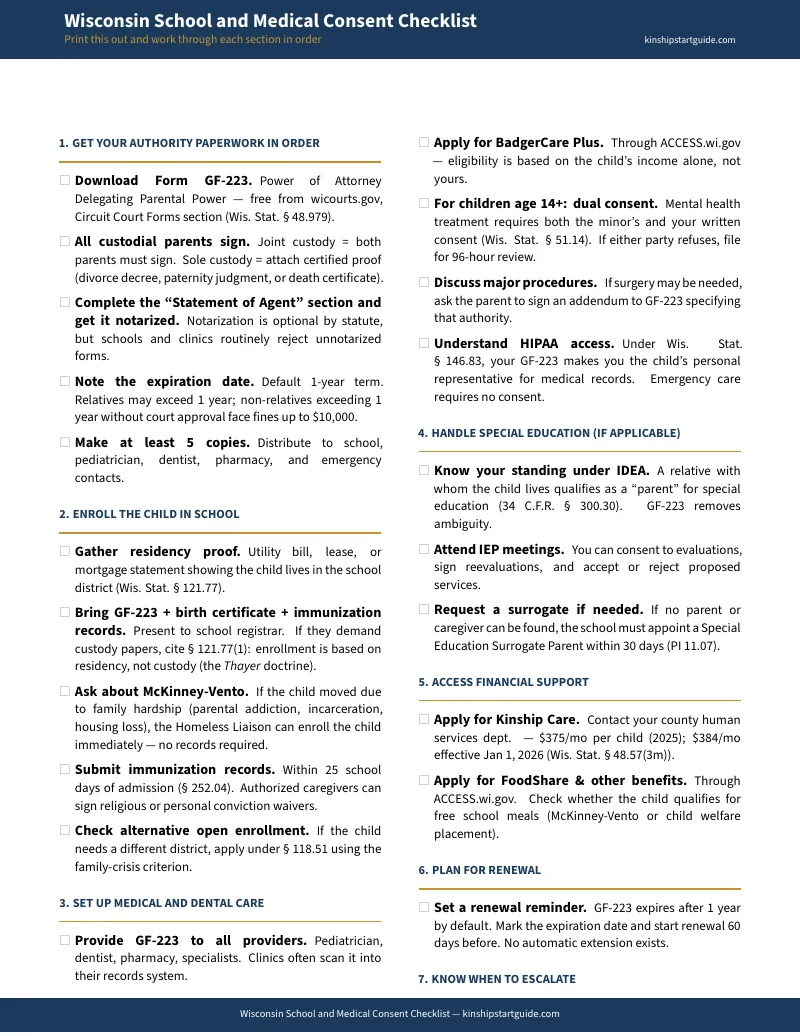
- The quick-start checklist — a printable 24-item, two-page summary of the forms, enrollment documents, and contact numbers you need in the first 72 hours
- Instrument Comparison Decision Tree — a one-page worksheet that starts with your situation and leads you to the right consent mechanism
- School District Enrollment Worksheet — every document to bring to the district office, with the statutory basis for each and a space to record what they asked for
- Medical Consent Checklist — what to bring to the child's first appointment with a new paediatrician, dentist, or specialist, plus which prescriptions you can pick up
- Delegation Expiry and Renewal Tracker — a one-year calendar log for tracking the GF-223 expiration and renewal dates, with a 60-day advance renewal prompt
- Refusal and Escalation Log — a dated evidence trail for building a record if a school or medical provider demands paperwork the law doesn't require
- Document Distribution Tracker — a log of which school, doctor, dentist, pharmacy, and agency has a current copy of each consent document
- Agency Communication Log — a dated record of calls to county human services, the Wisconsin Family Connections Center, and legal aid
Satisfaction Guarantee
Full refund, no time limit. If the guide doesn't help, email [email protected] and you get your money back. No form, no explanation required.
Download the free checklist to see the high-level steps. When you're ready for the full guide — with every worked example, every worksheet, and every statutory citation — the complete toolkit is here.
Frequently Asked Questions
What if the rules change after I buy?
We update the guide when the rules change. Email us any time, even years later, and we'll send you the current edition free.