The Court Won't Tell You Which Path to Take — This Guide Will
Virginia splits legal authority for children across two court systems, five legal instruments, and evidentiary standards that range from a notarized signature to the highest burden in civil law. File in the wrong court and your petition gets dismissed. Skip the UCCJEA affidavit and intake sends you home. Show up to the hearing without evidence tied to the ten statutory best-interest factors and the judge rules against you — even when everyone agrees the child belongs with you.
The Supreme Court of Virginia publishes the blank forms. Legal aid websites explain the law in general terms. Neither tells you what to do, in what order, with which form, at which court — and that procedural gap is where self-represented relatives lose their cases.
The Virginia Kinship Court Navigation System
This guide closes the gap between knowing you need a court order and actually getting one. It maps every step of the Virginia kinship court process — from the moment you decide you need legal authority through the day you hand a certified copy of your order to the school registrar.
At the front, a decision framework walks you through Virginia's five legal instruments — nonparent custody (JDR Court, Form DC-511), guardianship of the person and estate (Circuit Court, Title 64.2), standby guardianship (JDR Court, Form DC-503), and power of attorney (no court, notarized) — and matches your circumstances to the right one before you pay a filing fee or spend a day at the courthouse.
What's Inside
- Five-instrument comparison matrix — side-by-side breakdown of nonparent custody, guardianship of the person, guardianship of the estate, standby guardianship, and power of attorney, with the governing statute, the court, the filing fee, and what each one actually gives you
- JDR Court filing walkthrough — the Court Service Unit intake interview, Form DC-511 (petition), DC-620 (UCCJEA affidavit), DC-606 (fee waiver application), service of process requirements, and how to handle absent, incarcerated, or military parents
- Constitutional parental presumption explained — what Troxel v. Granville and Bailes v. Sours mean for your case, the five recognised grounds for overcoming the presumption, and the clear-and-convincing evidence standard you must meet
- Ten best-interest factors unpacked — each of the ten factors the judge must weigh under Va. Code § 20-124.3, with guidance on what evidence and documentation supports each one
- Emergency and temporary orders — when an emergency protective order or preliminary protective order applies, who can request one, and the specific circumstances the court requires
- Guardian ad litem preparation — what the GAL's role is, what they look for during a home visit, and how to organise your documentation before the interview
- Circuit Court guardianship procedure — when guardianship of the person or estate is the right instrument, the oath and bond requirements, and the Commissioner of Accounts oversight
- Standby guardianship procedure — how a parent facing progressive illness, incarceration, or deportation can designate a standby guardian, and the petition timeline after the trigger event
- Post-order execution — how to get certified copies from the clerk, present them to schools, doctors, and agencies, and what to do when circumstances change and you need a modification
- Public benefits unlocked by the court order — an overview of TANF, KinGAP, the state kinship subsidy, and Medicaid for the child, with handoffs to the companion financial help guide
Printable Worksheets and Tools Included
- UCCJEA five-year residence history worksheet — compile every address and co-resident for the child's past five years before you fill out DC-620, so intake does not send you home for missing information
- Fee-waiver financial worksheet — calculate and organise the household figures the court needs on Form DC-606
- Parental notice and service tracking log — document every certified mail attempt, publication step, and Department of Corrections service request, with dates and proof references the court will need
- Court Service Unit intake preparation checklist — what to bring, what the intake officer will ask, and what forms to have ready
- Hearing evidence organiser — map your evidence to each of the ten best-interest factors and the parental presumption grounds
- Post-order action checklist — certified copies, school registrar visits, medical provider notifications, and benefit applications, with spaces for tracking completion
- GAL home visit preparation checklist — what the Guardian ad Litem looks for during the home visit: safety items, records to have on hand, and questions to expect
- Agency communication log — track every call, email, or in-person visit with courts, DSS, schools, and service providers, with dates and what was promised
Who This Is For
This guide is for grandparents and relatives in Virginia who are raising a child and need a court order — because a school, doctor, or benefits office demands legal authority that an informal arrangement or a power of attorney does not provide. It is written for people who are navigating the court system without a lawyer, in plain language, with the specific Virginia forms, fees, and procedures you will actually use.
It is not legal advice, and it does not advise on the merits of any dispute with a parent. It does not cover school and medical consent procedures (that is the companion Virginia School and Medical Consent Guide) or financial assistance applications (that is the companion Virginia Kinship Financial Help Guide). It explains the court process — the path from deciding you need legal authority to holding a court order that schools, doctors, and agencies will accept.
Why Not Just Use the Free Forms and Websites?
The Supreme Court of Virginia publishes every form you need — DC-511, DC-620, DC-606, DC-503 — as free downloadable PDFs. Virginia Legal Aid and virginialawhelp.org explain the law clearly. These are valuable resources, and this guide links to them.
What they do not provide is the procedural sequence. The forms do not tell you that many JDR courts require non-attorneys to go through a Court Service Unit intake interview before filing. The legal aid fact sheets do not include a worksheet for assembling the five-year address history that DC-620 demands. The court's website does not explain how to serve notice on a parent in a Virginia prison or how to petition for service by publication when a parent cannot be found. National form sellers like LegalZoom and Rocket Lawyer charge recurring subscription fees for generic templates that do not address Virginia's bifurcated court system or the mandatory intake process.
This guide puts the forms, the procedures, and the preparation tools into one sequence — so you can walk into the Court Service Unit prepared, file your petition correctly the first time, and present your case at the hearing with documentation organised around the factors the judge is required to consider.
The Free Checklist
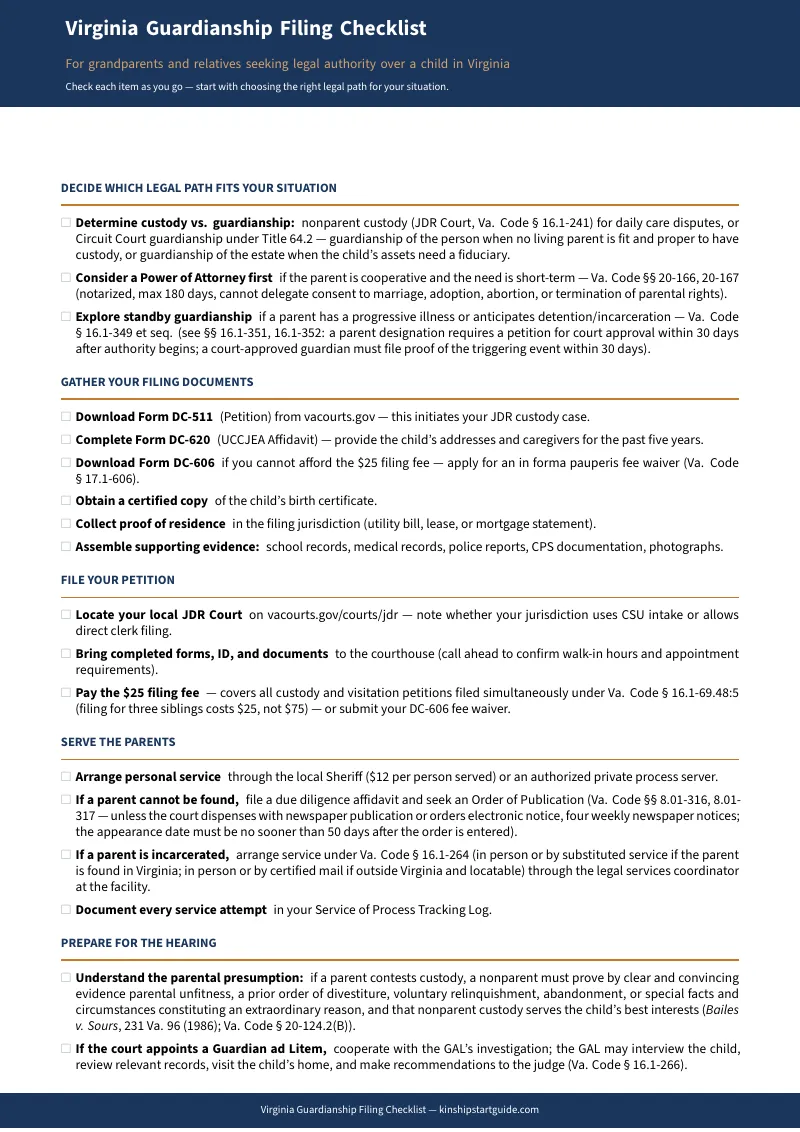
Not sure you need the full guide yet? Download the free Virginia Guardianship Filing Checklist — a one-page overview of the forms, fees, notice steps, and hearing milestones for a relative's guardianship or custody case in Virginia. It shows you the full timeline at a glance so you can decide what level of preparation you need.
Satisfaction Guarantee
Full refund, no time limit. If the guide is not what you expected, email [email protected] and you will receive a complete refund. The guide costs — a one-time purchase, no subscription, no recurring fees.
Frequently Asked Questions
What if the rules change after I buy?
We update the guide when the rules change. Email us any time, even years later, and we'll send you the current edition free.