The School Wants Guardianship Papers. The Doctor Wants a Parent's Signature. Vermont Has No Form for This.
You're raising a grandchild, niece, nephew, or family friend's child in Vermont — and the systems that are supposed to help children keep sending you away. The school registrar asks for a court order you don't have. The pediatrician's office says only a parent can sign. The health insurance application needs a relationship you can't prove on paper.
Most states have a solution for this. California lets relatives sign a Caregiver Authorization Affidavit. Massachusetts has a similar form. Vermont has nothing — no statewide affidavit, no standardised consent instrument, no single form that forces a school or clinic to recognise your authority over a child in your care.
That gap leaves you navigating three separate legal pathways, scattered across different statutes, each with its own signers, limits, and failure points. Get the wrong form for the wrong situation, and you're back at the front desk being told to come back with different paperwork.
The Vermont Consent Authority Navigator
This guide maps every path Vermont law gives a relative caregiver — the parental delegation documents, the school enrollment procedures under 16 V.S.A. § 1075, the medical consent framework, and the formal guardianship routes through the Probate Division — so you walk into the school office or the clinic knowing exactly which document to hand over.
It's built specifically for Vermont. Not a generic multi-state template that references California law. Not a single power of attorney that covers half of what you need. Every chapter is built around Vermont statutes and the administrative realities that relative caregivers face in Vermont school districts and medical offices.
What's Inside
- The three authority pathways compared — a side-by-side matrix of informal parental delegation, financial power of attorney under 14 V.S.A. Ch. 127, and custodial minor guardianship under 14 V.S.A. § 2621 et seq.: what each covers, who must sign, whether you need a notary, and what each one explicitly does not authorise
- School enrollment under 16 V.S.A. § 1075 — how legal residence is determined, what documents to bring, local district residency affidavits, and the 24-hour dispute process when enrollment is refused, including the appeal to the Secretary of Education
- McKinney-Vento enrollment rights — when the child qualifies for immediate enrollment without guardianship papers, birth certificates, or immunisation records, and how to contact your district's Homeless Education Liaison
- Medical and dental consent step by step — the informed consent framework, when providers require parental signature, how a parent-signed delegation letter works in practice, and what to do when a clinic refuses your paperwork
- Minor self-consent rights — Vermont's specific statutes for mental health treatment (18 V.S.A. § 8350), substance abuse care (18 V.S.A. § 4226), reproductive health (18 V.S.A. § 9493), and sexually transmitted infection treatment (18 V.S.A. § 7503) — when the child can consent on their own
- Dr. Dynasaur and health insurance — how to apply for Vermont's free or low-cost children's health coverage (income below 312% FPL), who can apply on the child's behalf, and the difference between having insurance and having consent authority
- The full guardianship landscape — custodial, permanent, emergency (hearing within 3 business days), and standby guardianship (H.98, for adverse immigration actions), with Probate Division form numbers and filing procedures
- Special education rights — IDEA and Section 504 protections, who can request an evaluation, and what happens when the school says you aren't the "parent" under federal education law
- Financial assistance — Reach Up child-only TANF, foster-care-level kinship payments (when DCFS-involved), and the OBBBA changes affecting benefit calculations
- Six printable worksheets — school enrollment checklist, medical visit preparation sheet, institutional refusal log, document expiration tracker, legal authority comparison matrix, and an escalation protocol card for when the front desk says no
Who This Is For
You're a grandparent, aunt, uncle, older sibling, or family friend in Vermont who has taken in a child without a court order. Maybe the parent is in treatment. Maybe they're incarcerated, hospitalised, or simply unable to care for the child right now. The child is with you, and you need the school and the doctor's office to recognise your authority — now, not after months of court proceedings.
This guide is for informal caregivers navigating daily logistics. It is not legal advice, it does not take sides in any family dispute, and it does not replace an attorney for contested custody situations.
Why Not Just Download a Free Form?
You can find free consent form templates online. Most of them are built for states that have caregiver affidavit statutes — Vermont does not. A $39 template from a national legal document site references California Family Code or Massachusetts law and has no statutory basis in Vermont. A generic minor power of attorney doesn't address school enrollment or the specific way Vermont Probate Courts handle minor guardianship.
Free Vermont resources exist and are valuable — VKAP's helpline, Legal Services Vermont, the court's own forms — but they're spread across different websites and agencies, and none of them puts the full picture together. The guide organises what's scattered: which instrument for which situation, the district-specific rules, the consent hierarchy, and the escalation protocol for when the process stalls.
Satisfaction Guarantee
Full refund, no time limit. If the guide doesn't help your situation, email [email protected] and you'll get your money back. No forms, no waiting period.
Get Started
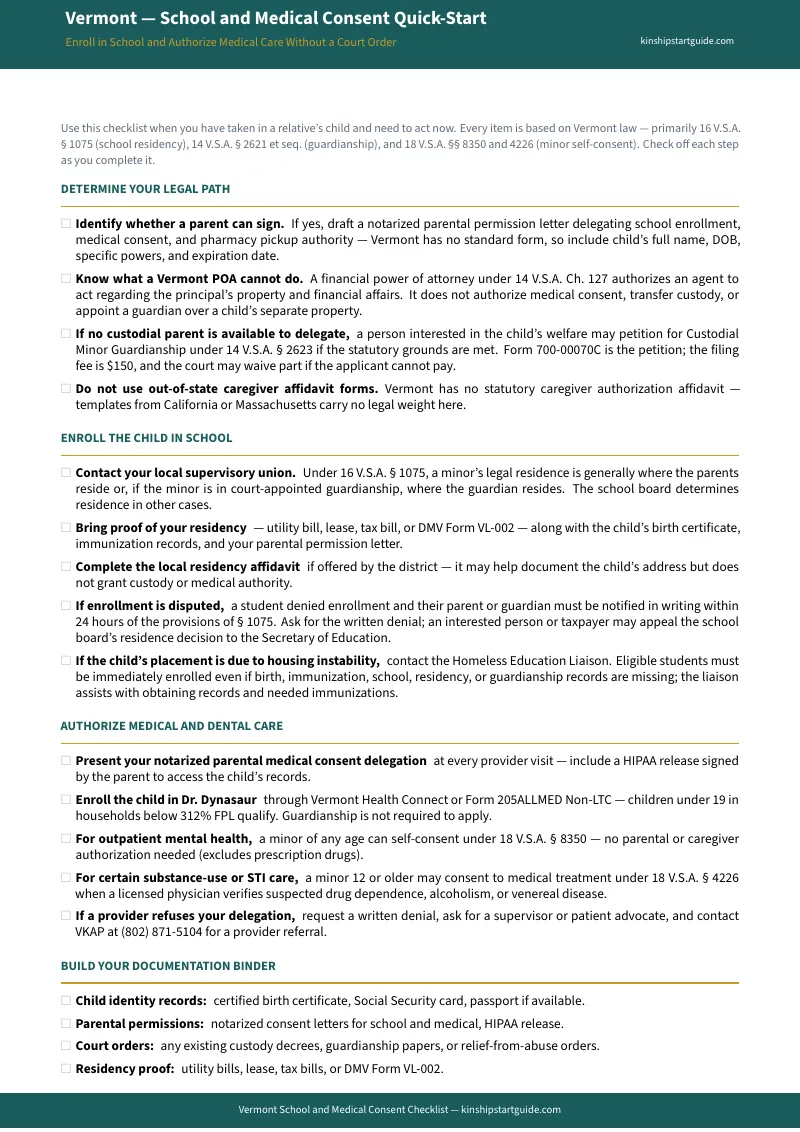
Download the free 24-item checklist to see the essential consent forms, enrollment steps, and medical consent points at a glance. When you're ready for the full walkthroughs and planning tools, get the complete toolkit — the 47-page guide, the checklist, and six printable worksheets built for Vermont's specific rules.
Frequently Asked Questions
What if the rules change after I buy?
We update the guide when the rules change. Email us any time, even years later, and we'll send you the current edition free.