The School Wants a Custody Order. The Doctor Wants a Parent's Signature. You Have Neither.
You're raising your grandchild, niece, nephew, or a family friend's child in Tennessee — and the systems that are supposed to help keep turning you away. The school registrar wants guardianship papers. The pediatrician won't schedule a checkup without a parent on file. The insurance application asks for a legal relationship you can't prove on paper.
Tennessee actually has two clear non-court instruments for this — a Power of Attorney for Care of a Minor Child under T.C.A. § 34-6-301 and a 60-day healthcare affidavit under T.C.A. § 34-6-402 — but they're buried in separate chapters of the Tennessee Code, and nobody explains which one you need, whether a parent has to sign, what happens when a parent is in prison or unreachable, or what to say when the front desk turns you away.
The Tennessee Kinship Consent Roadmap
This guide maps every path Tennessee law gives an informal caregiver — the consent instruments, the school enrollment procedures for major districts, the medical and dental consent hierarchy, and the step-by-step escalation protocol — so you can stop guessing which form to bring and start getting the child into school and into the doctor's office.
It's built specifically for Tennessee. Not a generic multi-state power of attorney template, not a form-filling site behind a subscription. Every chapter is built around the Tennessee statutes and school district rules that apply to your situation, including T.C.A. § 34-6-301 (the POA), T.C.A. § 34-6-402 (the healthcare affidavit), T.C.A. § 34-6-310 (the liability protection that schools and clinics can rely on), and district-specific policies for Metro Nashville, Memphis-Shelby County, Knox County, and rural LEAs.
What's Inside
- Tennessee's two non-court consent instruments compared — the Power of Attorney for Care of a Minor Child (T.C.A. § 34-6-301) and the 60-day in loco parentis healthcare affidavit (T.C.A. § 34-6-402): who signs each one, whether you need a notary or witnesses, how long it lasts, and what it explicitly doesn't authorise
- School enrollment step by step — what each major district requires, the documents you need, how to handle district-specific caregiver residency forms, and what to say when a registrar demands a court order you don't have — backed by T.C.A. § 34-6-310's liability protection
- Medical and dental consent walkthroughs — how the POA works in practice for routine care, prescriptions, and specialist referrals, plus how the 60-day healthcare affidavit covers you when no parent is available
- Mental health consent for teenagers — Tennessee's T.C.A. § 33-8-202 rules for minors 16 and older, the limits on what a caregiver can authorise, and how to find mental health access when consent is blocked
- McKinney-Vento enrollment rights — when the child qualifies for immediate enrollment without the usual documents, how to reach the district homeless liaison, and what protections apply while you gather paperwork
- HIPAA and FERPA for caregivers — how to access the child's medical and school records without a custody order, and which consent instrument unlocks which records
- TennCare, Families First, and the Relative Caregiver Program — the child-only health coverage, cash assistance, and supportive services the child may be entitled to, with the agencies and application steps
- The court escalation decision — five clear triggers for when informal authority is no longer enough and a court order becomes the practical next step, with links to free legal help for filing
- Two worked examples — a routine pediatric visit with an active POA and an emergency when the parent is unreachable, showing exactly what to present and what to say at each stage
Who This Is For
You're a grandparent, aunt, uncle, older sibling, or family friend in Tennessee who is raising a child without a court order. Maybe the parent is struggling with addiction. Maybe they're incarcerated, hospitalised, or simply gone. The child is with you, and you need the school and the doctor's office to recognise your authority — now, not after months of court proceedings.
This guide is for informal caregivers navigating daily logistics. It is not legal advice, it does not take sides in any family dispute, and it does not replace an attorney for contested custody situations.
Why Not Just Download a Free Form?
You can find the official DCS Power of Attorney form online in a few minutes. But downloading a blank form and getting it accepted at the front desk are two different things. Most form rejections happen because the hardship ground was left blank, the execution was improperly witnessed, or the registrar didn't know Tennessee law recognises the POA for enrollment. A generic template from a subscription legal site doesn't distinguish between Tennessee's POA and the healthcare affidavit — and using the wrong instrument at the wrong desk wastes a trip.
This guide puts the full picture in one place — which instrument for which situation, the district-specific enrollment rules, the medical consent hierarchy, the escalation protocol with statutory citations, and the benefits the child may be entitled to — for less than a single hour at a document preparation counter.
Satisfaction Guarantee
Full refund, no time limit. If the guide doesn't help your situation, email [email protected] and you'll get your money back. No forms, no waiting period.
Get Started
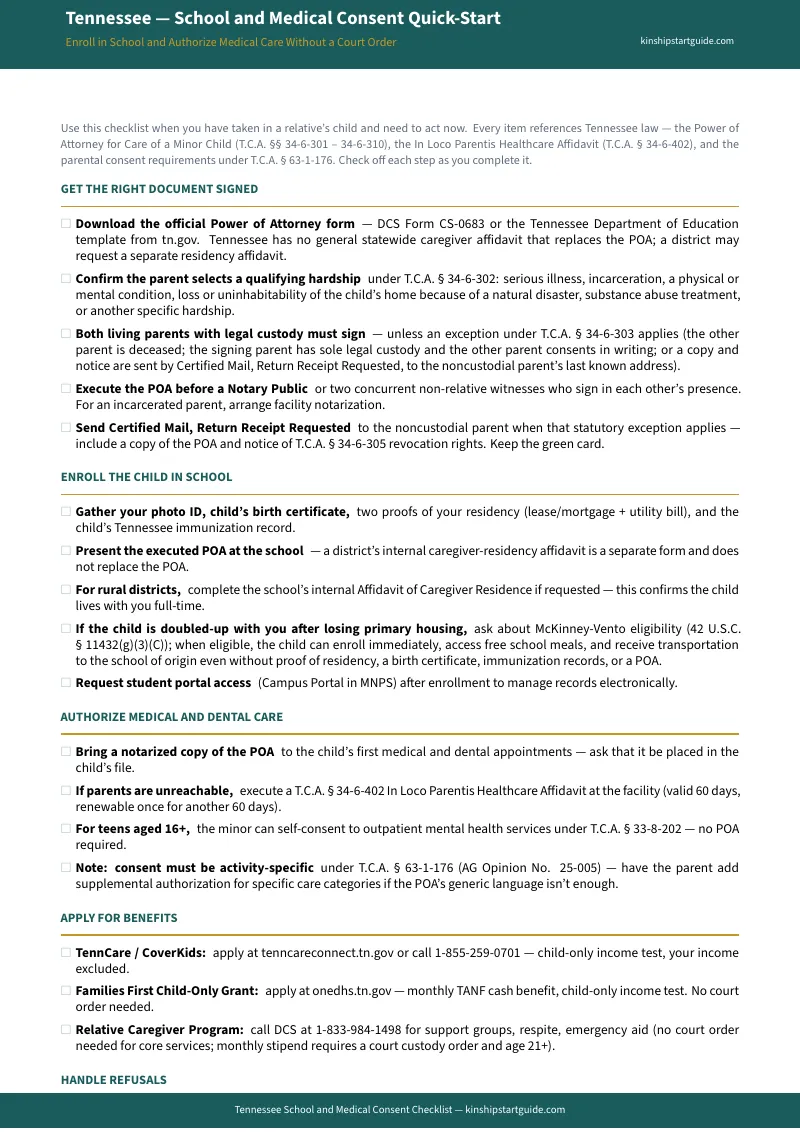
Download the free 25-item checklist to see the essential steps at a glance. When you're ready for the full walkthroughs, district-specific procedures, and consent instrument guides, get the complete toolkit — the 49-page guide, the checklist, and five printable planning tools including a POA execution checklist, a school enrollment document-gathering sheet, a medical consent tracker, a benefits application tracker, and an escalation log.
Frequently Asked Questions
What if the rules change after I buy?
We update the guide when the rules change. Email us any time, even years later, and we'll send you the current edition free.