The school wants a court order. The clinic wants a parent's signature. South Dakota law has a path that requires neither — but nobody at the front desk knows about it.
You took in a child — a grandchild, a niece, a nephew, or the child of a close friend who can't be there right now. The reasons are painful and private, and you didn't have weeks to plan. What you had was overnight.
Now the child needs to start school. Needs a pediatrician. Needs a dentist. And every office you walk into asks for custody papers you don't have and a parent's signature you can't get.
Here's what most South Dakota caregivers don't find out until they've already been turned away: the state has a Consent Navigation System — a set of distinct legal pathways that let you handle school enrollment and medical care without filing a single court petition. SDCL 13-28-10 lets you petition the school board to accept the child as a district resident without changing custody. A parent-signed delegation letter authorizes routine medical and dental care when the parent can cooperate. Emergency reliance under SDCL 20-9-4.2 protects providers who treat a child when life or health is at stake. And McKinney-Vento protects enrollment when the child's housing is unstable. The problem isn't the law. The problem is that school clerks and clinic receptionists don't know these pathways exist — and the generic "caregiver authorization affidavit" and "minor power of attorney" forms sold online for other states carry no legal weight in South Dakota.
What the Consent Navigation System Covers
The guide walks you through every consent mechanism South Dakota recognizes for a caregiver without a court order, and shows you exactly when to use each one:
- School Board Residency Petition — SDCL 13-28-10 — the administrative pathway that works even when no parent is available. If the child lives with you, you can submit a written request asking the school board to accept the child as a district resident. No court order, no custody change, no parental signature required. The guide includes the School Board Request Letter Template with the correct statutory citation, the documents to bring on enrollment day, and the 15-day appeal process if the board says no.
- McKinney-Vento Federal Protections — when the child lost housing, experienced economic hardship, eviction, or domestic violence, federal law requires immediate enrollment with no records, no proof of address, and no custody questions. The guide explains how to identify the district's Homeless Liaison and what they are legally required to do. Kinship placement alone does not qualify — the housing instability must be present.
- Medical Consent Boundaries — SDCL 20-9-4.2 — emergency reliance protects licensed physicians and hospitals who treat a minor without parental consent when an immediate threat to life or health exists and the parent is unavailable. The guide explains exactly where this protection ends — it does not cover routine checkups, dental cleanings, immunizations, or elective care — and what to do for the appointments that fall outside it.
- Parent-Signed Delegation Letters — for non-emergency medical and dental care, the strongest path is a written consent form signed by the parent before they become unreachable. The guide provides a structured delegation letter approach covering medical history, provider authorization, prescription consent, and immunization records. It walks you through what the letter should include, how to execute it, and what to do when a provider still hesitates.
- Why Generic Minor POA Forms Fail Here — South Dakota's Uniform Power of Attorney Act (SDCL Chapter 59-12) applies to adults and financial matters. SDCL 59-12-2 explicitly excludes healthcare decisions. The $39/month "minor power of attorney" templates sold online cite this chapter — and carry no statutory backing for medical consent in South Dakota. The guide explains what a parent-signed POA can and cannot do in this state.
- Mental Health, Substance Treatment, and Age-Based Consent — which minors can consent to their own outpatient treatment, the age-16 divide for psychotropic medication, school-based behavioral health programs, and when caregiver consent through a delegation letter applies versus when the teen already has the right to decide.
- Special Education, IEPs, and Section 504 — who counts as a "parent" under IDEA in South Dakota, how surrogate parent appointments work when no parent can be found, and the consent triggers that come up at every IEP or 504 meeting.
When the School or Doctor's Office Says No
South Dakota school districts routinely demand guardianship orders that the state's own enrollment statute doesn't require. Front-desk staff at pediatric offices refuse to see a child because the caregiver doesn't have custody papers. Clinic receptionists ask for forms that don't exist under South Dakota law.
The guide includes a refusal escalation protocol with statutory citations for every pathway — what to say, who to escalate to (superintendent, school board, South Dakota Department of Education, healthcare compliance officer), and how to document the interaction. You also get the School and Medical Refusal Log — a dated record of every time a school or clinic demands something the law doesn't require, with columns for the staff member's name, what they demanded, and the statutory authority that addresses it. You also get Front-Desk Conversation Scripts so you know the exact sentence to read at the counter.
The Consent Decision Flowchart
Should you use the SDCL 13-28-10 school board petition, a parent-signed delegation letter, McKinney-Vento protections, or a court guardianship petition? The guide includes a decision flowchart that starts with your situation — is the parent available to sign? is the child living with you? is the housing stable? is this an emergency? — and leads you to the right instrument. Most caregivers discover they can handle school and medical care without court. Some learn they need a court order sooner than they thought. Either way, you stop guessing.
Who This Is For
- A grandparent, aunt, uncle, or older sibling who has taken in a child and needs to get that child enrolled in school and seen by a doctor — this week
- A family friend who isn't technically a relative and needs to understand which consent pathways work for non-relatives in South Dakota
- A caregiver who was turned away by a school district or clinic and told they need "custody papers" — and wants to know whether that's actually true under South Dakota law
- Anyone managing temporary arrangements who needs to know when informal authority runs out and court guardianship under SDCL Chapter 29A-5 becomes the better path
- A family helper or adult child buying this on behalf of an older relative who needs clear, printable, step-by-step instructions
Why Not Free Resources?
East River Legal Services and Dakota Plains Legal Services offer free legal help for eligible families, and we include their intake numbers and eligibility details in the guide. The South Dakota Unified Judicial System publishes guardianship forms at no cost. The guide doesn't replace any of that — it bridges the gap between knowing these resources exist and knowing how to use them at 7:30 a.m. when the school enrollment office opens.
Free resources tell you that SDCL 13-28-10 exists. They don't tell you how to write the school board request letter, what to bring on enrollment day, or what to say when the clerk insists on guardianship papers she's never actually read the statute for. They don't walk you through whether the child's Medicaid card is enough for a doctor's visit or whether you also need the parent's written delegation. They don't explain why the "caregiver authorization affidavit" you found on Etsy doesn't work in South Dakota. And they don't put the school enrollment pathway, the medical consent rules, the delegation letter approach, and the refusal escalation protocol in one place — organized by the situation you're actually in, not the statute number it's filed under.
What You Get
- The complete guide — 13 chapters covering every consent pathway, the SDCL 13-28-10 school board petition process, parent-signed delegation letters for medical and dental care, emergency reliance under SDCL 20-9-4.2, mental health and age-based consent rules, special education rights under IDEA, CHIP and Medicaid enrollment through Access SD, ICWA and tribal jurisdiction, common scenarios with step-by-step action plans, and a directory of free South Dakota resources
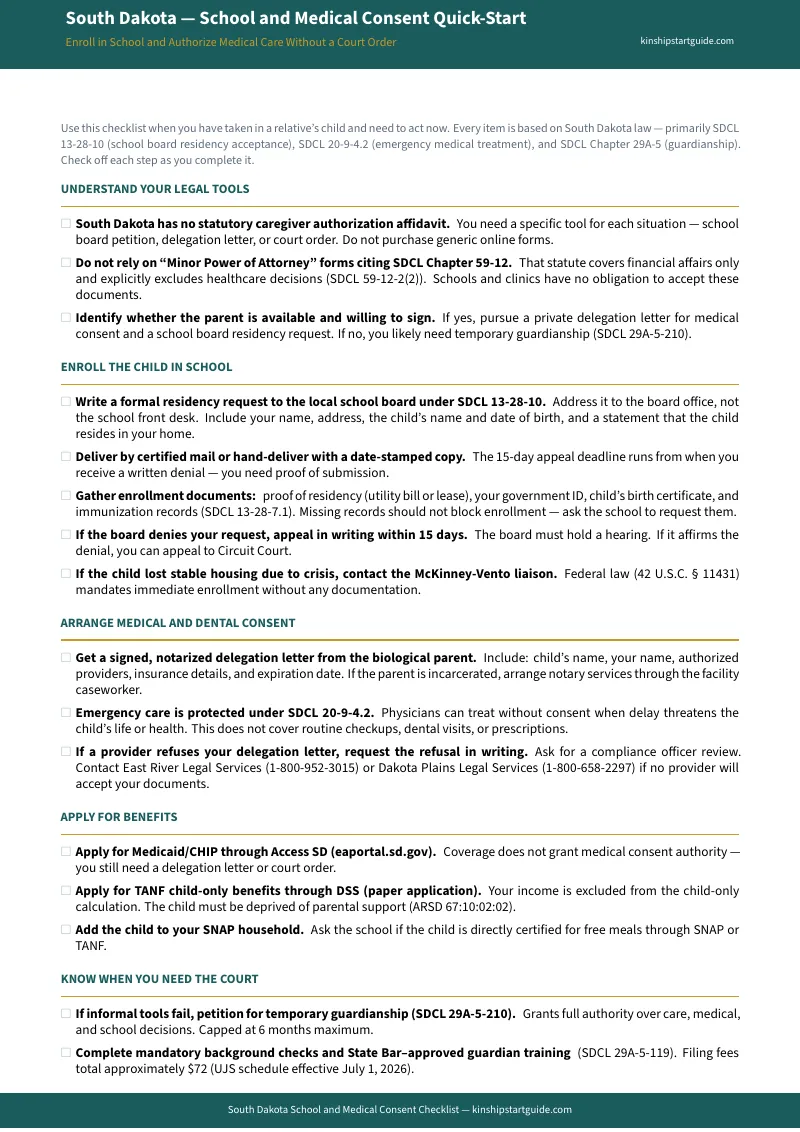
- The quick-start checklist — a printable 22-item summary of the forms, enrollment documents, and contact numbers you need in the first 72 hours
- School Board Request Letter Template — the SDCL 13-28-10 petition, ready to customize with your details and submit to the school board
- Document Preparation Checklist — every document to gather before your first school or medical appointment
- School and Medical Refusal Log — a dated evidence trail for building a record if a school or provider demands paperwork the law doesn't require
- Parent Consent Outreach Form — a structured worksheet for obtaining and documenting the parent's written authorization
- Medical History and Immunization Tracker — organize the child's health records for provider intake
- Front-Desk Conversation Scripts — the exact sentences to read at the school or clinic counter, with statutory citations
- Consent Decision Flowchart — a one-page visual that starts with your situation and leads you to the right instrument
Satisfaction Guarantee
Full refund, no time limit. If the guide doesn't help you navigate your situation, email [email protected] and we'll refund every penny — no forms, no waiting period, no questions.
A Child Shouldn't Wait for a Court Date to See a Doctor
South Dakota's consent pathways exist so they don't have to. The guide shows you how to use them — and what to do when someone at the front desk tries to tell you they don't.
Download includes the full guide, the quick-start checklist, and standalone printable PDFs (worksheets, tracking logs, and the consent decision flowchart). Instant access after purchase.
Already have the free checklist? The full guide goes deeper — the step-by-step school board petition process, delegation letter instructions for medical and dental care, the refusal escalation protocol with statutory citations, the consent decision flowchart that turns "I think this is right" into "I know exactly which document I need," and the common scenario action plans for when a parent is in treatment, incarcerated, or unreachable.
Frequently Asked Questions
What if the rules change after I buy?
We update the guide when the rules change. Email us any time, even years later, and we'll send you the current edition free.