The school wants a custody order. The clinic wants the parent's signature. South Carolina law says you need neither.
You took in a child — a grandchild, a niece or nephew, maybe the child of a friend who can't be there right now. The reason is painful and private, and you had no time to prepare. What you had was overnight.
Now the child needs to start school. Needs a doctor. Needs a dentist. And every front desk you approach asks for paperwork that sounds like it requires a lawyer, a judge, or a parent who isn't available.
Here's what most caregivers in South Carolina don't realise: the state has a Two-Document Consent System that lets you handle school enrollment and medical care without a court hearing, without an attorney, and — in many situations — without the parent's signature at all. The Caregiving Power of Attorney (S.C. Code Ann. § 63-15-720) and the Relative Caregiver School Enrollment Affidavit (§§ 59-63-31 and 59-63-32) were written for exactly your situation. The problem is that school registrars and clinic staff routinely don't know these statutes exist — and when they turn you away, you have no idea what to say next.
What the Two-Document Consent System Covers
The guide walks you through both instruments and shows you exactly when to use each one, when you need both, and when neither is enough:
- Caregiving Power of Attorney (§ 63-15-720) — the broadest single document. A cooperating parent signs before a notary, and you get up to 12 months of authority over school enrollment, routine medical and dental care, immunisations, extracurricular activities, and daycare. The guide covers execution requirements, the six things a POA cannot authorise (including major non-emergency surgery), the military deployment exception that extends beyond one year, and what happens if the parent revokes it or dies
- Relative Caregiver School Enrollment Affidavit (§§ 59-63-31 / 59-63-32) — your own sworn statement, no parent signature required. The guide explains each of the six qualifying grounds (death, serious illness, incarceration, relinquishment, abuse/neglect, military deployment), the notarisation requirement, the $200 misdemeanor penalty for false statements, and how district-level practices vary from Charleston to Greenville to rural Barnwell County
- Medical, dental, and mental health consent — what the POA covers and where it stops, how to get the child to a doctor when you have no POA, the age-16 self-consent threshold under § 63-5-340, and what to do when a clinic refuses your paperwork
- McKinney-Vento protections — if the child came from an unstable home or lost housing before moving in with you, federal law waives enrollment barriers entirely. The guide explains how to trigger McKinney-Vento through your district's homeless liaison
- Special education rights — how a relative caregiver qualifies as the child's "parent" for IEP and Section 504 purposes under federal law, and what to do if the school tries to block your participation
When the School or Clinic Says No
District policies across South Carolina regularly contradict state law. Registrars at larger districts like Richland One and Greenville County enforce strict verification procedures and may insist on custody papers the statute does not require. Pediatric offices turn caregivers away because front-desk staff don't understand the POA's scope. A form vendor on page one of Bing sells a "South Carolina Caregiver Affidavit" that is actually a California form with California driver's licence fields — and it has been rejected by every SC district that has seen it.
The guide includes a refusal decision tree — a step-by-step script for the conversation you have when an office says no. It identifies the statute to cite, the person to escalate to, and the documentation trail to create if the refusal persists. You shouldn't need it. But when a clerk who hasn't read § 59-63-31 stands between a child and the classroom, you will be glad it's in your folder.
The Instrument Comparison Table
Should you use the Caregiving POA, the School Enrollment Affidavit, both, or go straight to Family Court? The guide lays each option out side by side: what it authorises, who needs to sign, whether notarisation is required, how long it lasts, what it costs, and when the simpler option stops being enough. Most caregivers discover they can handle school and medical care at the kitchen table. Some learn the court pathway is closer than they think. Either way, you stop guessing.
Who This Is For
- A grandparent, aunt, uncle, or older sibling who has taken in a child and needs to get that child into school and to a doctor — this week
- A family friend or godparent who needs to know exactly which consent instruments apply to non-relatives
- A family helper or adult child buying this on behalf of an older relative who needs clear, step-by-step instructions
- Anyone who was turned away by a school or clinic and told "you need custody papers" — and wants to know whether that's actually true
Why Not Free Resources?
The official SCDE affidavit is free at ed.sc.gov, and South Carolina Legal Services publishes plain-language fact sheets. The guide doesn't replace any of that — it links directly to the official forms. What free resources don't provide is line-by-line completion instructions, an explanation of which instrument fits your specific situation, a practical plan for what to say when a registrar or clinic refuses your documents, or a system for tracking expiration dates across schools, doctors, and dentists so nothing lapses without warning.
The top-ranking "South Carolina Caregiver Affidavit" on commercial form sites is actually a California form containing California Family Code § 6552 and California driver's licence fields. It is invalid in South Carolina. The guide is built entirely on Title 63 and Title 59 of the South Carolina Code — the statutes that actually govern your situation.
What You Get
- The complete guide — 13 chapters covering every consent pathway, school enrollment, medical and dental consent, adolescent self-consent, IEPs and Section 504, school meals and benefits, the court pathway, and key resources
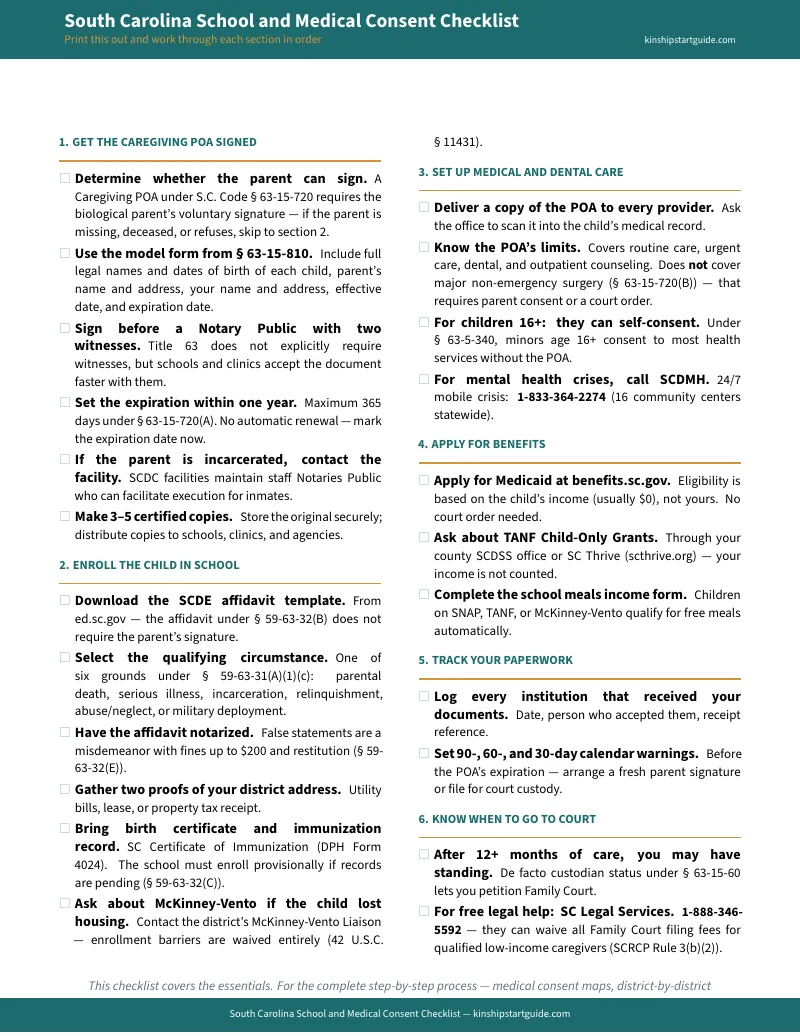
- The quick-start checklist — a printable 23-item, 2-page summary of the consent forms, enrollment documents, benefit applications, and deadlines for the first 48 hours, first week, and first month
- Non-Parent School Enrollment Checklist — the documents to gather before you walk into the registrar's office
- Medical, Dental and Mental Health Authority Log — which providers have the POA on file, which appointments are set, which consent gaps remain
- 12-Month POA Expiration and Renewal Calendar — 90-, 60-, and 30-day warning dates keyed to the execution date
- Document Submission and Delivery Log — every office that received a copy, with the staff name and receipt number
- Registrar and Clinic Refusal Decision Tree — the six-step escalation path and the sentence to say at the counter
- Agency Communication Log — every call, email, and visit with schools, clinics, and agencies
Satisfaction Guarantee
Full refund, no time limit. If the guide doesn't help you navigate your situation, email [email protected] and we'll refund every penny — no forms, no waiting period, no questions.
A Child Shouldn't Wait for a Court Date to See a Doctor
South Carolina built a system so they don't have to. The guide shows you how to use it — and what to do when someone tries to tell you it doesn't exist.
Download includes the 13-chapter, 45-page guide, the 23-item quick-start checklist, and six printable worksheets. Instant access after purchase.
Already have the free checklist? The full kit goes deeper — line-by-line form instructions, the instrument comparison table, the Registrar and Clinic Refusal Decision Tree, school meal and benefit eligibility, the court pathway chapter, and the 12-Month POA Expiration and Renewal Calendar that turns "I think this is still valid" into "I know exactly when to renew."
Frequently Asked Questions
What if the rules change after I buy?
We update the guide when the rules change. Email us any time, even years later, and we'll send you the current edition free.