The school says bring a court order. The clinic wants custody papers. Pennsylvania law says you need neither.
You took in a child — maybe your grandchild, a niece, a nephew, or the child of a friend who can't be there right now. The reasons are painful and private, and you didn't have weeks to prepare. What you had was overnight.
Now the child needs to start school. Needs a doctor's appointment. Needs immunizations before the district will let them through the door. And every front desk you walk up to asks for paperwork that sounds like it requires a lawyer, a judge, or a parent who isn't available.
Here's what most caregivers don't know: Pennsylvania has a Consent Authority System — a set of statutory instruments that let you enrol a child in school and consent to medical care using documents you can prepare at your kitchen table. No court hearing, no attorney, and no parent signature required for school enrollment. The problem isn't the law. The problem is that school registrars and clinic staff routinely get the law wrong, and when they turn you away, you don't know which statute to cite or what to say next.
What the Consent Authority System Covers
The guide walks you through every consent instrument Pennsylvania recognises for a caregiver without a court order, and shows you exactly when to use each one:
- Section 1302 Sworn Statement (24 P.S. § 13-1302) — the foundation for school enrollment. Step-by-step instructions for the PDE Attachment C form, including how to handle the "gratis" support question when you receive TANF, CHIP, or SSI for the child (benefits for the child do not breach the requirement), and what the district can and cannot demand as proof
- Medical Consent Act Authorization (11 P.S. § 2510.1) — a parent-signed delegation of medical, dental, surgical, mental health, and immunization consent authority to any adult. The guide includes a drafting checklist covering scope clauses, term limits, notarisation options, and what to include so compliance officers accept it on the first visit
- Act 88 Standby Guardianship (23 Pa.C.S. §§ 5621–5625) — for parents entering residential treatment who can designate a family member before admission. The guide explains the witness requirements, the 90-day extension cycle, the 365-day cap, and how standby guardianship gives you authority a medical consent authorization alone does not
- Mental health consent at age 14 (Act 65 of 2020) — Pennsylvania's parallel consent threshold that lets minors aged 14 and older consent to outpatient mental health treatment independently. The guide covers how this interacts with your caregiver authority, what the record-access rules mean, and when a provider can share information with you
When the School or Clinic Says No
School districts across Pennsylvania routinely contradict state law. Registrars demand court custody orders that the Public School Code does not require. Pediatric offices refuse medical consent authorizations because the form "doesn't look official." Enrollment clerks insist on a biological parent's signature when the Section 1302 sworn statement is signed by the caregiver alone.
The guide includes a four-step refusal escalation protocol — with pre-written statutory citations referencing the exact PDE Basic Education Circulars, School Code sections, and Medical Consent Act provisions — that you can present to a reluctant principal, registrar, or clinic manager. You shouldn't need it. But when an administrator who hasn't read the law stands between a child and a school desk or a doctor's appointment, you will be glad you have it.
The Instrument Comparison Table
Should you use the Section 1302 sworn statement, a Medical Consent Act authorization, Act 88 temporary guardianship, or a court petition? The kit includes a side-by-side comparison table and a one-page decision flowchart that lay out the authority each instrument grants, who needs to sign, whether notarisation is required, how long it lasts, and when the simpler option stops being enough. A general power of attorney is not a Pennsylvania school or medical consent instrument — it only helps at PennDOT if it expressly names driver's-licensing consent. Most caregivers discover they can handle school and routine medical care without a courthouse visit. Some learn they need the court sooner than they thought. Either way, you stop guessing.
Who This Is For
- A grandparent, aunt, uncle, or older sibling who has taken in a child and needs to get that child into school and to the doctor — this week
- A family friend caring for a child whose parent is incarcerated, in treatment, deployed, or unable to be present — and who needs to know exactly which documents work
- A caregiver receiving TANF, CHIP, or SSI for the child who has been told — incorrectly — that accepting benefits disqualifies them from the Section 1302 "gratis" requirement
- A family helper or adult child buying this on behalf of an older relative who needs clear, large-print instructions they can follow step by step
- Anyone who was turned away by a school or clinic and told they need "custody papers" — and wants to know whether that's actually true
Why Not Free Resources?
The PDE Attachment C sworn statement form is free, and we link directly to it in the guide. Organisations like the Education Law Center and MidPenn Legal Services publish helpful factsheets. The KinConnector helpline (1-866-546-2111) connects caregivers to local support. The guide doesn't replace any of that — it bridges the gap between having the form and knowing what to do with it.
Free resources give you the blank sworn statement. They don't walk you through how to answer the "gratis" question when you receive a TANF child-only grant. They don't give you a medical consent authorization drafting guide with the scope clauses and statutory references that compliance officers look for. They don't explain the distinction between Act 88 standby guardianship and a standard power of attorney — or why that distinction matters when the parent is in residential treatment. And they don't include refusal escalation letters with the exact PDE citations for when a registrar tells you the child can't start school without a court order.
What You Get
- The complete guide — 13 chapters covering every consent pathway, school enrollment, the Medical Consent Act, Act 88 standby guardianship, mental health consent at age 14, special education rights, McKinney-Vento protections, benefits and insurance, parent-absent scenarios, the court path, everyday authority, and refusal escalation
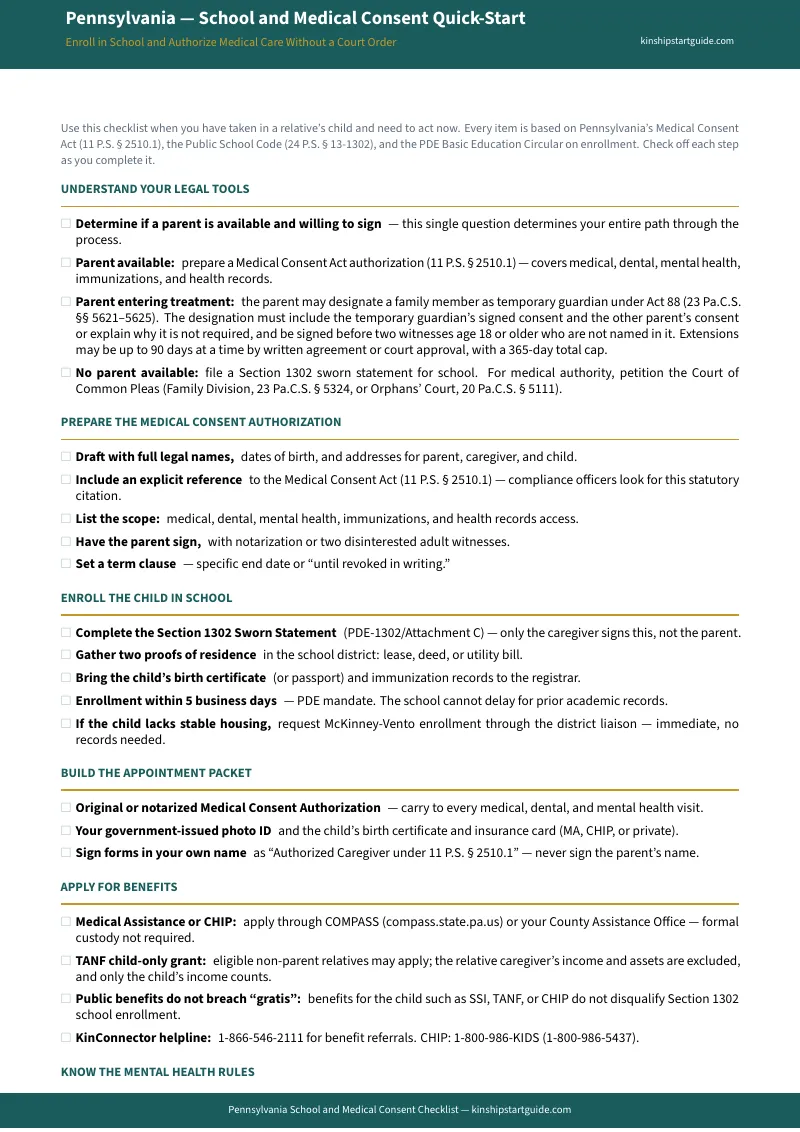
- The quick-start checklist — a two-page printable summary of the consent forms, school enrollment steps, benefits contacts, and mental health rules you need in the first 72 hours
- Section 1302 sworn statement worksheet — field-by-field answers for PDE Attachment C, including how you will handle the gratis question
- Medical consent authorization checklist — everything to include in the parent-signed authorization so the document passes compliance review on the first visit
- School enrollment document tracker — every document to bring to the district office, with Have/Need boxes and the five-business-day deadline
- Appointment packet checklist — the folder you pack the night before a medical, dental, or school visit
- Refusal log — a dated evidence trail for logging interactions with schools and clinics that refuse valid paperwork
- School and medical escalation letters — fill-in letters with the PDE and Medical Consent Act citations for a registrar or clinic that says no
- Annual renewal calendar — tracks the Section 1302 renewal, CHIP recertification, TANF reviews, Act 88 extensions, and immunization booster schedule so nothing lapses
- Instrument comparison table and decision flowchart — sworn statement vs. medical consent authorization vs. Act 88 vs. court order, plus a one-page path that names your starting document
- Key resources and contacts — KinConnector, Education Law Center, SeniorLAW Center, PA Legal Aid Network, county assistance offices, and court self-help centres
Satisfaction Guarantee
Full refund, no time limit. If the guide doesn't help you navigate your situation, email [email protected] and we'll refund every penny — no forms, no waiting period, no questions.
A Child Shouldn't Wait for a Court Date to See a Doctor
Pennsylvania built a system so they don't have to. The guide shows you how to use it — and what to do when someone tries to tell you it doesn't exist.
Download includes the full 49-page guide, the two-page quick-start checklist, and ten standalone printable worksheets (Section 1302 worksheet, medical consent checklist, enrollment document tracker, appointment packet checklist, refusal log, two escalation letters, instrument comparison table, decision flowchart, and annual renewal calendar). Instant access after purchase.
Already have the free checklist? The full guide goes deeper — step-by-step form completion, a medical consent authorization drafting guide, refusal escalation letters with statutory citations, Act 88 standby guardianship explained, and the scenario walkthroughs that turn "I think this is right" into "I know exactly what to do."
Frequently Asked Questions
What if the rules change after I buy?
We update the guide when the rules change. Email us any time, even years later, and we'll send you the current edition free.