The school wants a court order. The clinic wants custody papers. Oregon law says you need neither — if you file the right instrument.
You took in a child — maybe your grandchild, a niece, a nephew, or the child of a friend who can't be there right now. The reasons are painful and private, and you didn't have weeks to prepare. What you had was overnight.
Now the child needs to start school. Needs a doctor's appointment. Needs a dentist. And every front desk you walk up to asks for paperwork that sounds like it requires a lawyer, a judge, or a parent who isn't available.
Here's what most caregivers don't know: Oregon has a Caregiver Consent and Delegation System built into the Revised Statutes that lets you handle school enrollment and medical care using documents you can complete at your kitchen table — with no court hearing and no attorney. But Oregon's system splits into two instruments with different rules. The Relative Caregiver Affidavit under ORS 109.575 lets you sign consent for the child yourself, under penalty of perjury, when a parent can't be reached. The Delegation of Parental Powers under ORS 109.056 requires the parent to sign a power of attorney in your favor. File the wrong one and the institution is within its rights to turn you away.
What the Caregiver Consent and Delegation System Covers
The guide walks you through every consent pathway Oregon recognises for a caregiver without a court order, and shows you exactly when to use each one:
- ORS 109.575 Relative Caregiver Affidavit — the instrument you sign when a parent can't be found. Step-by-step completion of the ten mandatory elements (ORS 109.580), the reasonable efforts requirement, the perjury declaration, the one-year expiration cap from date of delivery to a school or provider, parent revocation rules, and the safety exception that preserves your authority when a parent's objection threatens the child
- ORS 109.056 Delegation of Parental Powers — the instrument a parent signs when they are available and willing. The six-month general cap, the twelve-month school-administrator exception, notarisation and execution instructions (including sending the document to a correctional facility), revocation, and the 2025 HB 2331 watch-point (a bill that would have restricted delegations when a child is in ODHS custody — it failed, but the guide explains why it matters)
- School enrollment and residency — proving physical residency under ORS 339.133, what documents to bring on enrollment day, how the district residency requirement works, and the McKinney-Vento protections that bypass standard enrollment requirements entirely when housing loss brought the child to you
- Medical, dental, and mental health consent — what your affidavit or delegation authorises, where the limits sit (elective surgery requires court authority), and how to present your paperwork at a pediatric intake desk
- Teen self-consent rules — ORS 109.640 (age 15+ for general medical and dental), ORS 109.675 (age 14+ for outpatient mental health and substance treatment), any-age reproductive and STI care, and where your caregiver authority ends and the teenager's own rights begin
- Court guardianship — when no parent is available to sign and the affidavit's one-year clock is running out. Probate guardianship under ORS Chapter 125, filing fees, notice requirements, and the triggers that signal it's time to move to court
When the School or Clinic Says No
School registrars and clinic receptionists across Oregon routinely reject valid Relative Caregiver Affidavits, insisting on court orders or foster care documentation that no statute requires. Rural districts are the worst — they see fewer kinship placements and are less familiar with ORS 109.575. But refusals happen in Portland, Eugene, and Salem too. They aren't malicious — they come from risk-averse training and unfamiliarity with the statute. But they stand between a child and the care that child needs right now.
The download includes ready-to-print escalation letters — citing ORS 109.575 and ORS 109.580, including the statutory immunity clause that protects providers who rely on your affidavit in good faith — that you can hand to a reluctant registrar or clinic manager. You shouldn't need them. But when an administrator who hasn't read the statute stands between a child and a doctor's appointment, you will be glad you have them.
The Expiration Clocks That Void Everything
The Relative Caregiver Affidavit expires one year after you deliver it to a school or provider. The Delegation of Parental Powers expires after six months from the execution date — twelve months if delegated specifically to a school administrator. There is no grace period on either instrument — the moment the calendar date passes, every institution that relied on that document is within its rights to refuse service. Miss the renewal window, and you start over with a new execution and new copies to every provider.
The guide includes an Authority Expiration and Renewal Tracker with date calculations and a four-weeks-before reminder so you never lose authority mid-school-year. It also covers the military deployment exception for delegations and the renewal coordination strategy when a parent's circumstances have changed — moved out of state, entered treatment, or become incarcerated.
The Side-by-Side Decision Matrix
Should you use the Relative Caregiver Affidavit, the Delegation of Parental Powers, or a probate court guardianship? The guide includes a comparison table that lays out who signs, whether the parent must be available, how long the authority lasts, what it covers, and when the simpler option stops being enough. Most caregivers discover they can skip the courthouse entirely. Some learn they need the court sooner than they thought. Either way, you stop guessing.
Who This Is For
- A grandparent, aunt, uncle, or older sibling who has taken in a child and needs to get that child into school and to the doctor — this week
- A caregiver who tried to enrol a child and was turned away because they didn't have a court order — and wants to know whether that refusal was correct
- A relative who isn't sure whether the parent needs to sign, whether the affidavit alone is enough, or whether it's time for court
- A family helper or adult child buying this on behalf of an older relative who needs clear, step-by-step instructions
Why Not Free Resources?
The Oregon Kinship Navigator (1-833-201-5557) is free, Oregon Law Help provides downloadable blank PDF forms and a self-help guide, and Legal Aid Services of Oregon offers legal aid. The guide links directly to all of them. It doesn't replace any of that — it bridges the gap between knowing those resources exist and knowing what to do when you're standing at a school registration desk right now.
Free resources tell you that the Relative Caregiver Affidavit and the Delegation of Parental Powers exist. They don't give you the Authority Expiration and Renewal Tracker that prevents your paperwork from lapsing. They don't include a School Enrollment Preparation Worksheet with the specific documents your district office expects. They don't tell you what to say when a registrar demands guardianship papers that no statute requires. And they don't walk you through the teen self-consent thresholds, special education rights under IDEA, McKinney-Vento protections, Oregon Health Plan enrollment for the child, or scenario walkthroughs showing how the rules apply to situations like yours.
What You Get
- The complete guide — 12 chapters covering both non-court consent pathways, school enrollment and residency, medical and dental consent tiers, teen self-consent (ages 14 and 15), special education and IDEA surrogate parent rules, McKinney-Vento protections, Oregon Health Plan enrollment, handling institutional refusals, everyday permissions (sports, activities, travel), the court guardianship pathway under ORS Chapter 125, ODHS placement distinctions, worksheets, and a resource directory
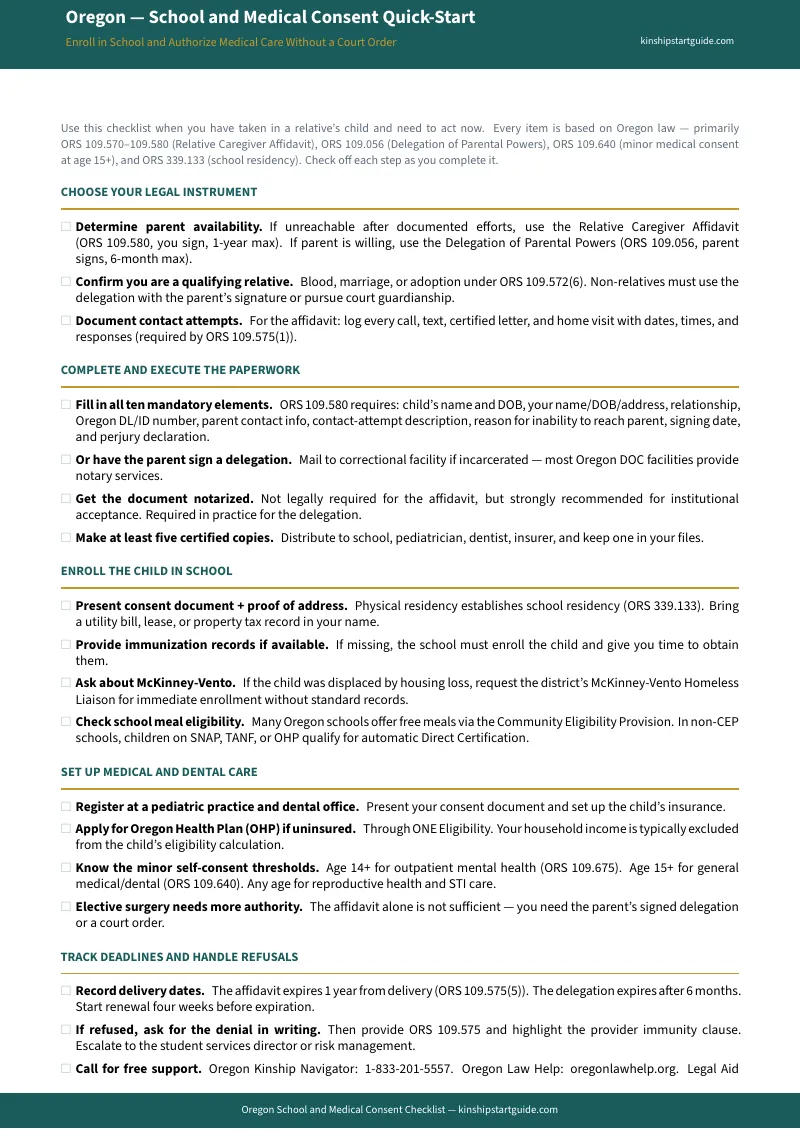
- The quick-start checklist — a printable 21-item summary of the forms, enrollment documents, and contact numbers you need in the first 72 hours
- Document Readiness Checklist — a pre-action checklist to confirm you have every document and signature before visiting an institution
- Affidavit and POA Execution Checklist — step-by-step completion and notarisation tracker for either consent instrument
- Instrument Decision Flowchart — a one-page worksheet that walks you to the right instrument for your situation
- Administrative Refusal Log — a dated evidence trail for filing formal complaints when an institution rejects valid paperwork
- Agency Communication Log — a running record of every call, visit, and email with schools, clinics, insurers, and social services
- School Enrollment Preparation Worksheet — every document to bring to the district office, records transfer tracking, and enrollment-day reminders
- Medical Intake Preparation Worksheet — what to bring to the child's first appointment, medical history fill-in, and appointment-day reminders
- Authority Expiration and Renewal Tracker — date calculations with a four-weeks-before reminder row so you can calendar the renewal before the cap
- School and medical escalation letters — ready-to-print letters citing ORS 109.575 and ORS 109.580, including the statutory immunity clause
- Side-by-side Instrument Comparison Table — Relative Caregiver Affidavit vs. Delegation of Parental Powers vs. probate guardianship, with signing requirements, duration, and scope
- Emergency contact and key information card — two cut-out cards (wallet and backpack) with the child's name, allergies, insurance, and consent document dates
- Legal aid and kinship navigator directory — in the guide: Oregon Kinship Navigator (1-833-201-5557), Legal Aid Services of Oregon, Oregon Law Help, FACT Oregon, 211info, and OJD guardianship resources
Satisfaction Guarantee
Full refund, no time limit. If the guide doesn't help you navigate your situation, email [email protected] and we'll refund every penny — no forms, no waiting period, no questions.
A Child Shouldn't Wait for a Court Date to See a Doctor
Oregon's consent and delegation rules exist so they don't have to. The guide shows you how to use them — every form, every deadline, every conversation — so the paperwork never stands between a child and the care that child needs.
Download includes the full 12-chapter guide, the 21-item quick-start checklist, and 12 standalone printables (document readiness checklist, affidavit and POA execution checklist, instrument decision flowchart, administrative refusal log, agency communication log, school enrollment preparation worksheet, medical intake preparation worksheet, authority expiration and renewal tracker, school and medical escalation letters, instrument comparison table, and emergency contact cards). Instant access after purchase.
Already have the free checklist? The full kit goes deeper — step-by-step instrument completion, the Authority Expiration and Renewal Tracker that protects your paperwork, escalation letters for reluctant institutions, the court pathways, teen self-consent rules, Oregon Health Plan enrollment, special education rights, and the scenario walkthroughs that turn "I think this is right" into "I know exactly what to do."
Frequently Asked Questions
What if the rules change after I buy?
We update the guide when the rules change. Email us any time, even years later, and we'll send you the current edition free.