The school says bring a court order. The clinic wants custody papers. Ohio law says you need neither.
You took in a child — maybe your grandchild, a niece, a nephew, or the child of a friend who can't be there right now. The reasons are painful and private, and you didn't have weeks to prepare. What you had was overnight.
Now the child needs to start school. Needs a doctor's appointment. Needs immunizations before the district will let them through the door. And every front desk you walk up to asks for paperwork that sounds like it requires a lawyer, a judge, or a parent who isn't available.
Here's what most caregivers don't know: Ohio has a Caregiver Consent System — a set of statutory instruments that let you enrol a child in school and consent to medical care using documents you can execute at your kitchen table. The problem isn't the law. The problem is that school registrars and pediatric intake staff routinely get the law wrong, and when they turn you away, you don't know which statute to cite or what to say next.
What the Caregiver Consent System Covers
The guide walks you through every consent instrument Ohio recognises for a caregiver without a court order, and shows you exactly when to use each one:
- Grandparent Power of Attorney (ORC § 3109.52) — the primary instrument when a parent is available and willing to sign. Step-by-step instructions for the Supreme Court statutory form (SCO-CSD-CFC-0001), including who signs, how to handle the certified mail notice to a non-signing parent, the notarisation requirements, and the mandatory five-day juvenile court filing deadline that voids the document if you miss it
- Caretaker Authorization Affidavit (ORC § 3109.65) — the instrument for grandparents when the parent cannot be located after reasonable efforts. The grandparent signs alone. The guide explains what "reasonable efforts" means, the diligent-search documentation standard, and the one-year validity and automatic termination rules
- Non-grandparent alternatives — Ohio's GPOA and CAA are restricted to grandparents. If you're an aunt, uncle, older sibling, or family friend, the guide covers the paths that work for you: McKinney-Vento protections for immediate school enrollment, a parental delegation letter for medical consent, and the juvenile court petition route when no informal instrument is available
- Minor mental health consent at age 14 (ORC § 5122.04) — Ohio's parallel consent threshold that lets teenagers aged 14 and older consent to outpatient mental health counseling independently, up to six sessions or 30 days. The guide covers how this interacts with your caregiver authority and what the privacy rules mean for your access to the teen's therapy records
The Five-Day Filing Rule — The Deadline Nobody Warns You About
Both the GPOA and CAA must be notarised and filed with the county juvenile court within five calendar days. Miss it, and the document is legally void. You start over — another trip to the notary, another filing, another five-day clock. Meanwhile the child can't start school and can't see the doctor.
The guide maps the entire five-day timeline: who notarises the document, what attachments the court requires (the UCCJEA custody affidavit, the certified mail receipt for one-parent GPOAs), whether your county charges a filing fee (state law says fees must be waived, but local practice varies), and how to file by certified mail if you can't get to the courthouse in person.
When the School or Clinic Says No
School districts across Ohio routinely contradict state law. Registrars demand court custody orders that ORC § 3313.64 does not require. Pediatric offices refuse a properly filed GPOA because "it doesn't look like a custody order." Enrollment clerks insist on a biological parent's signature when the Caretaker Authorization Affidavit is signed by the grandparent alone.
The guide includes a refusal escalation protocol — with statutory citations referencing ORC § 3313.64, § 3109.52, and § 3109.65 — that you can present to a reluctant principal, registrar, or clinic manager. You shouldn't need it. But when an administrator who hasn't read the statute stands between a child and a school desk or a doctor's appointment, you will be glad you have it.
The Instrument Comparison Table
Should you use the GPOA, the CAA, a parental delegation letter, or a court petition? The guide includes a side-by-side comparison table and a one-page decision flowchart that lay out the authority each instrument grants, who needs to sign, whether notarisation is required, which court you file with, how long it lasts, and when the simpler option stops being enough. Most caregivers discover they can handle school and routine medical care without a courthouse hearing. Some learn they need the court sooner than they thought. Either way, you stop guessing.
Who This Is For
- A grandparent who has taken in a grandchild and needs to get that child into school and to the doctor — this week
- An aunt, uncle, older sibling, or family friend caring for a child whose parent is incarcerated, in treatment, or unable to be present — and who needs to know exactly which documents work when Ohio's statutory forms are limited to grandparents
- A caregiver who has been told — incorrectly — that they need a court custody order to enrol a child in school or schedule a doctor's appointment
- A family helper or adult child buying this on behalf of an older relative who needs clear, printable instructions they can follow step by step
- Anyone who was turned away by a school or clinic and told they need "custody papers" — and wants to know whether that's actually true
Why Not Free Resources?
The Supreme Court of Ohio statutory forms are free, and we link directly to them in the guide. Ohio Legal Help publishes guided form builders for the GPOA and CAA. The OhioKAN helpline (1-844-644-6526) connects caregivers to local support. The guide doesn't replace any of that — it bridges the gap between having the blank form and knowing what to do with it.
Free resources give you the blank statutory form. They don't walk you through the five-day filing timeline step by step. They don't explain how to document "reasonable efforts" to locate a parent for the CAA. They don't give you a refusal escalation protocol with the exact ORC citations for when a registrar turns you away. They don't cover the distinction between a GPOA and a general power of attorney — or why that distinction matters when the school says your document "isn't valid." And they don't include the seven printable worksheets that keep every deadline, contact, and document organized in one place.
What You Get
- The complete guide — 14 chapters covering every consent pathway, the five-day filing rule, school enrollment rights, special education under IDEA, medical and dental consent, mental health consent at age 14, HIPAA and FERPA records access, Medicaid and Healthy Start, court options, financial help (OWF, SNAP, KPIP, KGAP), daily life and travel, pending legislation (SB 58, HB 913), and worksheets
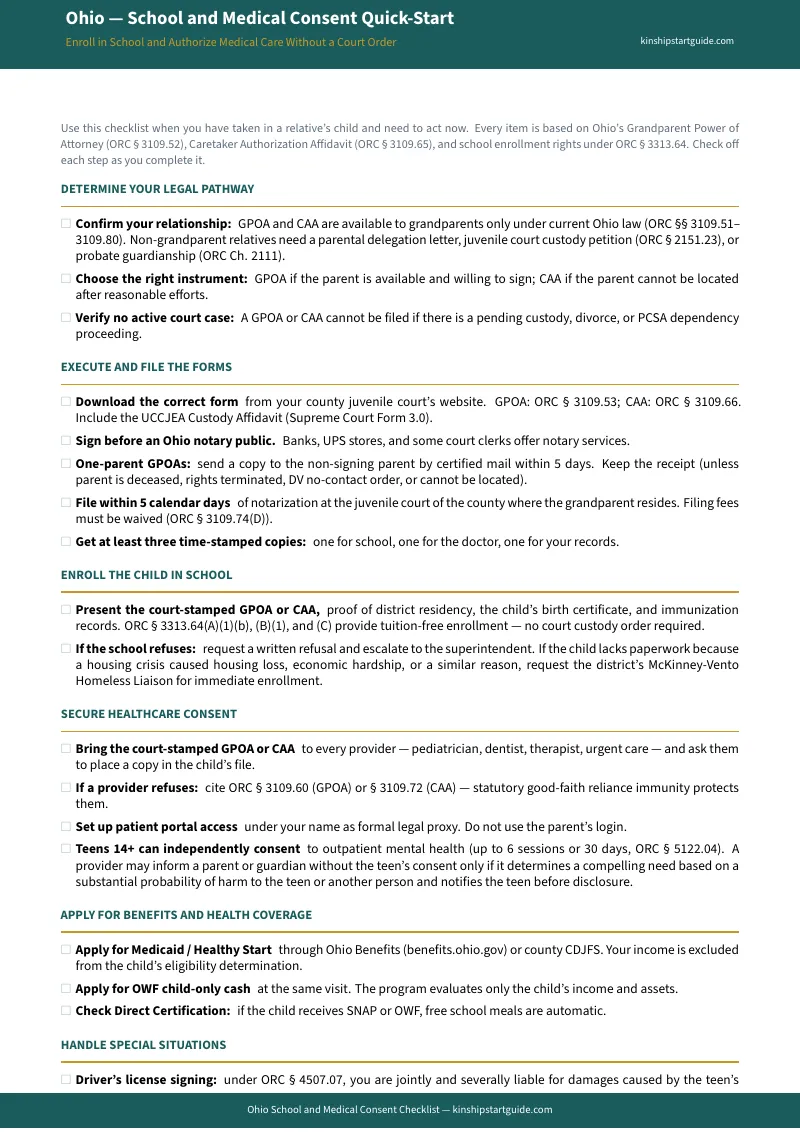
- The quick-start checklist — a two-page printable summary of the consent forms, school enrollment steps, benefits contacts, and mental health rules you need in the first 72 hours
- Instrument decision flowchart — answers "Which form applies to my family situation?" in a visual yes/no format based on your relationship to the child and the parent's availability
- School enrollment document tracker — every document to bring to the district office, with Have/Need checkboxes and space for registrar contact names
- School enrollment communication log — a dated log of registrar, superintendent, Homeless Liaison, and special-education contacts, including the 30-day / 60-day evaluation clock
- Appointment and medical authorization tracker — a log for every healthcare provider visit, including what was authorized and whether your GPOA/CAA copy is on file
- Refusal log — a dated evidence trail for documenting interactions with schools and clinics that refuse valid paperwork
- Certified mail tracking sheet — organizes proof-of-mailing receipts for the certified mail notice required when only one parent signs a GPOA
- Annual renewal calendar — tracks the one-year CAA expiration, immunization deadlines, school registration windows, Medicaid recertification, and OWF review dates in one place
- Key resources and contacts — OhioKAN, Ohio Legal Help, Ohio Department of Education and Workforce, county juvenile courts, county CDJFS offices, and legal aid societies
Satisfaction Guarantee
Full refund, no time limit. If the guide doesn't help you navigate your situation, email [email protected] and we'll refund every penny — no forms, no waiting period, no questions.
A Child Shouldn't Wait for a Court Date to See a Doctor
Ohio built a system so they don't have to. The guide shows you how to use it — and what to do when someone tries to tell you it doesn't exist.
Download includes the full 45-page guide, the two-page quick-start checklist, and seven standalone printable worksheets (instrument decision flowchart, school enrollment document tracker, school enrollment communication log, appointment and medical authorization tracker, refusal log, certified mail tracking sheet, and annual renewal calendar). Instant access after purchase.
Already have the free checklist? The full guide goes deeper — step-by-step notarisation and filing instructions, the five-day timeline mapped out, a refusal escalation protocol with statutory citations, county filing variation warnings, benefits eligibility for the child, special education rights, and the scenario walkthroughs that turn "I think this is right" into "I know exactly what to do."
Frequently Asked Questions
What if the rules change after I buy?
We update the guide when the rules change. Email us any time, even years later, and we'll send you the current edition free.