The school says bring a court order. The doctor wants custody papers. New York law says you need neither.
You took in a child — maybe your grandchild, a niece, a nephew, or the child of a close friend who can't be there right now. The reasons are painful and private, and you didn't have time to prepare. What you had was overnight.
Now the child needs to start school. Needs a pediatrician. Needs a dentist. And every front desk you walk up to asks for paperwork you don't have — custody papers, court orders, documents that sound like they require a judge and a lawyer.
Here's what most caregivers don't know: New York has a Parent Designation System under GOL Title 15-A that lets a parent delegate school and medical authority to you — no court hearing, no attorney, no filing fee. And when the parent can't sign, the state's school residency affidavit system lets you enrol the child anyway. The problem isn't the law. The problem is that school clerks and clinic intake staff routinely get the law wrong, and when they turn you away, you don't know which statute to cite or what form to hand them.
What the Parent Designation System Covers
The guide walks you through every consent instrument New York recognises for a caregiver without a court order, and shows you exactly when to use each one:
- GOL Title 15-A Designation (Form OCFS-4940) — the core instrument. Line-by-line instructions for New York's official Designation of Person in Parental Relation form, including the two-tier execution system: 30-day quick designations (signature only) and 12-month notarised designations with the caregiver's written consent
- School residency affidavit (8 NYCRR 100.2(y)) — when the parent can't or won't sign. This affidavit establishes the child's right to free public school attendance in your district based on total physical care and control — no parental signature, no court order
- Medical consent tiers under PHL § 2504 — the critical distinction between routine care (doctor visits, dental, immunisations, prescriptions) that a designated person in parental relation can authorise and major procedures (elective surgery, ECT, withdrawal of life-sustaining treatment) that require a court-appointed guardian
- Standby guardianship (SCPA § 1726) — when a parent faces terminal illness, long-term hospitalisation, or military deployment. The guide explains how to set up authority that activates automatically upon the parent's incapacity, bridging the gap until a court can confirm guardianship
- Adolescent mental health and minor self-consent — how New York's rules for youth who are married, parents themselves, pregnant, or designated homeless under McKinney-Vento affect your authority and the child's right to independent medical decisions
When the School or Clinic Says No
School registration clerks across New York regularly turn away relative caregivers, demanding court custody orders that state regulations explicitly say are not required. Under 8 NYCRR 100.2(y), if a school questions enrollment, the school board or its designee must issue an official written determination within two business days — detailing the specific grounds for denial and the 30-day appeal process to the Commissioner of Education.
The guide includes a pre-written Notice of Right to Written Determination — a polite, fill-in-the-blank letter you can hand to a reluctant registration clerk to trigger this mandatory formal process. You shouldn't need it. But when an administrator who hasn't read the regulations stands between a child and a classroom, you will be glad you have it.
The Parent Availability Decision Worksheet
Should you use Form OCFS-4940, a school residency affidavit, a standby guardianship designation, or a full court guardianship petition? The answer depends almost entirely on the parent's situation — cooperative, in treatment, incarcerated, deceased, or unlocatable. The kit includes a structured decision worksheet that maps each parental circumstance to the exact instruments available, who needs to sign, how long each lasts, and when the simpler path stops being enough. Most caregivers discover they can skip the courthouse entirely. Some learn they need the court sooner than they thought. Either way, you stop guessing.
Who This Is For
- A grandparent, aunt, uncle, or older sibling who has taken in a child and needs to get that child into school and to the doctor — this week
- A family friend or godparent who provides daily care and wants to know exactly what they can and cannot authorise in New York
- A family helper or adult child buying this on behalf of an older relative who needs clear, step-by-step instructions
- Anyone who was turned away by a school or clinic and told they need "custody papers" — and wants to know whether that's actually true under New York law
Why Not Free Resources?
Form OCFS-4940 is free, and we link directly to it in the guide. The NYS Kinship Navigator (877-454-6463) provides excellent telephone support and legal fact sheets. LawHelpNY publishes authoritative guidance on informal kinship care. The guide doesn't replace any of that — it bridges the gap between having the form and knowing what to do with it.
Free resources give you the form. They don't give you line-by-line completion instructions for the two-tier execution system. They don't tell you what to say when a school district in Buffalo or Yonkers demands a court order the law doesn't require. They don't separate the medical procedures you can authorise from the ones you cannot. And they don't walk you through five real scenarios — incarcerated parent, deceased parent, unlocatable parent, child needing mental health treatment, child with an IEP — so you can see how the rules apply to a situation like yours.
What You Get
- The complete guide — 14 chapters covering the GOL Title 15-A designation, school enrollment, medical consent tiers, McKinney-Vento protections, adolescent mental health, special education rights, everyday authority boundaries, and the court guardianship pathway
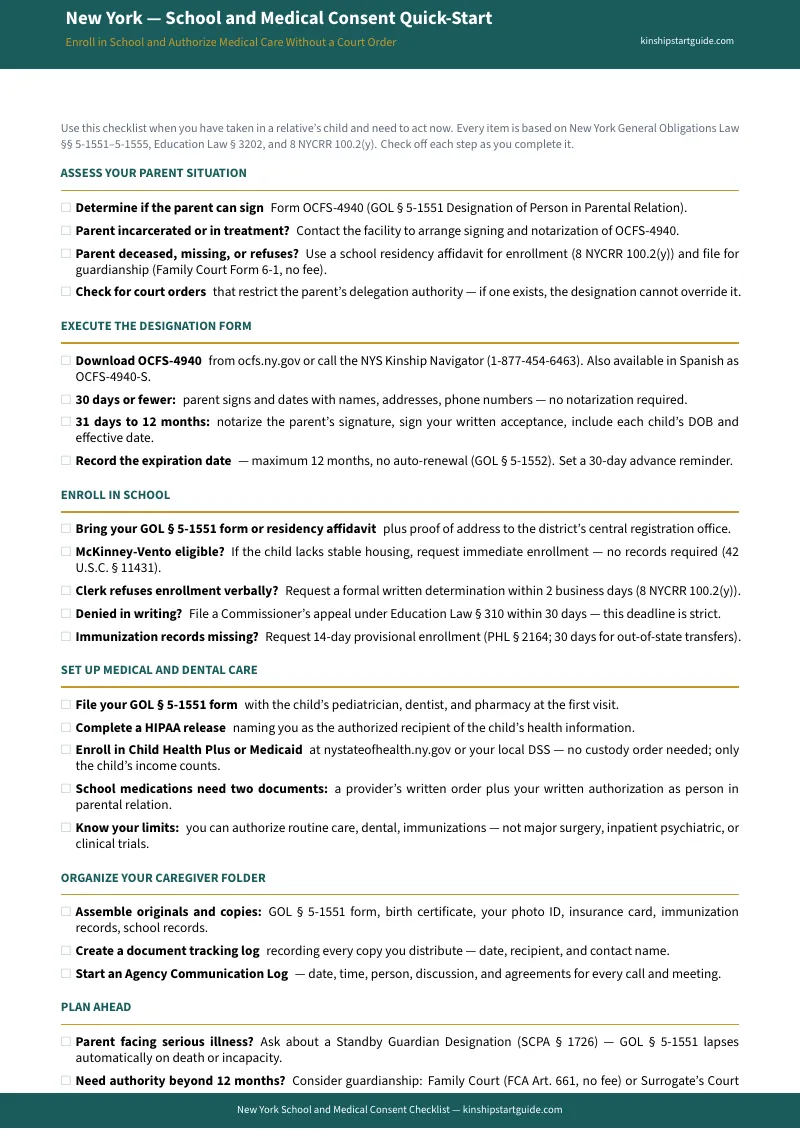
- The quick-start checklist — a printable 25-item summary of the forms, enrollment documents, and contact numbers you need in the first 72 hours
- Form OCFS-4940 completion worksheet — fill this in before the official state form so nothing gets rejected for a clerical mistake or missing notarisation
- Parent availability decision worksheet — a one-page chart mapping parental circumstances to the right instruments
- School enrollment document list — every document to bring to the district's central registration office, with the statutory basis for each and what to say if they ask for more
- School enrollment escalation worksheet — a ready-to-print Notice of Right to Written Determination citing 8 NYCRR 100.2(y)
- Clinical consent scope worksheet — a plain-language checklist separating routine care, emergency treatment, and major surgical exclusions so you know exactly what to tell a doctor's intake desk
- Medical visit preparation checklist — what to pack the night before a new pediatrician, dentist, or specialist appointment
- Document expiry and renewal log — tracks signature dates, notary timestamps, 30-day and 12-month expiration thresholds, and renewal reminders
- Agency communication log — a dated record of every call and visit with schools, clinics, insurers, and agencies
- Emergency contact cards — two fill-in cards with the child's key information for your wallet and the child's backpack
- Five caregiving situations mapped in the guide — incarcerated parent, deceased parent, unlocatable parent, child needing mental health care, child with an IEP — tied to the forms and steps that fit
- Legal aid and kinship navigator directory — free statewide and regional resources including the NYS Kinship Navigator, LawHelpNY, NYS-TEACHS, and local legal aid contacts
Satisfaction Guarantee
Full refund, no time limit. If the guide doesn't help you navigate your situation, email [email protected] and we'll refund every penny — no forms, no waiting period, no questions.
A Child Shouldn't Wait for a Court Date to See a Doctor
New York built a system so they don't have to. The guide shows you how to use it — and what to do when someone tries to tell you it doesn't exist.
Download includes 11 PDFs — the full guide, the quick-start checklist, and 9 standalone printables (form worksheet, decision worksheet, enrollment list, escalation letter, consent scope sheet, visit-prep checklist, expiry log, communication log, and emergency contact cards). Instant access after purchase.
Already have the free checklist? The full guide goes deeper — line-by-line form instructions, a pre-written escalation letter, the parent availability decision worksheet, the clinical consent scope worksheet, and the situation walkthroughs that turn "I think this is right" into "I know exactly what to do."
Frequently Asked Questions
What if the rules change after I buy?
We update the guide when the rules change. Email us any time, even years later, and we'll send you the current edition free.