The school wants a custody order. The clinic wants a parent who isn't here. Nebraska law says you need neither — if you use the right instrument.
You took in a child — maybe your grandchild, a niece, a nephew, or the child of a friend who can't be there right now. The reasons are painful and private, and you didn't have weeks to prepare. What you had was overnight.
Now the child needs to start school. Needs a doctor's appointment. Needs a dentist. And every front desk you walk up to asks for paperwork that sounds like it requires a lawyer, a judge, or a parent who isn't available.
Here's what most caregivers don't know: Nebraska has a Delegation and Enrollment System built into state law that lets you handle school enrollment and medical care using documents you can complete at your kitchen table — with no court hearing and no attorney. But the system has gaps that trap people. Unlike some states, Nebraska has no caregiver-authorization affidavit a relative can sign alone. If you've been searching for one online, stop — those forms have no statutory basis in Nebraska, and a school registrar will reject them. What works is a § 30-2604 power of attorney with a parent's notarised signature, or the NDE Rule 19 enrollment form when a parent isn't available. The law works, but only when you use the right instrument for your situation.
What the Delegation and Enrollment System Covers
The guide walks you through every consent instrument Nebraska recognises for a caregiver without a court order, and shows you exactly when to use each one:
- § 30-2604 Power of Attorney (Form DC 6:10.1) — the core document. Step-by-step execution instructions, including notarisation requirements, the strict six-month statutory cap, the renewal strategy with a five-month calendar reminder, what happens when a parent revokes, and coordination with facility notaries when a parent is incarcerated or in treatment
- Medical consent boundaries — what you can and cannot authorise. Routine care, dental visits, immunisations, prescriptions, the emergency care doctrine, and the line between having health insurance coverage (Kids Connection) and having the legal right to consent to treatment — because they are not the same thing
- School enrollment and NDE Rule 19 — how to enrol a child using the "Adult with Legal or Actual Charge or Control" form under § 79-215, what documentation to bring, when a § 30-2604 POA strengthens your position, and what to say when a registrar demands a custody order the law doesn't require
- Minor guardianship through the courts — when no parent is available to sign. Filing under § 30-2608, temporary guardianship under § 30-2611(c), costs, notice requirements, and when the court path becomes the better route
- Teen self-consent rules — Nebraska's age of majority is 19 for general medical consent, but 18-year-olds can consent to their own mental health treatment. The guide maps out exactly where your caregiver authority ends and a teenager's own consent begins
When the School or Clinic Says No
School registrars across Nebraska routinely demand court orders or guardianship papers that no statute requires for enrollment. Pediatric offices refuse to see a child without "custody documentation" that the Code doesn't mandate. These refusals aren't malicious — they come from risk-averse institutional training and unfamiliarity with the enrollment statute. But they stand between a child and the care that child needs right now.
The download includes ready-to-print escalation letters — citing the exact Nebraska statutes, including § 79-215 residency law and § 30-2604 delegation authority — that you can hand to a reluctant registrar or clinic manager. You shouldn't need them. But when an administrator who hasn't read the statute stands between a child and a doctor's appointment, you will be glad you have them.
The Six-Month Clock That Voids Everything
A § 30-2604 power of attorney expires after six months from the date of notarisation. There is no grace period, no automatic extension, no warning from the state. The moment the six months pass, every school and medical provider that relied on that document is within its rights to refuse service. Miss the renewal window, and you start over with a new execution, a new notarisation, and new copies to every institution.
The guide includes a POA Expiration and Renewal Tracker with date calculations and a five-month calendar reminder so you never lose authority mid-school-year. It also covers the armed-forces deployment exception (up to 12 months) and the renewal coordination strategy when a parent's circumstances have changed — moved out of state, entered treatment, or become incarcerated.
The Statute Trap That Wastes Your Money
Online legal form sites routinely confuse two adjacent sections of Nebraska law. Section 30-2604 delegates parental care and custody powers. Section 30-2603 governs the delivery of money or personal property to a minor — capped at $40,000 per year — and provides zero authority to enrol a child in school or consent to medical treatment. If a website or template references "§ 30-2603" as the basis for parental delegation, the document is built on the wrong statute. The guide calls this out directly so you don't pay for a form that won't hold up.
The Side-by-Side Decision Matrix
Should you use a § 30-2604 power of attorney, an NDE Rule 19 enrollment form, or a court-appointed guardianship? The guide includes a comparison table that lays out the cost, the authority each instrument grants, who needs to sign, how long it lasts, and when the simpler option stops being enough. Most caregivers discover they can skip the courthouse entirely. Some learn they need the court sooner than they thought. Either way, you stop guessing.
Who This Is For
- A grandparent, aunt, uncle, or older sibling who has taken in a child and needs to get that child into school and to the doctor — this week
- A caregiver who tried to enrol a child and was turned away because they didn't have a court order — and wants to know whether that refusal was correct
- A relative caregiver who isn't sure whether a power of attorney, an NDE Rule 19 form, or a court guardianship petition is the right path right now
- A family helper or adult child buying this on behalf of an older relative who needs clear, step-by-step instructions
Why Not Free Resources?
Lutheran Family Services Kinship Navigation (1-833-572-2053) is free, Legal Aid of Nebraska provides legal representation, and the Nebraska Judicial Branch portal has the Form DC 6:10.1 available at no cost. The guide links directly to all of them. It doesn't replace any of that — it bridges the gap between knowing those resources exist and knowing what to do when you're standing at a school registration desk right now.
Free resources tell you that a § 30-2604 power of attorney exists and point you to the blank form. They don't give you the POA Expiration and Renewal Tracker that prevents your authority from lapsing. They don't include a School Enrollment Preparation Worksheet with the specific items a Nebraska district office expects. They don't tell you what to say when a registrar demands guardianship papers that no statute requires. And they don't walk you through the court guardianship path, teen self-consent rules, special education rights, McKinney-Vento protections, insurance and benefit eligibility, the coverage-versus-consent distinction, or scenario walkthroughs showing how the rules apply to situations like yours.
What You Get
- The complete guide — 13 chapters covering every consent pathway, school enrollment and NDE Rule 19, medical consent boundaries, mental health and teen self-consent, the court guardianship paths, special education and IDEA authority under NDE Rule 51, McKinney-Vento, insurance and benefits (Kids Connection Medicaid, ADC Relative Payee, Heritage Health managed care, SNAP), the coverage-versus-consent distinction, worksheets, scenario walkthroughs, and a resource directory
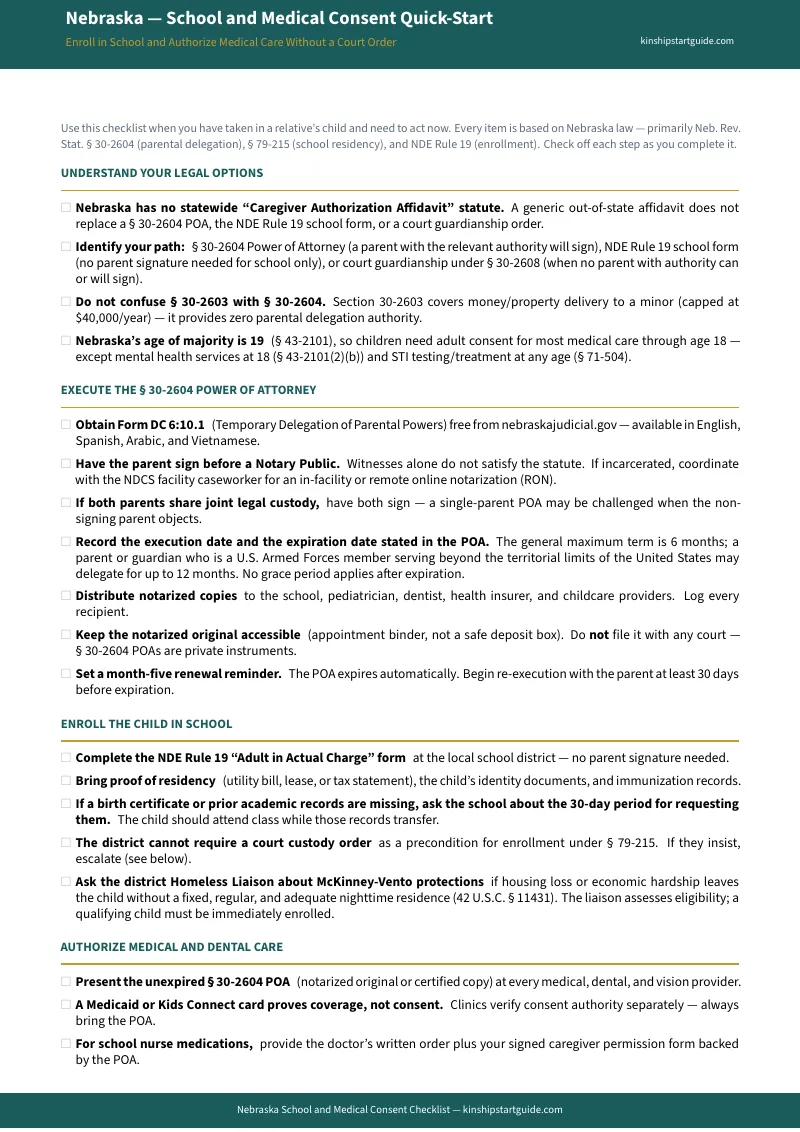
- The quick-start checklist — a printable 29-item summary of the forms, enrollment documents, and contact numbers you need in the first 72 hours
- Document Readiness Checklist — obtained, expiration date, and location stored for every school, medical, and benefits document before an appointment
- POA Execution Checklist — every step from drafting the § 30-2604 instrument through notarisation and distributing copies to the school and providers
- POA Expiration and Renewal Tracker — date calculations and a five-month reminder row so you can calendar the renewal yourself before the six-month cap
- School Enrollment Preparation Worksheet — every document to bring to the district office, with the basis for each and what to do if an item is missing
- Medical Intake Preparation Worksheet — what to bring to the child's first appointment, plus a consent block for when a parent cannot be reached
- School and medical escalation letters — ready-to-print letters citing the Nebraska statutes that override institutional refusals
- Side-by-side Instrument Comparison Table — § 30-2604 POA vs. NDE Rule 19 vs. court-appointed guardianship, with costs, signing requirements, and a fill-in for your situation
- Instrument Decision Flowchart — a one-page worksheet that walks you to the document that fits your situation
- Administrative Refusal Log — a dated evidence trail for filing formal complaints
- Agency Communication Log — date, person, what was discussed, what was decided, and follow-up for every school, clinic, and DHHS interaction
- Emergency contact and key information card — two cut-out cards (wallet and backpack) with the child's name, allergies, insurance, and POA execution date
- Legal aid and kinship navigator directory — in the guide: Lutheran Family Services Kinship Navigation (1-833-572-2053), Legal Aid of Nebraska (1-844-241-0020), Nebraska Judicial Branch Self-Help, and county DHHS contacts
Satisfaction Guarantee
Full refund, no time limit. If the guide doesn't help you navigate your situation, email [email protected] and we'll refund every penny — no forms, no waiting period, no questions.
A Child Shouldn't Wait for a Court Date to See a Doctor
Nebraska's delegation and enrollment rules exist so they don't have to. The guide shows you how to use them — every form, every deadline, every conversation — so the paperwork never stands between a child and the care that child needs.
Download includes the full 13-chapter guide, the 29-item quick-start checklist, and standalone printables (document readiness checklist, POA execution checklist, expiration and renewal tracker, school enrollment preparation worksheet, medical intake preparation worksheet, escalation letters, comparison table, decision flowchart, refusal log, agency communication log, and emergency cards). Instant access after purchase.
Already have the free checklist? The full kit goes deeper — step-by-step form execution, the POA Expiration and Renewal Tracker that protects your authority, escalation letters for reluctant institutions, the court pathways, benefits and insurance eligibility, the coverage-versus-consent distinction, and the scenario walkthroughs that turn "I think this is right" into "I know exactly what to do."
Frequently Asked Questions
What if the rules change after I buy?
We update the guide when the rules change. Email us any time, even years later, and we'll send you the current edition free.