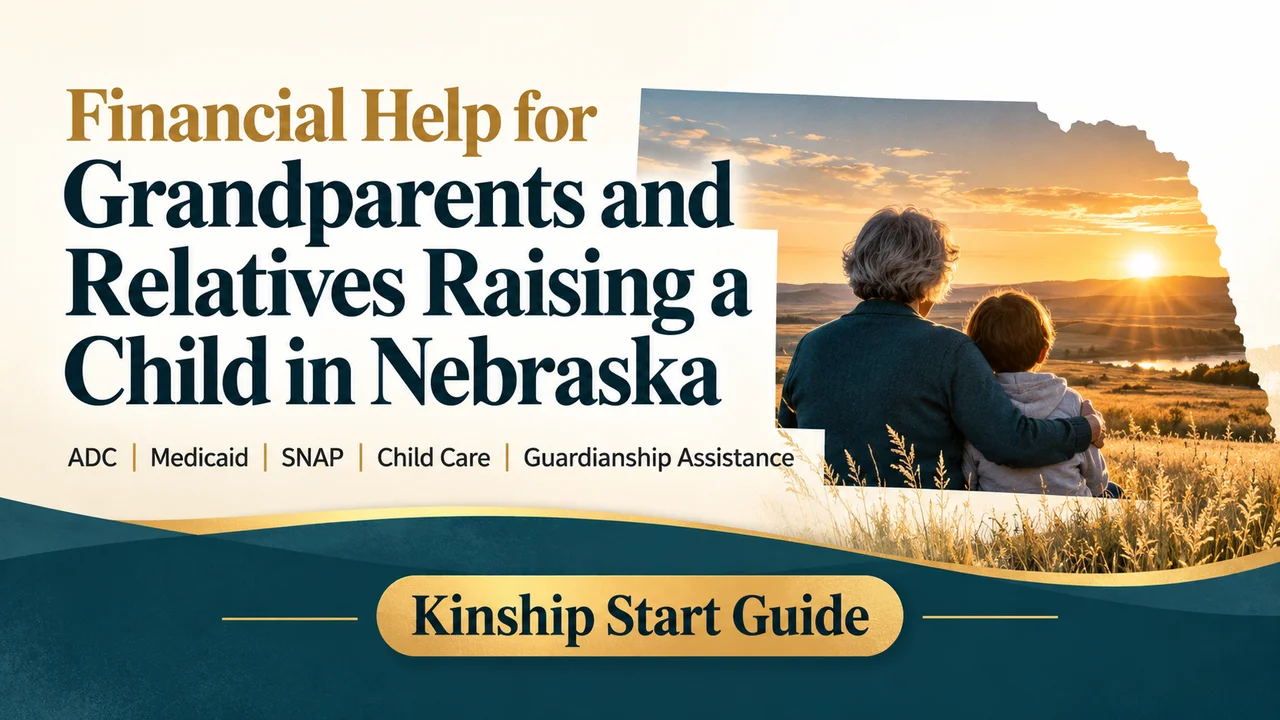
Your grandchild's income is what matters — not yours
A child arrived in your home with no warning. Within days, the costs started adding up — food, clothes, school supplies, a doctor who needs insurance information you don't have. And somewhere in the back of your mind, a question you're afraid to ask: can I really afford this?
Here's what most grandparents and relatives in Nebraska don't know: the state's most important cash program — the ADC child-only grant — completely ignores your income. Your Social Security, your pension, your wages, your savings. DHHS evaluates only the child's own income. If the child has little or none, the child qualifies. And that one approval triggers automatic eligibility for Medicaid, WIC, and free school meals.
The problem is that nobody tells you this in one place. Each program has different rules about whose income counts. SNAP includes your household income. The Child Care Subsidy counts it too. Subsidized Guardianship requires a prior foster care placement. The ACCESSNebraska portal uses a single application for all programs, and one wrong checkbox — including yourself in the assistance unit when you shouldn't be — can tank a child-only application.
The Nebraska Kinship Benefits Navigation System
This guide is a printable preparation system that organizes every financial program Nebraska offers to kinship families into a clear sequence: what to apply for, what documents to bring, whose income counts under each program's rules, and what deadlines to track after you're approved.
It's the difference between showing up to DHHS with a folder of loose papers and hoping your caseworker walks you through everything — and arriving with every document organized, every form identified, and a filing log that keeps your case on track through six-month redeterminations.
What's inside the guide
- The ADC child-only income exclusion explained in plain language — how to apply as a non-needy payee so DHHS never evaluates your retirement income or savings, plus the child support cooperation requirement and how to claim a good-cause exemption if there's a safety concern
- Medicaid and Kids Connect for the child — income thresholds by age bracket (133–194% FPL), why your income is excluded in most cases, and how to enroll through the same application
- SNAP household rules that work differently from ADC — why your income counts here, how the elderly/disabled household resource limit works, the Expanded Resource Program, and how LIHEAP triggers the heating deduction that raises your allotment
- Child Care Subsidy under Title 392 — who qualifies, what "approved activity" means, and how a relative at a different address can be paid as a license-exempt provider
- Subsidized Guardianship Assistance (GAP) — the specific conditions under which a kinship family can negotiate ongoing monthly payments after a child welfare placement
- Emergency resources when you can't wait — LFS Kinship Navigation emergency flexible funds, LIHEAP energy assistance, and WIC for children under 5
- Care arrangement comparison table — a side-by-side matrix showing how informal care, a § 30-2603 Power of Attorney, court guardianship, and foster placement each affect ADC, Medicaid, SNAP, and guardianship assistance eligibility
- Master document checklist — every piece of paper DHHS, the school district, and the pediatrician will ask for, organized in one printable list you can work through before your first call
- Agency communication log — a structured log for every call, visit, and document submission: filing dates, upload confirmation codes, caseworker names, and the follow-up deadlines you cannot miss
- Renewal and redetermination calendar — the 6-month ADC review, the 12-month Medicaid renewal, and the 10-day change-reporting window, with space to record every date the day your approval letter arrives
- Appeal instructions — how to file Form DA-6, the 90-day window, the 10-day continuation rule that keeps benefits running during your dispute, and where to get free legal help
- Nebraska contact directory — direct phone numbers for DHHS Economic Assistance, LFS Kinship Navigation, NCHS, Legal Aid of Nebraska, Area Agencies on Aging, and the Eldercare Locator
Who this is for
- Grandparents on a fixed income who just took in a grandchild and need to know what the child is entitled to — fast
- Aunts, uncles, adult siblings, and cousins raising a relative's child anywhere in Nebraska
- Relatives caring for a child under an informal arrangement, a notarized Power of Attorney, or a court guardianship order
- Adult children, social workers, or faith-based volunteers buying a clear, printable resource on behalf of an older relative
Why not just call the caseworker?
You should call the caseworker. This guide doesn't replace that call — it prepares you for it. ACCESSNebraska caseworkers process the application you submit. They verify documents, check eligibility, and issue decisions. What they cannot do, with 45 minutes on a phone queue and a caseload of hundreds, is walk you through every program you might be eligible for, explain which ones count your income and which don't, or help you build a filing system for the redetermination that arrives six months later.
Free navigators like LFS Kinship Navigation and Legal Aid of Nebraska are invaluable partners — call them too. But a phone call gives you verbal advice and referrals. It doesn't build the physical filing system sitting on your desk. This guide does both: it teaches you the rules and gives you the printable tools to stay organized long after the call ends.
What this guide does not do
This is an independent preparation guide and worksheet set — not a government publication, not a legal service, and not a promise of eligibility. It does not provide legal advice about custody, parental termination, or court strategy. Questions about whether to pursue guardianship are directed to Legal Aid of Nebraska (1-888-998-6574). It does not replace official state application forms. And if your family is facing an immediate food or shelter emergency, skip everything and call 2-1-1 or the LFS Kinship Navigator at (833) 572-2053 right now.
Full refund, no time limit
If the guide does not help your situation, email [email protected] for an immediate refund. No deadline, no hoops.
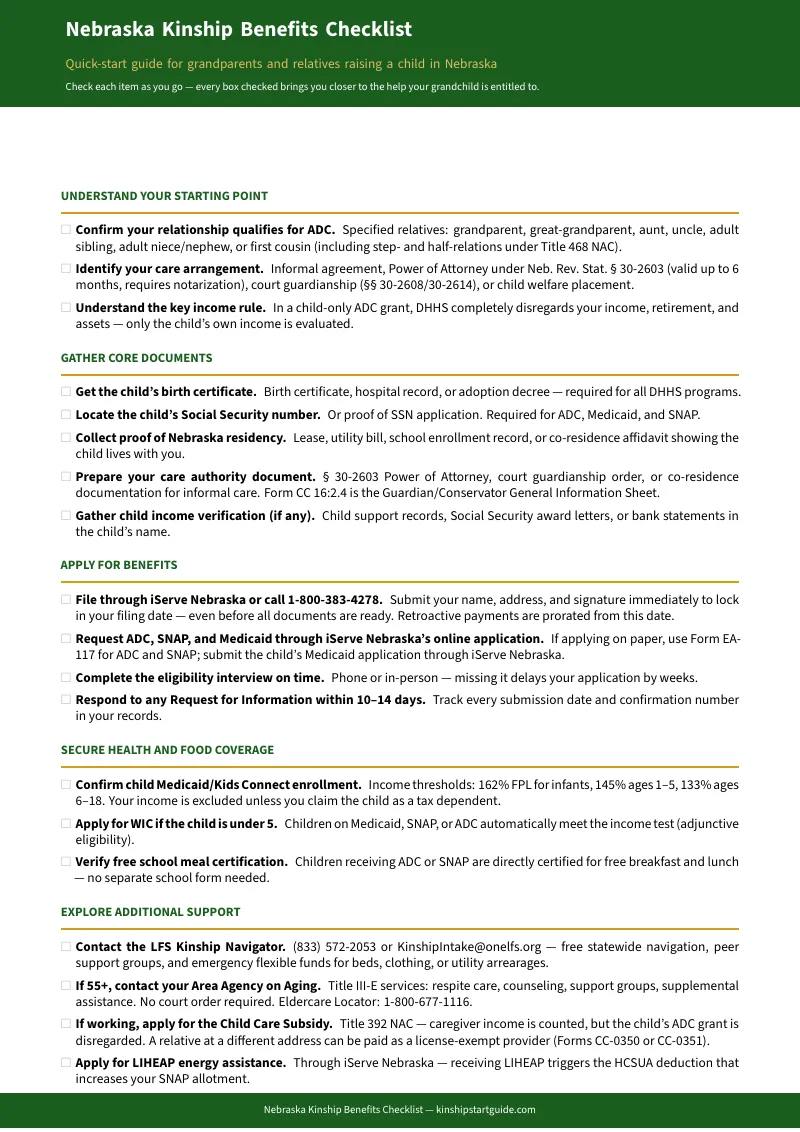
The free checklist gives you the highlights — the programs to check, the agencies, and the documents to bring. The full guide gives you the preparation system: program-by-program rules, worked examples, printable trackers, and the contact directory you need to get every dollar the child is entitled to.
Frequently Asked Questions
What if the rules change after I buy?
We update the guide when the rules change. Email us any time, even years later, and we'll send you the current edition free.