The school wants a court order. The clinic wants custody papers. Montana law says you may need neither — if you use the right paperwork.
You took in a child — maybe your grandchild, a niece, a nephew, or the child of a friend who can't be there right now. The reasons are painful and private, and you didn't have weeks to prepare. What you had was overnight.
Now the child needs to start school. Needs a doctor's appointment. Needs a dentist. And every front desk you walk up to asks for paperwork that sounds like it requires a lawyer, a judge, or a parent who isn't available.
Here's what most caregivers don't know: Montana has a Dual Affidavit System — the MCA 20-5-503 educational authorization affidavit and the MCA 40-6-502 medical authorization affidavit — that lets a blood relative sign consent paperwork without a parent, without a lawyer, and without a court order. When a parent is reachable, the MCA 72-5-103 minor power of attorney covers both school and medical decisions in a single document. But these instruments have traps. The medical affidavit expires after six months with no grace period. The educational affidavit expires at the end of the school year. Generic "Caregiver Authorization Affidavit" forms sold by commercial document sites often cite the wrong statute or borrow language from states with different laws — present one to a Billings school registrar or a Missoula pediatric office and you'll get a polite refusal and a wasted trip.
The guide shows you the instruments Montana actually recognises — the two statutory affidavits, the minor power of attorney, the continuing custody affidavit, and guardianship — and tells you exactly which one to use, how to complete it, and what to say when someone at the front desk says no.
What the Dual Affidavit System Covers
The guide walks you through every consent mechanism Montana recognises for a caregiver without a court order, and shows you when to use each one:
- MCA 20-5-503 Educational Authorization Affidavit — the instrument that gets a child into school without a parent's signature. The relative signs under oath before a notary, attesting that the child lives with them full-time, no parent is available, and no adequate educational provision has been made. The guide covers the four enrollment conditions under MCA 20-5-502, the mandatory statutory warning language, the school-year expiration, and what to do when a district demands more than the statute requires
- MCA 40-6-502 Medical Authorization Affidavit — the companion instrument for healthcare. Same eligibility, same notarisation requirement, but a six-month cap instead of a school-year cycle. The guide covers the attestation boxes, the good-faith reliance protection that shields providers under MCA 40-6-502(4)(a), and the renewal cycle you need to track
- MCA 72-5-103 Minor Power of Attorney — when a parent is reachable and willing. This single document delegates school, medical, and daily caregiving authority to any designated adult, including non-relatives. The parent signs, and the authority lasts up to six months with a military extension for Guard, Reserve, and active-duty members. The guide covers execution step by step, including what happens when the signing parent is incarcerated, in treatment, or overseas
- School enrollment and free meals — the MCA 20-5-502 residency pathway, McKinney-Vento protections for children in unstable housing, TANF child-only direct certification for free school meals, and the records you need to bring to the district office
- Medical, dental, and teen consent — what each instrument authorises, the emergency care exception, the adolescent self-consent provisions under MCA 41-1-402, and the situations where a teenager can consent to their own treatment
- Insurance, benefits, and financial support — Healthy Montana Kids (HMK), TANF child-only, Best Beginnings child-care assistance, and how to apply without a custody order
- Guardianship under MCA Title 72, Chapter 5, Part 2 — when informal authority isn't enough. Filing the petition, the notice requirements, the hearing, and the situations where a court order becomes the clearer path
When the School or Clinic Says No
School registrars across Montana sometimes demand court orders or guardianship papers that no statute requires for enrollment. Pediatric offices refuse to see a child without "custody documentation" that the law doesn't mandate for care authorised under a valid affidavit or power of attorney. These refusals aren't malicious — they come from institutional caution and unfamiliarity with the consent statutes. But they stand between a child and the care that child needs right now.
The guide includes a step-by-step escalation protocol — requesting the written policy, presenting the statutory text and the provider immunity provisions under MCA 20-5-503(4)(a) and MCA 40-6-502(4)(a), escalating to district leadership or a clinic's patient advocate, and calling for reinforcement from Montana Legal Services Association or the Montana Kinship Navigator Program. You shouldn't need it. But when an administrator who hasn't read the statute stands between a child and a doctor's appointment, you'll be glad you have it.
The Commercial Form Trap
Commercial document sites sell "Montana Caregiver Authorization Affidavits" and generic minor power of attorney forms that cite the wrong statute, use financial POA language instead of the parental delegation statute, or borrow templates from states whose laws have no equivalent in Montana. Some charge a one-time fee. Others lock you into a monthly subscription. And the institutions that matter — schools, hospitals, pharmacies — may reject them because the legal authority they claim doesn't exist in this state.
The guide cuts through this by explaining the actual statutory framework: what Montana law provides, what it doesn't, and which documents a caregiver can present with confidence because the statute stands behind them.
The Authority Comparison Matrix
Should you use the educational affidavit, the medical affidavit, the minor power of attorney, or a guardianship petition? The guide includes a comparison of all five instruments: statutory basis, who can use each one, whether a parent must sign, whether a court filing is required, maximum duration, and when the simpler option stops being enough. Most caregivers discover they can handle school and medical needs without a court filing. Some learn they need guardianship sooner than they thought. Either way, you stop guessing.
Who This Is For
- A grandparent, aunt, uncle, or older sibling who has taken in a child in Montana and needs to get that child into school and to the doctor — this week
- A caregiver who tried to enrol a child and was turned away because they didn't have a court order — and wants to know whether that refusal was correct
- A non-relative family friend who cannot use the statutory affidavits and needs to understand which pathways require a parent's signature
- A relative who has a willing parent available to sign but doesn't know whether the educational affidavit, the medical affidavit, or the minor power of attorney is the right document
- A family helper or adult child buying this on behalf of an older relative who needs clear, step-by-step instructions
Why Not Free Resources?
Montana Legal Services Association publishes legal guides and operates a helpline. The Montana Kinship Navigator Program at MSU Extension offers peer support and referrals. The Judicial Branch Self-Help Centers distribute guardianship packets. The guide links to all of them. It doesn't replace any of that — it bridges the gap between knowing those resources exist and knowing what to do when you're standing at a school registration desk right now.
Free resources tell you that MCA 20-5-503 and MCA 40-6-502 exist. They don't walk you through the attestation boxes, the mandatory warning language, and the notarisation step by step. They don't include a renewal tracker that prevents your medical affidavit from lapsing after six months. They don't give you the escalation protocol for when a registrar demands guardianship papers that no statute requires. And they don't cover the minor power of attorney for non-relatives, the continuing custody affidavit when a parent reappears, teen self-consent boundaries, special education rights, McKinney-Vento protections, HMK and TANF eligibility, ICWA and MICWA considerations, or the scenarios that show how the rules apply to situations like yours.
What You Get
- The complete guide — 14 chapters covering every consent pathway, the MCA 20-5-503 educational affidavit, the MCA 40-6-502 medical affidavit, the MCA 72-5-103 minor power of attorney, the MCA 40-6-602 continuing custody affidavit, school enrollment and meals, special education and Section 504, adolescent self-consent, insurance and benefits, completing and filing the forms, guardianship, ICWA and MICWA, institutional refusal escalation, and a resource directory
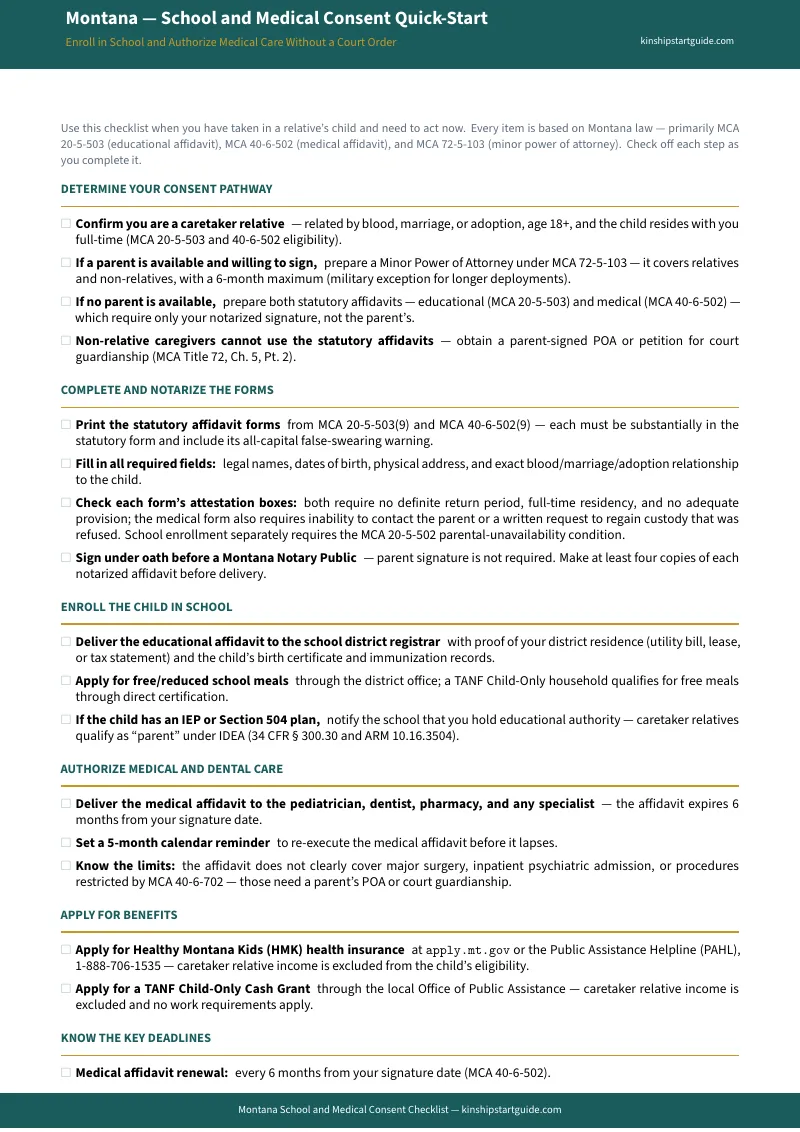
- The quick-start checklist — a printable summary of the forms, enrollment documents, and contact numbers you need in the first 72 hours
- 7 printable planning tools — an affidavit renewal tracker, a document delivery log, a provider contact sheet, a medical visit preparation checklist, an institutional refusal response sheet with statutory citations, a benefits application checklist, and an agency communication log
Satisfaction Guarantee
Full refund, no time limit. If the guide doesn't help you navigate your situation, email [email protected] and we'll refund every penny — no forms, no waiting period, no questions.
A Child Shouldn't Wait for a Court Date to See a Doctor
Montana's statutory affidavits and minor power of attorney exist so they don't have to. The guide shows you how to use them — every form, every deadline, every conversation — so the paperwork never stands between a child and the care that child needs.
Download includes the complete 14-chapter guide, the quick-start checklist, and 7 printable planning tools. Instant access after purchase.
Already have the free checklist? The full guide goes deeper — step-by-step affidavit completion with the mandatory statutory language, 7 printable planning tools including the renewal tracker that protects your authority, the escalation protocol for reluctant institutions, the minor power of attorney for non-relatives, the continuing custody affidavit, the court process, benefits and insurance eligibility, and the chapter-by-chapter walk-throughs that turn "I think this is right" into "I know exactly what to do."
Frequently Asked Questions
What if the rules change after I buy?
We update the guide when the rules change. Email us any time, even years later, and we'll send you the current edition free.