The school says bring a court order. The clinic wants guardianship papers. Missouri law says you need neither.
You took in a child — maybe your grandchild, a niece, a nephew, or the child of a close friend who can't be there right now. The reasons are painful and private, and you didn't have time to prepare. What you had was overnight.
Now the child needs to start school. Needs a pediatrician. Needs a dentist. And every front desk you walk up to asks for paperwork that sounds like it requires a lawyer, a judge, or a parent who isn't available.
Here's what most caregivers don't discover until they've already been turned away: Missouri has a Dual-Track Consent System — two distinct non-court instruments that let you handle school enrollment and medical care without filing a single court petition. The Parental Power of Attorney under RSMo 475.602 works when a parent can cooperate. The Relative Caregiver Affidavit under RSMo 431.058 works when the parent is unavailable, incarcerated, in treatment, or unreachable — and it requires only your signature. On top of these, Missouri's school residency exceptions under RSMo 167.151 and DESE's explicit guidance against mandatory guardianship demands give you a separate enrollment pathway that doesn't depend on either document. The problem isn't the law. The problem is that school clerks and clinic receptionists routinely get the law wrong — demanding court orders that Missouri's own statutes don't require — and when they turn you away, you don't know which instrument to reach for or what to say next.
What the Dual-Track Consent System Covers
The guide walks you through every consent mechanism Missouri recognises for a caregiver without a court order, and shows you exactly when to use each one:
- Parental Power of Attorney — RSMo 475.600–475.604 — the parent-signed delegation instrument under the Supporting and Strengthening Families Act. The guide covers every mandatory element under RSMo 475.604 (the child's full name and DOB, caregiver contact details, the exact statutory delegation statement, the time period, the revocability acknowledgment, and the notarial seal), the three background checks required by RSMo 475.602.6 (fingerprint criminal, sex offender registry, child abuse registry), the one-year expiration, the military extension for active-duty parents (deployment plus thirty days), the four powers that can never be delegated, how to coordinate a notarisation at a correctional facility or treatment centre when the parent is institutionalised, and the Missouri Court of Appeals ruling in In the Interest of A.J.C. (WD86706, August 2024) confirming that a power of attorney is not an unlawful custody transfer.
- Relative Caregiver Affidavit — RSMo 431.058 — the consent pathway that doesn't require a parent's signature. The guide covers who qualifies as a relative under the statute (blood, marriage, or adoption), how to document reasonable efforts to contact an unreachable parent, the scope of authority it grants (educational services and medical treatment under RSMo 431.061), how its one-year clock starts differently from the POA's, and the rule that any conflicting parent decision still overrides yours — unless the parent's decision threatens the child's safety.
- School enrollment protections — RSMo 167.020 and 167.151 — the enrollment pathway that works even when no parent is available to sign anything. If the child is orphaned, has only one living parent, or resides in the district due to family hardship, Missouri law recognises the child as entitled to attend school tuition-free. The guide includes the Proof of Residency Hardship Waiver procedure (the child attends classes while the 45-day hearing period runs), the sworn Safe Schools Act statement, and DESE's official guidance that districts should not require court-ordered guardianship before enrolling a child who is not living with a parent.
- McKinney-Vento federal protections — when the child's housing situation is unstable, federal law requires immediate enrollment with no records, no proof of address, and no questions about legal custody. The guide explains how to identify the district's Homeless Liaison and what they are legally required to do.
- Medical, dental, and mental health consent — how the power of attorney and the Relative Caregiver Affidavit each extend to routine checkups, immunisations, specialist referrals, prescriptions, and dental appointments. Plus the critical distinction between having a MO HealthNet card and having legal authority to consent to treatment — they are not the same thing, and a clinic can turn you away with one but without the other. The guide also covers outpatient mental health consent, the inpatient psychiatric wall that catches caregivers off guard, and emergency consent when no paperwork exists at all.
- MO HealthNet, SNAP, and child-only TANF — how to enrol the child in Medicaid or CHIP coverage, the public assistance programmes available to a child in informal kinship care, and the distinction between private kinship care and state agency placement that determines which benefits apply.
- Special education, Section 504, and IDEA protections — who qualifies as the "parent" under IDEA for signing IEPs and consent forms, how to request an initial evaluation, Section 504 accommodations, and the surrogate parent process when no one holds educational authority.
When the School or Doctor's Office Says No
Missouri school districts routinely demand guardianship orders the state's own enrollment statutes don't require. Front-desk staff at pediatric offices refuse to see a child because the caregiver's name isn't on the insurance card. Enrollment clerks ask for documents that DESE's own residency guidelines don't mention.
The guide includes a school enrollment checklist with statutory references for every document — what to bring, the law that supports it, and what to say if they ask for more. You also get an intake preparation sheet for medical providers, a polite escalation path citing DESE guidance and the relevant statutes, and an institutional refusal log — a dated record of every time a school or clinic asks for something the law doesn't require, with a column for the staff member's name, what they demanded, and the statute that overrides them. You shouldn't need it. But if a district between St. Louis and Kansas City won't follow state law, you'll have a paper trail.
The Authority Decision Map
Should you use the Parental Power of Attorney, the Relative Caregiver Affidavit, a school residency waiver, McKinney-Vento protections, or a formal court guardianship petition? The guide includes a one-page decision map that starts with your situation — is the parent cooperating? is the parent reachable at all? is the child living with you? is the housing stable? — and leads you to the right instrument. Most caregivers discover they can skip the courthouse entirely. Some learn they need the court sooner than they thought. Either way, you stop guessing.
Who This Is For
- A grandparent, aunt, uncle, or older sibling who has taken in a child and needs to get that child into school and to the doctor — this week
- A family friend who isn't technically a relative and needs to understand which consent pathways still work for them
- A caregiver whose parent is incarcerated, in treatment, or unreachable — and needs a consent path that doesn't require a parent's signature
- Anyone managing a one-year power of attorney who needs to track the expiration date and coordinate renewal with a cooperating parent
- Anyone who was turned away by a school or clinic and told they need "custody papers" — and wants to know whether that's actually true under Missouri law
- A family helper, adult child, or school counselor buying this on behalf of an older relative who needs clear, step-by-step instructions
Why Not Free Resources?
Missouri's ParentLink programme operates the MO KIN-4-KID navigator line at 1-833-KIN-4-KID and the Family WarmLine at 1-800-552-8522, and we include their contact information in the guide. Legal Aid of Western Missouri, Mid-Missouri Legal Services, and Legal Services of Eastern Missouri offer free legal help for eligible families. Missouri's Revisor of Statutes publishes every section of the Supporting and Strengthening Families Act at no cost. The guide doesn't replace any of that — it bridges the gap between knowing these resources exist and knowing how to use them at 7:30 a.m. when the school enrollment office opens.
Free resources tell you that RSMo 475.602 exists. They don't tell you what to do when the power of attorney expires in three weeks and the parent is in a treatment facility. They don't give you a script for the enrollment clerk who insists on guardianship papers because she's never read DESE's own residency guidance. They don't walk you through whether the child's MO HealthNet card is enough for a clinic visit or whether you also need the POA. They don't explain the three background checks that RSMo 475.602.6 requires before you accept the delegation — or what happens if you skip them. And they don't put the school enrollment documents, the medical consent path, the POA renewal timeline, the Relative Caregiver Affidavit option, and the institutional refusal tools in one place — organised by the situation you're actually in, not the statute number it's filed under.
What You Get
- The complete guide — 13 chapters covering every consent pathway, the POA completion walkthrough, the Relative Caregiver Affidavit process, school enrollment, medical and dental consent, the MO HealthNet-versus-consent distinction, mental health consent rules, MO HealthNet and SNAP enrollment, special education and IDEA protections, the court guardianship escalation path, institutional refusal strategies, and every free resource available in Missouri
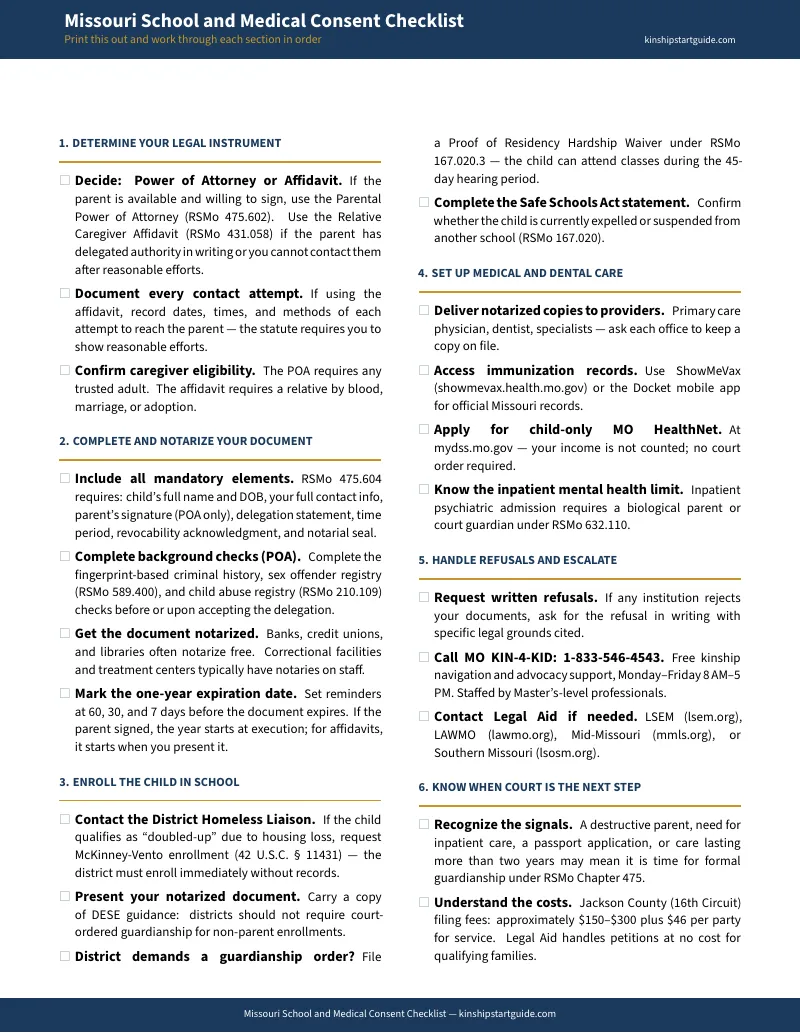
- The quick-start checklist — a printable 20-item summary of the forms, enrollment documents, and contact numbers you need in the first 72 hours
- Authority decision map — a one-page visual that starts with your situation and leads you to the right consent instrument
- School enrollment checklist — every document to bring to the district office, with the statutory basis for each and what to say if they ask for more
- Medical consent matrix and intake prep sheet — a printable reference showing which care types you can authorise under each instrument, plus what to bring to the child's first appointment
- Delegation expiry tracker — a one-year calendar log for tracking power of attorney expiration and renewal dates, with 60-, 30-, and 7-day reminders
- Institutional refusal log — a dated evidence trail for building a record if a school or medical provider demands paperwork the law doesn't require
- Document distribution tracker — a log of which school, doctor, dentist, and agency has a current copy of each consent document
Satisfaction Guarantee
Full refund, no time limit. If the guide doesn't help you navigate your situation, email [email protected] and we'll refund every penny — no forms, no waiting period, no questions.
A Child Shouldn't Wait for a Court Date to See a Doctor
Missouri built a system so they don't have to — two non-court instruments, clear school residency protections, and emergency consent rules that exist for exactly this moment. The guide shows you how to use them, and what to do when someone tries to tell you they don't exist.
Download includes the full guide, the quick-start checklist, and standalone printable PDFs (worksheets, tracking logs, and the authority decision map). Instant access after purchase.
Already have the free checklist? The full guide goes deeper — the step-by-step POA completion walkthrough, the Relative Caregiver Affidavit for when the parent can't sign, school enrollment scripts for handling refusals, the one-year renewal tracker, the MO HealthNet-versus-consent distinction most caregivers discover too late, the background check requirements most template sites skip entirely, and the authority decision map that turns "I think this is right" into "I know exactly which document I need."
Frequently Asked Questions
What if the rules change after I buy?
We update the guide when the rules change. Email us any time, even years later, and we'll send you the current edition free.