Your Income Doesn't Count — But Nobody Told You That
You called the county MDHS office to ask about help for the grandchild who just moved in. The worker asked about your Social Security check. You gave the number, and the conversation went sideways — income limits, asset tests, work requirements. So you assumed the child wasn't eligible for anything, and you hung up.
Here is what the worker didn't explain: Mississippi runs a child-only TANF program where your income, your savings, and your assets are completely invisible to the eligibility calculation. The child's own income — usually zero — is the only number that matters. A grandparent collecting $1,450 a month in retirement can apply on behalf of a grandchild with no income and qualify for a monthly cash grant. The same exclusion applies to Medicaid: the child's health coverage eligibility is evaluated without a single dollar of your income under MAGI rules.
The problem is not that the programs don't exist. The problem is that the information is scattered across four separate state agencies, buried in policy manuals written for caseworkers, and routinely misapplied at the front desk. That is what this guide fixes.
The Mississippi Kinship Benefits Map
The Financial Help for Grandparents and Relatives Raising a Child in Mississippi guide is a single, organised reference that pulls together every benefit the child may be entitled to — cash assistance, health coverage, food help, childcare vouchers, and caregiver support — with the specific Mississippi rules, forms, agencies, and deadlines for each one. It replaces dozens of scattered state web pages and policy manuals with one document you can print and bring to the county office.
What makes it different from a state brochure or a general grandparenting book is the Benefit-by-Arrangement Map: a decision framework that matches your exact care situation — informal kinship care, power of attorney, Chancery Court guardianship, or formal MDCPS placement — to every benefit available under that arrangement. You see in one table what you qualify for, which agency handles it, and what documents you need before you walk in.
What's Inside
- Child-only TANF cash assistance — how the income exclusion works, what the child-only grant pays ($112/month for one child with zero countable income), how child support income is deducted dollar-for-dollar, and exactly how to ensure your application is opened as a child-only case instead of a standard household case
- Medicaid and CHIP health coverage — MAGI eligibility rules for children in kinship care (covered up to 214% FPL), what the Division of Medicaid needs from a relative caregiver, and how to maintain continuous coverage through annual renewals
- SNAP food assistance — the household composition rules that determine when your income counts and when it doesn't, and how a separate household claim may apply in specific circumstances
- CCPP childcare vouchers — eligibility for working or student caregivers through MDHS Early Childhood, and how to document work or education activity requirements
- Foster board payments — what MDCPS pays relatives who are licensed foster parents ($684.90–$1,546.50/month by age), and how formal placement changes the benefit picture
- Title III-E caregiver support — respite care, supplemental services, and information referrals for relative caregivers aged 55 and older through the Area Agency on Aging
- Benefit compatibility matrix — which legal arrangement unlocks which programs, laid out in a single reference table so you know your options before making any legal decisions
- Worked examples with real numbers — two complete calculations showing how the income exclusion applies to an actual Mississippi household, with every step of the arithmetic visible
- Application walkthrough — forms, portals, the Access MS online application, and what to expect at the interview
- Appeals guide — what to do when benefits are denied or reduced, how to request a fair hearing, and how to organise your evidence
Five Printable Worksheets You Can Bring to the Office
- Benefit Screening Worksheet — match your care arrangement to available programs before contacting any agency
- Document Assembly Checklist — a program-by-program list of every document you need, organised so you can check off items as you collect them
- Agency Contact and Submission Log — record every call, visit, and document you submit, with the worker's name and date, so nothing gets lost
- Renewal and Recertification Tracker — a calendar for certification periods and renewal deadlines across all programs
- Appeal Preparation Worksheet — organise your case before filing a hearing request: the decision, the rule, why it was wrong, and your evidence
Who This Is For
- Grandparents on a fixed income who assumed their Social Security or pension disqualified the child from cash assistance
- Aunts, uncles, older siblings, or family friends who took in a child suddenly and need to know what help is available before the next grocery bill
- Relatives caring for a child with no court order who don't realise that informal kinship care qualifies for child-only TANF, Medicaid, and SNAP
- Adult children or community advocates buying the guide on behalf of an older relative who is raising a grandchild
Why Not Just Google It?
You can find every benefit mentioned in this guide on a government website somewhere. The problem is that "somewhere" is scattered across MDHS, the Division of Medicaid, MDCPS, the Area Agency on Aging, county Chancery Courts, and dozens of subpages that link to each other in circles. The TANF child-only rules live in one manual. The SNAP household composition rules live in another. The Medicaid MAGI thresholds live on a third agency's site. And none of them explains how the programs interact with each other or how your legal arrangement with the child changes what's available.
Meanwhile, the first page of search results mixes Mississippi-specific rules with national overviews, outdated policy PDFs from 2018, and commercial form sellers charging more than this guide for a single power-of-attorney template that doesn't even help you apply for benefits.
This guide puts every Mississippi program in one place, with the rules that apply to kinship caregivers specifically — not foster parents, not biological parents, not adoptive parents. And it gives you the printable paper-trail tools that no state website offers: the submission log that proves you turned in your documents, the renewal tracker that keeps your coverage from lapsing, and the appeal worksheet that organises your case when a benefit is denied.
No Risk, No Time Limit
If the guide doesn't help — for any reason, at any time — email [email protected] for a full refund, no questions asked and no time limit. The free checklist is yours to keep either way.
This guide is an independent educational resource. It is not a government publication, does not replace legal advice, and does not guarantee eligibility for any program. All official Mississippi benefit applications are available for free from the state agencies listed in the guide.
Get Started
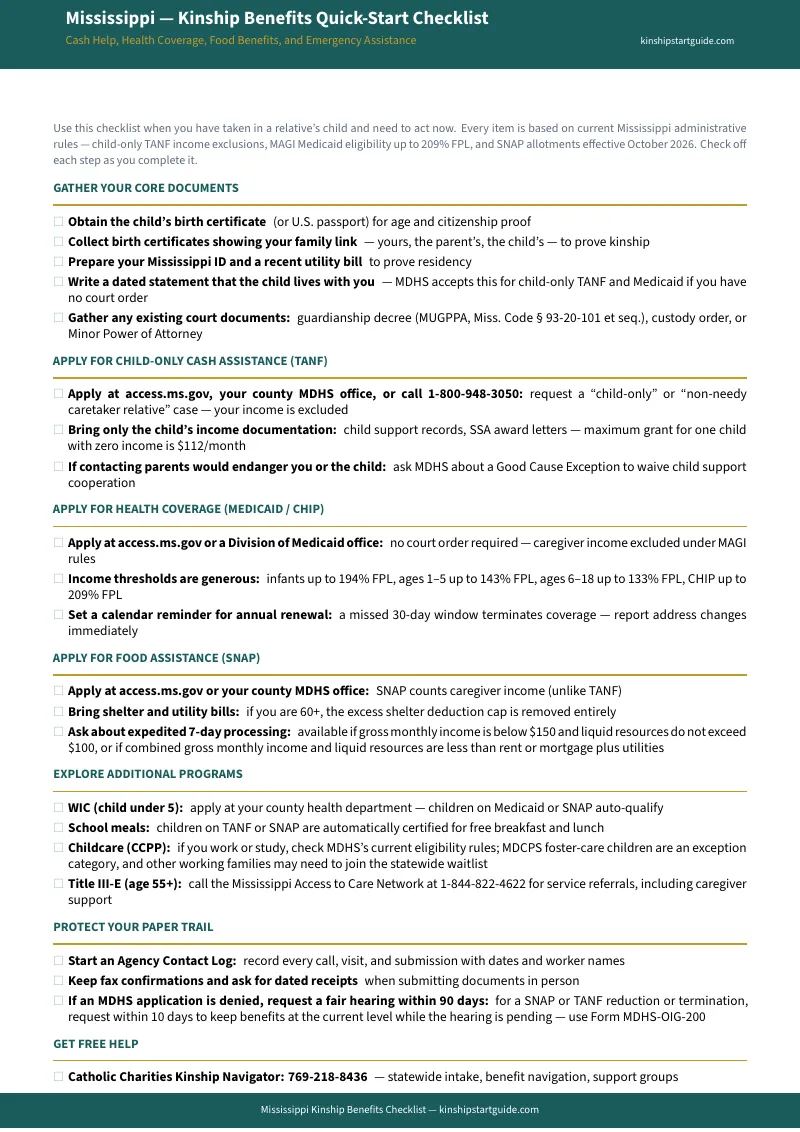
Download the free Mississippi Kinship Benefits Checklist to see which programs to check first. When you're ready for the full application walkthroughs, worked examples, and printable worksheets, the complete guide is — a one-time purchase with no subscription and no time limit on the refund.
Frequently Asked Questions
What if the rules change after I buy?
We update the guide when the rules change. Email us any time, even years later, and we'll send you the current edition free.