
The School Wants a Court Order. The Doctor Wants Proof. DTA Wants a Form You've Never Heard Of.
You have been raising your grandchild — getting them to school, keeping them fed, making sure they see the doctor — but every institution you walk into treats you like a stranger. The school wants a guardianship order before they'll let you sign anything. The paediatrician needs legal documentation for surgery consent. The DTA caseworker says you need paperwork you have never filed.
Massachusetts has a clear legal path from informal caregiver to court-appointed guardian. But the forms, notice rules, court timelines, and post-appointment duties are scattered across Mass.gov, MassLegalHelp, and individual court registry pages — and one wrong form can set you back weeks.
The Court Filing Sequence: Every Step, in Order
This is not a generic guardianship overview. The Massachusetts Guardianship and Custody Court Process Guide is a structured filing sequence that walks you through the entire Probate and Family Court process — from deciding whether you actually need a court order, through filing the petition, giving statutory notice, and standing in front of a judge, to the annual duties nobody tells you about after the order is signed.
Most caregivers searching for "Massachusetts guardianship forms" find Probate and Family Court forms grouped by subject and case type, with detailed notice and fee-waiver instructions on separate pages. The single most common mistake is downloading MPC 120 (the adult incapacitated-person petition) instead of MPC 140 (the minor guardianship petition). That error means a wasted trip to the registry and another week before the court sees your case.
The guide eliminates that confusion. It tells you exactly which forms you need, in the order you need them, with the supporting documents that must accompany each one.
What's Inside
- Do you actually need a court order? The Caregiver Authorization Affidavit (M.G.L. Chapter 201F) and the 60-day Temporary Agent under § 5-103 cover school enrolment and medical consent without going to court. The guide explains when these non-court options are enough — and when they are not, so you go to court only if you have to.
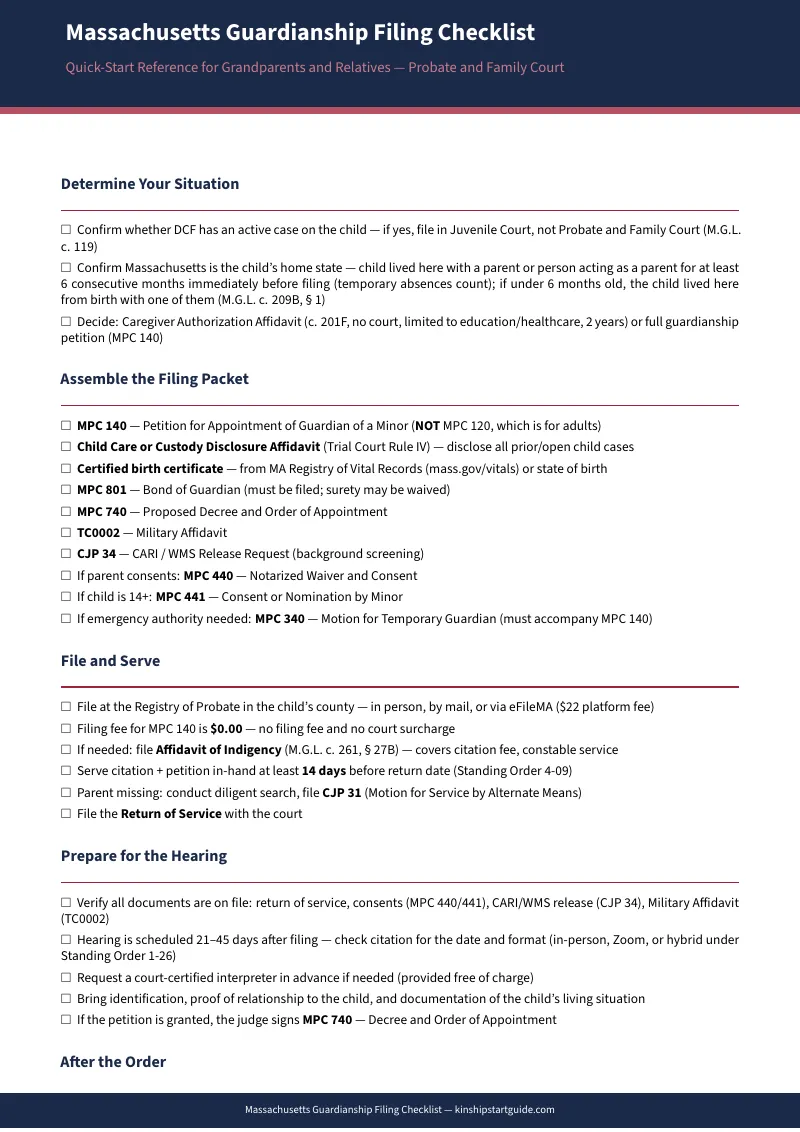
- The MPC 140 petition package, assembled. The Petition for Appointment of Guardian of a Minor (MPC 140), the Child Care or Custody Disclosure Affidavit (Trial Court Rule IV), the bond (MPC 801), the Military Affidavit (TC0002) when required under Uniform Probate Court Practice XXV, and the Proposed Decree and Order (MPC 740) — each form explained, with the filing sequence and the documents you need alongside them.
- Notice rules that catch most self-represented filers off guard. Probate and Family Court Standing Order 4-09 requires notice to interested parties — including living parents whose parental rights have not been terminated or surrendered and a minor who is 14 or older — at least 14 days before the hearing for a permanent petition. Temporary-guardian hearings have a separate 7-day notice period, which the court may shorten or waive in an immediate emergency. The guide covers in-hand service, abode service plus first-class mail when in-hand service cannot be completed, and the motion for alternative service. For unknown whereabouts, Standing Order 4-09 requires first-class mail to the last known address at least 14 days before the hearing and publication at least 7 days before, unless the court directs otherwise.
- Emergency and temporary orders (MPC 340). When the child needs immediate authority — a surgery, a school deadline, a safety concern — the Verified Motion for Temporary Guardian may accompany the permanent MPC 140 petition or be filed later while it is pending. A temporary appointment generally lasts up to 90 days, though the court may set a longer period for extraordinary circumstances and extend it for additional 90-day periods for good cause. The guide explains the two-part filing and what to expect at an emergency hearing.
- Fee waivers for eligible caregivers. The Affidavit of Indigency lets qualified applicants request a waiver of court costs, including the $15 citation fee, and sheriff service costs. The guide walks through completing the affidavit and what happens at the indigency hearing.
- Background checks, the hearing, and the decree. What the court looks at, what you should bring, and how the judge evaluates a guardianship petition when a parent is absent, consenting, or objecting.
- Post-appointment duties nobody warns you about. An Annual Report is due every year — the court does not send reminders. You must notify the court within 30 days of an address change. The guide covers where to get certified copies of your Letters of Guardianship for schools, medical providers, and financial institutions.
Printable Tools You Can Bring to Court
- Filing Checklist — every form and supporting document you need, in filing order, with checkboxes so nothing is missing when you walk into the registry
- Statutory Notice and Service Tracker — log delivery dates, first-class mailing records, sheriff returns of service, and the court's return date in one place
- Post-Appointment Compliance Log — annual report due dates, address-change deadlines, certified-copy distribution to schools, doctors, and banks, and benefits applications
- Hearing Preparation Worksheet — verify every procedural requirement and organise your evidence before the hearing date
- Agency Communication Log — record every call, email, and visit with DTA, MassHealth, schools, and other agencies
- MPC 140 Filing Sequence Reference Card — the entire filing packet, key deadlines, and costs on one page you can bring to the Registry of Probate
- Fee Waiver Quick Reference — the three Affidavit of Indigency eligibility categories and what costs can be waived
- Emergency Order Checklist — the MPC 340 temporary and emergency guardian motion, the notice rules, and the standard the court applies
- Form Comparison Card — MPC 120 vs MPC 140 at a glance, plus the non-court alternatives and when each one fits your situation
Who This Is For
- Grandparents who have been caring for a grandchild informally and now need a court order because a school, doctor, or agency demands one
- Aunts, uncles, older siblings, or other relatives who took in a child after a parent entered treatment, was incarcerated, became unreachable, or died
- Relatives facing an immediate deadline — a surgery, a school enrolment, a benefits application — who need to understand temporary and emergency orders
- Adult children or family friends helping an older relative navigate the Probate and Family Court process
Why Not Just Use the Free Resources?
You absolutely can. Mass.gov publishes the official court forms. MassLegalHelp explains the rules. Court Service Centers help with form completion at no cost. The guide does not sell access to those forms — they are public and free.
What the free resources do not do is put the entire process in one place in the order you need it. Mass.gov groups Probate Court forms by subject and case type. The notice rules are on a different page from the fee waiver instructions, which are on a different page from the post-appointment duties. Court Service Centers operate on limited hours and a first-come, first-served basis.
The guide gives you the complete filing sequence — forms, notice, hearing preparation, and post-appointment tracking — structured so you can work through it at your own pace, at home, without waiting for a counter.
Your Purchase Is Protected
Full refund, no time limit. If the guide does not help you, email [email protected] and we will return your money. The free checklist is yours to keep regardless.
Get Started
Download the free Massachusetts Minor Guardianship Filing Checklist to see the forms, fees, and notice steps at a glance. When you are ready for the complete court process — every form explained, the notice rules step by step, emergency orders, fee waivers, and the post-appointment duties — the full guide is .
Frequently Asked Questions
What if the rules change after I buy?
We update the guide when the rules change. Email us any time, even years later, and we'll send you the current edition free.