The school wants a court order. The pediatrician needs "legal paperwork." Maryland law says you can sign two affidavits and skip the courthouse entirely.
You took in a child — your grandchild, a niece, a nephew, maybe a sibling's child — because a parent can't be there right now. The reasons are painful. And you didn't have time to prepare. What you had was overnight, a child who needs you, and a list of institutional gatekeepers who don't know what to do with a caregiver who doesn't have a custody decree.
The child needs to start school. Needs a doctor. Needs a dentist. And every front desk asks for documents that sound like they require a judge, a lawyer, or a parent who isn't available.
Here's what most caregivers in Maryland don't know: the state has a Dual Affidavit System — two statutory instruments, one for school (Education § 7-101(c)) and one for healthcare (Health-General § 20-105) — that let a qualifying relative sign under penalty of perjury and get the child enrolled and seen by a doctor. No parent signature. No court hearing. No attorney. The problem isn't the law. The problem is that schools, clinics, and even some attorneys routinely confuse these affidavits with Powers of Attorney, generic consent letters, or court guardianship — and when they turn you away, you don't know which statute to cite or which office to file with.
What the Dual Affidavit System Covers
The guide walks you through every consent pathway Maryland recognises for a relative caring for a child without a court order:
- Education § 7-101(c) School Enrollment Affidavit — the form that lets a qualifying relative enrol a child in the local school district, make educational decisions, receive report cards and disciplinary notices, and attend parent-teacher conferences. You learn what the form says, how to complete it, what evidence your county school board typically asks for, and how to re-file before the annual deadline
- Health-General § 20-105 Healthcare Consent Affidavit — the separate instrument that authorises medical, dental, and mental health consent. The guide covers the official DHS Form DHS/SSA/554 (revised July 2025), the dual-filing requirement that most online sources skip entirely (one copy to the Department of Human Services, one to the treating provider), and the scope of authority it grants
- County-by-county enrollment forms — Maryland has 24 local school jurisdictions, and many use their own kinship care form alongside the state affidavit. The guide covers the major county-specific forms (Montgomery County Form 334-17, Frederick County Regulation Form 80, Baltimore City Policy JFBC) and explains how to handle districts that aren't on this list
- Minor Power of Attorney — when the parent is cooperative, reachable, and willing to sign. The guide explains when a POA gives you authority the affidavits don't, when you don't need one at all, and why national vendors selling generic POA templates at routinely get it wrong for Maryland kinship situations
- McKinney-Vento Act enrollment — the federal pathway that guarantees immediate school enrollment for displaced children, even without an affidavit. The guide explains when this route applies, how to find your district's homeless liaison, and why it matters for fictive kin who are excluded from the statutory affidavits
The Filing Step Nobody Tells You About
The school affidavit gets filed with the school. Most caregivers assume the healthcare affidavit works the same way. It doesn't. Health-General § 20-105 requires that you file the signed healthcare affidavit with the Maryland Department of Human Services, Social Services Administration, using Form DHS/SSA/554 — and deliver a copy to the treating medical provider. Miss the DHS filing and a clinic can reject your affidavit even if every line is filled out correctly. The guide walks you through both filings, with the addresses and procedures.
When a School or Clinic Says No
Local practice across Maryland routinely contradicts state law. School registrars demand court orders that the Education Code does not require. Medical offices refuse affidavits they've never seen before. Enrollment clerks insist on a parent's signature that the statute explicitly waives. The guide explains the four-step process for handling institutional pushback — from the initial conversation to a written complaint — so you don't lose days to a gatekeeper who hasn't read the statute.
Who This Is For
- A grandparent, aunt, uncle, or older sibling who has taken in a child and needs to get that child into school and to the doctor — this week
- A relative who was told by a school district or medical office that they need a court order or custody decree, and wants to know whether Maryland law actually requires one
- A caregiver who isn't sure whether their situation qualifies as one of the six statutory hardships (death, serious illness, drug addiction, incarceration, abandonment, or active military duty) that the affidavits require
- A family friend or fictive kin who has been told the kinship care affidavits don't apply to them, and needs to know what other pathways Maryland offers
- A family helper buying this on behalf of an older relative who needs clear, step-by-step instructions for forms that look intimidating
Why Not Free Resources?
Maryland's official forms are free, and the guide links directly to them. The People's Law Library of Maryland, the DHS Kinship Care portal, and Grandfamilies.org all publish helpful information. The guide doesn't replace any of that — it bridges the gap between having the forms and knowing exactly what to do with them.
Free resources are scattered across the DHS website, the People's Law Library, 24 different school district portals, and COMAR regulations. They don't tell you that you need two separate affidavits — one for school and one for healthcare — filed with different agencies. They don't explain the six hardship grounds and what evidence each county school district typically wants. They don't cover the annual re-filing deadline under COMAR 13A.08.05 that catches caregivers off guard every August. And they don't walk you through what to do when your situation doesn't fit the affidavit — when you're a non-relative, or the parent is cooperative but absent, or a teenager needs mental health care and the consent rules change at different ages.
What You Get
- The complete guide — 13 chapters covering both statutory affidavit tracks, county enrollment forms, medical and dental consent, HIPAA access, special education rights, adolescent mental health consent, the POA myth, annual renewal, and the court guardianship escalation pathway
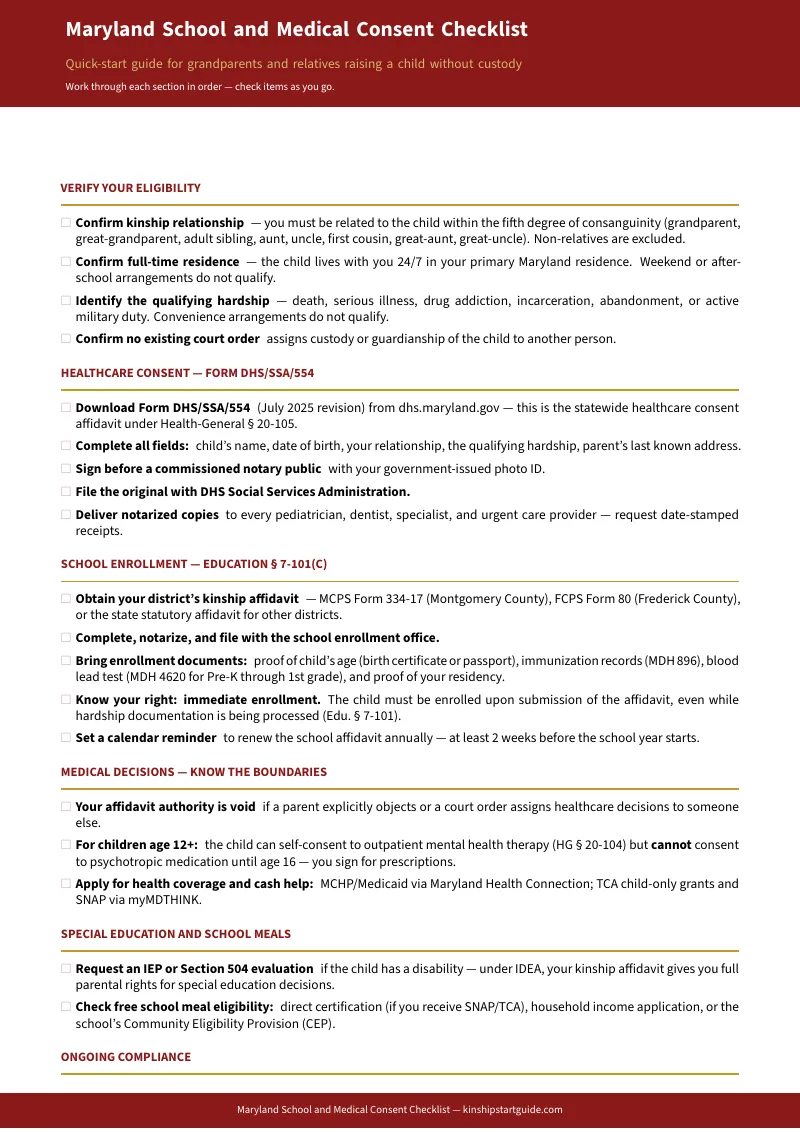
- The quick-start checklist — a printable 24-item summary of the forms, enrollment documents, and contact numbers you need in the first 72 hours
- Nine printable worksheets — Legal Instrument Decision Flowchart, Hardship Evidence Verification Checklist, Annual Renewal Tracker, Enrollment Day Preparation Checklist, Medical Provider Notification Log, Agency Communication Log, Affidavit Completion Worksheet, Medical Intake Prep Sheet, and Consent Pathway Comparison Worksheet
Satisfaction Guarantee
Full refund, no time limit. If the guide doesn't help you navigate your situation, email [email protected] and we'll refund every penny — no forms, no waiting period, no questions.
A Child Shouldn't Wait for a Court Date to See a Doctor
Maryland built a system so they don't have to. The guide shows you how to use it — both affidavits, both filings, both agencies — and what to do when someone at the front desk tells you it's not enough.
Instant access after purchase. Download the guide and checklist, print what you need, and bring it with you to the school office or the doctor's appointment.
Already have the free checklist? The full guide goes deeper — step-by-step affidavit completion, the DHS healthcare filing that most caregivers miss, county-specific enrollment forms, adolescent mental health consent rules, HIPAA access, special education rights, and the side-by-side comparison table that maps every consent pathway in one place.
Frequently Asked Questions
What if the rules change after I buy?
We update the guide when the rules change. Email us any time, even years later, and we'll send you the current edition free.