
Five agencies, five portals, and an 86% denial rate on the application that matters most
You're covering every expense for a child who arrived without a line in the budget. The groceries doubled. The pediatrician needs insurance you don't have. School wants supplies and forms and fees. And every month, your fixed income stretches thinner against costs that only grow.
Maryland funds real money for that child — a monthly cash grant, food benefits, full health coverage, childcare subsidies, energy assistance. But the programs sit inside different agencies, run by different caseworkers, with different forms, different income rules, and different portals. The MarylandBenefits.gov portal gives you an application — not an explanation of which application to file first. And state budget data shows that over 86% of Temporary Cash Assistance applications were denied in September 2025, driven overwhelmingly by missed caseworker calls, incomplete child support referrals, and missing documents — not because the applicants were ineligible.
The Intake-Ready Benefit System — every program, every form, one organized process
The Financial Help for Grandparents and Relatives Raising a Child in Maryland is a complete navigation system built around the way Maryland's benefit agencies actually work. It maps every financial program to the right agency, the right documents, and the right application order — so you walk into the local DSS with a complete file, not a partial one that triggers an automatic denial.
This is not a list of programs copied from the DHS website. It's a step-by-step system that connects the dots between agencies, explains why your retirement income does not disqualify the child from cash help, and gives you tracking tools for portal uploads, caseworker calls, and the deadlines that protect your right to appeal.
What's inside
- TCA child-only cash grants — the non-needy caretaker relative rule that excludes your pension, Social Security, and wages from the child's eligibility calculation, how to apply through MarylandBenefits.gov and the Statement of Monthly Expenses form (434-C), and what to do when a caseworker applies the wrong household income rules
- Subsidized guardianship assistance (Title IV-E GAP) — how the Guardianship Assistance Program works for children who transition from formal foster care to a relative's guardianship, what it pays, how it interacts with TCA, and the eligibility requirements that separate it from informal kinship benefits
- Health coverage through the Maryland Children's Health Program — enrolling the child in Medicaid or MCHP without a court custody order, income limits up to 322% of the federal poverty level, and how to apply separately from the cash benefits portal
- SNAP food benefits — Maryland's household composition rules for grandchildren living with a grandparent, how to file the child correctly so your retirement income doesn't reduce the benefit, citizen-child rules for mixed-status households, and the expedited processing rules for emergency situations
- MSDE Child Care Scholarship Program — income limits, copay calculations, and the kinship priority exception that keeps kinship placements eligible even during the general enrollment freeze enacted under HB 1272
- Emergency cash and crisis resources — energy assistance through OHEP and MEAP, Kinship Navigator referrals, community action agencies, and the emergency help available when one bill pushes everything over the edge
- Older caregiver support under Title III-E — respite care, support groups, and supplemental services through Maryland's Area Agencies on Aging for grandparents aged 55 and older raising grandchildren
- How to apply — forms, portals, and what to bring — a complete application chapter covering the MarylandBenefits.gov portal, in-person DSS office visits, the documents every agency needs, and printable checklists organized by program so you never arrive missing a piece of paper
- Keeping your benefits — redetermination schedules, what changes you must report, and how to handle the annual MSDE school affidavit renewal
- Denials, reductions, and fair hearings — how to request an administrative hearing before the Office of Administrative Hearings (30 days for TCA and Medicaid, 90 days for SNAP), the Good Cause Exemption for child support enforcement referrals, and what to include in your written statement
- Worksheets and planning tools — six printable files: Evidence Collection Worksheet, Application and Interview Tracker, Grant Calculation Worksheet, Agency Communication Log, Renewal Calendar Tracker, and Appeal Preparation Checklist
- Free-help directory — how to reach every Local Department of Social Services, plus Maryland Legal Aid, Maryland Volunteer Lawyers Service, 211 Maryland, Kinship Navigator contacts, and Area Agencies on Aging
Who this is for
This guide is for any relative in Maryland — grandparent, aunt, uncle, older sibling, family friend — who is raising a child and paying for that child's needs out of their own pocket. Whether you have a court order or an informal arrangement, whether the child arrived last week or three years ago, whether you're on Social Security or still working — the guide maps the financial help available to your specific situation.
If you're caring for a child because a parent is struggling with addiction, is incarcerated, is in treatment, has died, or simply cannot provide care right now — you are not alone, and more help exists than most people realize.
Why free resources aren't enough
Maryland publishes the rules. 211 Maryland takes calls. The Kinship Navigator program offers referrals. Maryland Legal Aid provides free legal help for those who qualify. All of those resources are valuable, and this guide tells you exactly how to reach every one of them.
But here's what none of them do: they don't sit across departmental lines. A SNAP caseworker cannot advise you on childcare scholarship applications or explain what the Good Cause Exemption means for child support enforcement. A 211 navigator doesn't know whether your pension counts against a child-only TCA application. The DHS website publishes each program separately, in statutory language, without explaining how the programs interact or which application to file first.
The national kinship factsheets — like AARP's GrandFacts and Grandfamilies.org — offer high-level legal summaries but contain zero Maryland dollar amounts, form numbers, or DSS office workflows. The legal document sites sell generic power-of-attorney templates for $39–$59 each, with no benefit guidance at all. And the printable planners on Etsy are organizational binders with blank lines where the answers should be.
This guide does the work those resources don't: it connects the programs to each other, translates the income rules into plain English, and gives you printable checklists you can carry into the DSS office tomorrow.
Satisfaction guarantee
If the guide doesn't help, email [email protected] for a full refund, no time limit. No forms, no questions. You're dealing with enough paperwork already.
Get started now
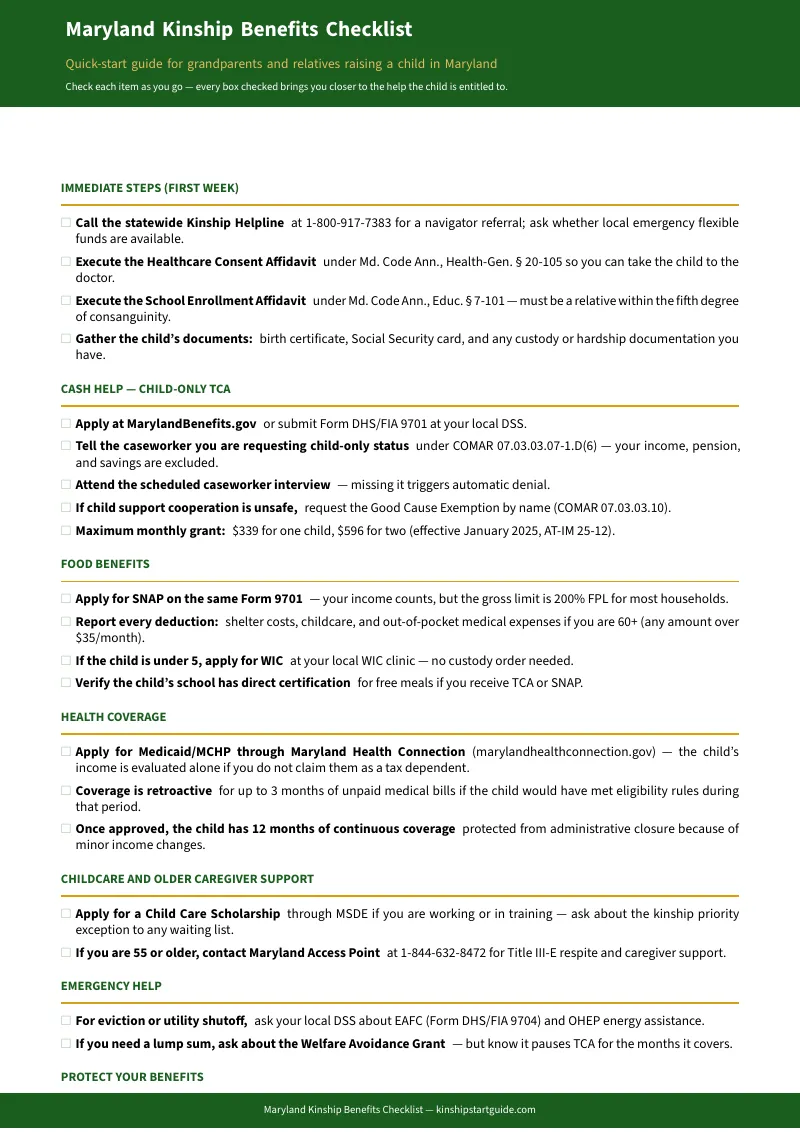
The free checklist gives you the two-page benefit map — every program, every agency, every document on two sheets. The full guide gives you the step-by-step system: income rule explanations, tracking tools, application checklists, and the cross-agency navigation that turns a stack of separate applications into one organized process. Download the checklist now, or get the complete guide for and start your first application tonight.
Frequently Asked Questions
What if the rules change after I buy?
We update the guide when the rules change. Email us any time, even years later, and we'll send you the current edition free.