
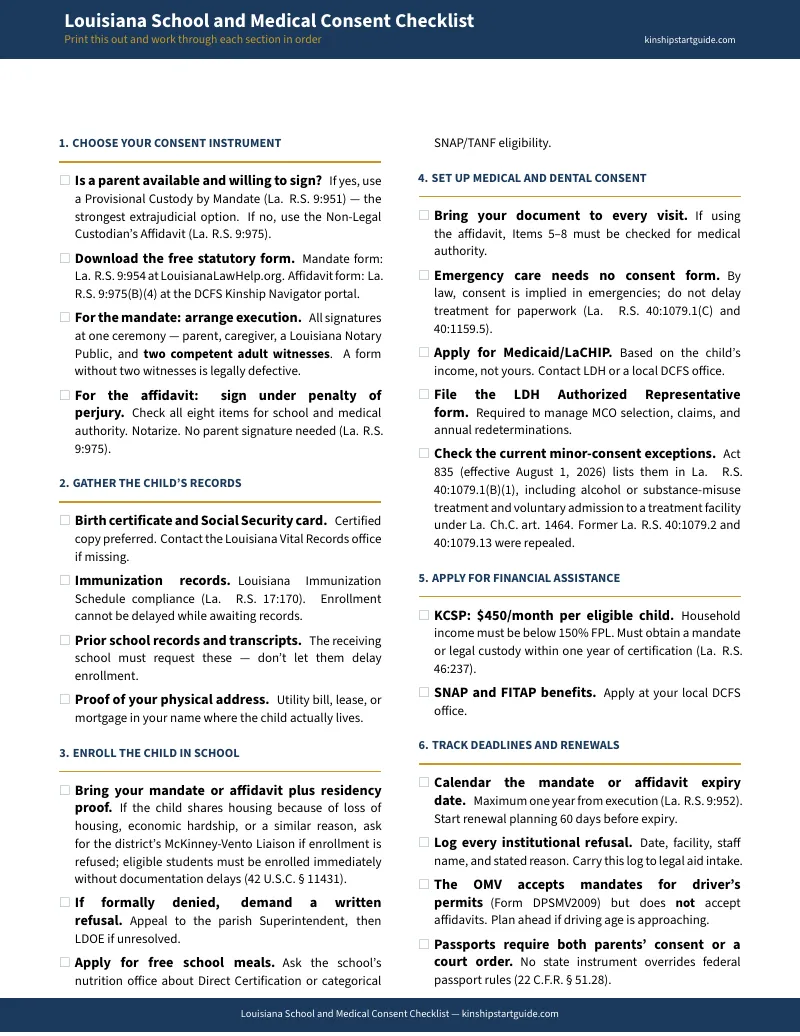
The school wants a court order. The clinic needs custody papers. Louisiana law says you need neither — but only if you use the right instrument, the right way.
You took in a child — maybe your grandchild, a niece, a nephew, a younger sibling, or the child of a friend who can't be there right now. The reasons are painful and private, and you didn't have time to prepare. What you had was a phone call, a suitcase, and a child who needs to start school and see a doctor.
Now every front desk you walk up to asks for paperwork that sounds like it requires a lawyer, a judge, or a parent who isn't available. And Louisiana makes it harder than most states, because the state runs on civil law — not common law. The terms are different. The execution rules are stricter. And a generic "Minor Power of Attorney" template from another state is legally invalid here.
Here's what most Louisiana caregivers don't know: the state has a Consent Authority Toolkit — a set of statutory instruments that lets you handle school enrollment, medical care, dental appointments, and daily permissions without a court hearing or attorney fees. But the instruments have different requirements, different signing rules, and different limits. Using the wrong one in the wrong place is the most common reason caregivers get turned away at the registration desk.
What the Consent Authority Toolkit Covers
The guide walks you through every consent instrument Louisiana recognises for a caregiver without a court order, and shows you exactly when to use each one:
- Provisional Custody by Mandate (La. R.S. 9:951–954) — the most powerful out-of-court instrument in Louisiana. A parent signs before a notary and two adult witnesses, delegating caregiving authority for up to one year. The guide walks you through every field of the statutory form, the authentic-act execution rules, and what to do when a parent is incarcerated, in treatment, or out of state
- Non-Legal Custodian's Affidavit (La. R.S. 9:975) — the alternative when a parent is missing, unreachable, or refuses to sign. The caregiver executes this instrument on their own authority. The guide explains its two-part scope structure, the third-party immunity provision, and the critical differences from the mandate
- McKinney-Vento Enrollment (42 U.S.C. § 11431) — immediate school enrollment without a birth certificate, immunisation records, transcripts, or proof of residence when a child qualifies as homeless or in a transitional living arrangement. The federal override that every parish school board must honour
- Medical, Dental, and Mental Health Consent — routine care, specialist referrals, prescription authorisation, dentist visits, and the mental-health consent rules after Act 835 (2026). The guide explains when your mandate or affidavit is enough, when a minor can consent independently, and how HIPAA applies to a caregiver who isn't the legal guardian
- Court Escalation Pathways — Voluntary Transfer of Custody (Children's Code Art. 1511), Civil Code Art. 133 custody, and formal tutorship. The guide explains when an out-of-court instrument stops being enough and a judge becomes necessary — so you can make that decision before a crisis forces it
When the School or Clinic Says No
Parish school boards and medical offices across Louisiana routinely misinterpret the law. Registration clerks demand court custody orders that La. R.S. 9:954 does not require. Clinic intake staff confuse a Provisional Custody by Mandate with a court-ordered custody decree and turn away caregivers with perfectly valid paperwork. Rural parishes handle the process differently from East Baton Rouge or Jefferson. And almost nobody at the front desk has heard of the Non-Legal Custodian's Affidavit.
The guide includes escalation scripts — citing the exact Revised Statutes and Children's Code articles — for speaking to parish school board liaisons, district homeless liaisons, clinic administrators, and patient access staff. You should not need them. But when an administrator who hasn't read the statute stands between a child and a doctor's appointment, you will be glad you have them.
The Side-by-Side Instrument Table
Should you use the Provisional Custody by Mandate, the Non-Legal Custodian's Affidavit, a power of attorney, or a court order? The guide includes a comparison table covering each instrument's statutory basis, what it authorises, who must sign, whether notarisation and witnesses are required, how long it lasts, and when one stops being enough. Most caregivers discover they can stay out of court entirely. Some learn they need a judge sooner than they thought. Either way, you stop guessing.
Who This Is For
- A grandparent, aunt, uncle, or older sibling who has taken in a child and needs to get that child into school and to the doctor — this week
- A relative who tried to enrol a child at a Louisiana parish school and was told they need custody papers or a court order
- A caregiver who needs the parent's signature on the mandate but the parent is incarcerated, in treatment, or unreachable
- A caregiver holding an existing mandate that's about to expire and wondering how renewal works under La. R.S. 9:952
- A family helper or adult child buying this on behalf of an older relative who needs clear, step-by-step instructions
- Anyone turned away by a school or clinic and told they need documents the statute doesn't actually require
Why Not Free Resources?
The statutory form text under La. R.S. 9:954 is free on LouisianaLawHelp.org, and we link directly to it. The DCFS Kinship Navigator helpline (211) provides referrals. The Governor's Office of Elderly Affairs publishes a grandparent resource guide. The guide doesn't replace any of that — it bridges the gap between having the form and knowing what to do with it.
Free resources give you the statutory form. They don't walk you line by line through completing it under Louisiana's authentic-act execution rules — the notary, the two witnesses, the signature blocks that generic out-of-state templates omit. They don't explain the critical difference between the Provisional Custody by Mandate (which only a parent can sign) and the Non-Legal Custodian's Affidavit (which a caregiver executes on their own authority when a parent is unavailable). They don't tell you what to say when a Jefferson Parish enrollment clerk demands a document the law doesn't require. And they don't cover the scenarios that trip caregivers up — the parent in a Louisiana DOC facility who can still sign through the facility case manager, the child with an IEP who needs a new IDEA parent designation, the teenager who may consent independently to mental-health treatment after Act 835, and the mandate that expires mid-school year.
What You Get
- The complete guide — 14 chapters, 54 pages covering every consent instrument, school enrollment, medical and dental authority, mental-health consent after Act 835, HIPAA access, everyday permissions, the court-order decision point, KCSP and FITAP financial assistance, and planning worksheets
- The quick-start checklist — a printable 24-item summary of the forms, enrollment documents, and contact numbers you need in the first 72 hours
- Instrument comparison table — Provisional Custody by Mandate vs. Non-Legal Custodian's Affidavit vs. power of attorney vs. Voluntary Transfer of Custody vs. formal tutorship, with signing requirements, duration, and legal scope
- Notary preparation sheet — everyone who must be present, every document to bring, the two-witness requirement, and a pre-signing verification checklist so nothing gets rejected for a procedural mistake
- School enrollment document checklist — every document to bring to the parish school registration desk, the statutory basis for each, and what to say if they ask for more
- Escalation scripts — what to say to a reluctant administrator, citing the exact Revised Statutes and Children's Code articles, and the escalation path to the district liaison or clinic administration
- Medical intake preparation sheet — documents, child information, and insurance details to bring to the first appointment with a new provider
- Institutional refusal log — a printable tracker for recording every refusal with dates, names, and stated reasons — the paper trail for a formal complaint
- Agency communication log — track every call and visit to schools, clinics, DCFS offices, and legal aid organisations so nothing gets lost
- Key resources and contacts — SLLS, ALSC, LSNL, Loyola Pro Bono, Louisiana Kinship Navigator, DCFS, McKinney-Vento liaisons, and court self-help resources on one fridge-ready page
- Appointment folder checklist — a grab-and-go list of every document to pack before any school or medical visit
- Statutory expiry and renewal tracker — track execution dates, expiration dates, and renewal windows for every mandate and affidavit, plus institution copy distribution
- Records collection tracker — check off every vital document as you collect it: identity, medical, and school records in one printable sheet
Satisfaction Guarantee
Full refund, no time limit. If the guide doesn't help you navigate your situation, email [email protected] and we'll refund every penny — no forms, no waiting period, no questions.
A Child Shouldn't Wait for a Court Date to See a Doctor
Louisiana built a system so they don't have to. The guide shows you how to use it — and what to do when someone tries to tell you it doesn't exist.
Download includes the 54-page guide, the quick-start checklist, and 10 printable standalone worksheets. Instant access after purchase.
Already have the free checklist? The full guide goes deeper — line-by-line form instructions, escalation scripts, scenario walkthroughs, and the instrument comparison table that turns "I think this is right" into "I know exactly what to do."
Frequently Asked Questions
What if the rules change after I buy?
We update the guide when the rules change. Email us any time, even years later, and we'll send you the current edition free.