The child qualifies for money you may not know about. Your income does not count against the application.
You took the child in because there was no one else. Now you are buying diapers with retirement money, stretching a fixed grocery budget for an extra person, and worrying about school clothes next month. Meanwhile, somewhere in the Kentucky benefits system, there is a monthly cash payment designed for exactly this child — a payment that ignores your Social Security, your pension, and your wages entirely. But the programs are split across three different DCBS divisions, the old "Kinship Care Program" name still floats around even though it closed to new applicants years ago, and the kynect portal does not tell you that your income does not count.
Many grandparents abandon their applications early because they assume their retirement check puts the household over the limit. It does not. Under 921 KAR Chapter 2, K-TAP child-only cash evaluates only the child's income and resources. Your personal finances are not in the equation. But nobody at the front desk explains that, the online portal does not flag it, and the result is that thousands of Kentucky children are not receiving the money they are entitled to in their own right.
The Benefits Navigation System: every program, every application, every document — organized by what you need first
The Financial Help for Grandparents and Relatives Raising a Child in Kentucky is a complete walkthrough of the money, health coverage, food assistance, and childcare subsidies available to a child being raised by a relative in Kentucky — organized not by bureaucratic division but by what you need to do first. It is not a general foster-care resource. It is not a national "kinship care 101" pamphlet. It is built on the specific Kentucky Administrative Regulations, DCBS program rules, and CHFS portal procedures that determine what this child gets and how you apply.
What you get
- K-TAP child-only cash grants, explained from scratch — monthly payment tiers from one child through seven or more, the income exclusion that keeps your Social Security and pension out of the calculation, the documentation DCBS needs, and how the federal 60-month TANF lifetime limit does not apply to child-only cases
- Relative and Fictive Kin Placement Support — the separate payment track that opens when DCBS child welfare is involved, covering both blood relatives and fictive kin (family friends, godparents, neighbors), with payment tiers, eligibility triggers, and the distinction between placement support and foster-care certification rates
- Subsidized Permanent Custody (SPC) — Kentucky's Guardianship Assistance Program, effective 2024, giving certified kinship foster parents a path to long-term financial stability without ongoing state supervision
- KCHIP and Medicaid health coverage — rapid enrollment pathways so the child has health insurance while you work through the cash benefit applications, including the income thresholds that apply to the child's household and how a Caregiver Authorization Affidavit interacts with the enrollment
- SNAP food benefits under BBCE — Kentucky's Broad-Based Categorical Eligibility rules simplify qualification for low-income older adults by removing redundant asset tests, and the guide explains how adding a child to the household changes the benefit calculation
- Child Care Assistance Program (CCAP) — income limits at application and recertification, the work-requirement rules and the exemptions that apply when a caregiver has a documented incapacity, and the critical fact that K-TAP child-only cash is excluded from countable income when determining CCAP eligibility
- LIHEAP utility assistance and emergency help — heating and cooling bill relief, crisis assistance, and the application windows that determine when to apply
- Family Caregiver Program through Area Agencies on Aging — annual grants for clothing, school supplies, legal expenses, and respite care for grandparents aged 55 or older, with the eligibility rule that this program cannot be stacked with certain Kinship Care payments
- WIC, school meals, and SUN Bucks — food assistance programs the child may qualify for independently, with enrollment steps and income thresholds
- Title III-E older caregiver support — federal Older Americans Act services for grandparents and older relatives, including respite care, supplemental services, and counseling
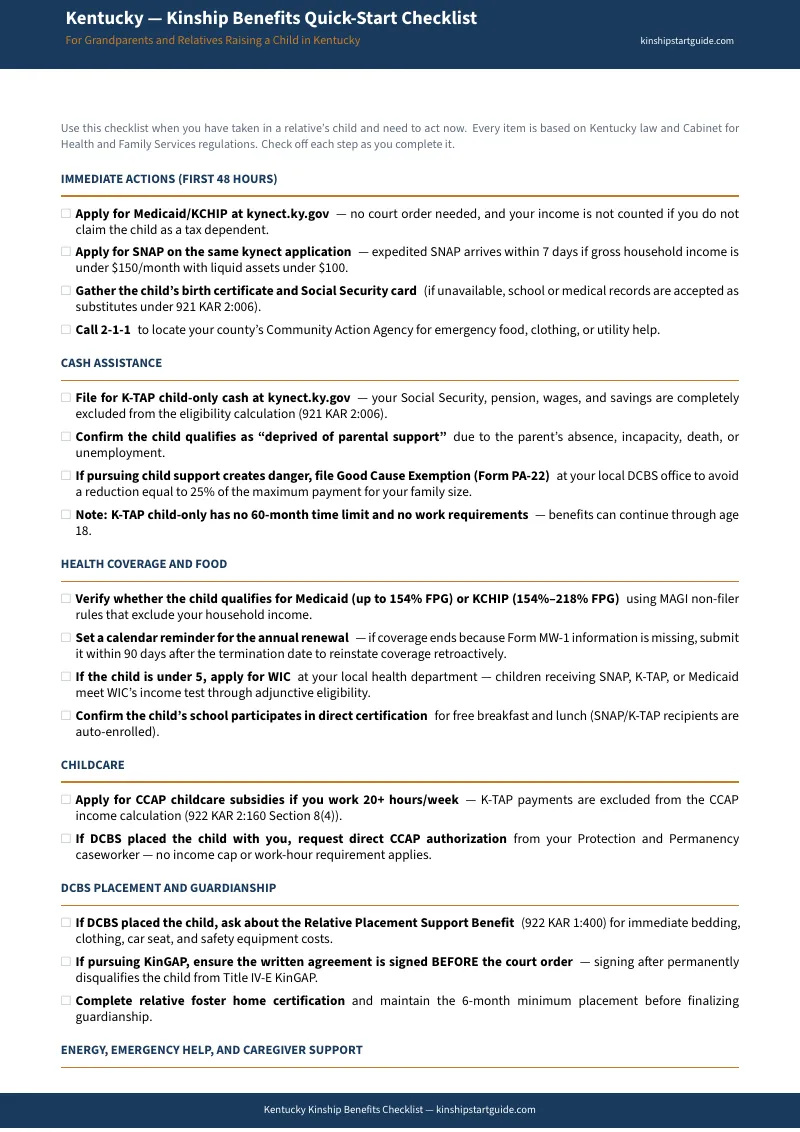
- Application document checklist — every document you need before you sit down at the DCBS office or open the kynect portal, organized by program so nothing is missing when your appointment arrives
- Worked dollar examples — two real scenarios showing how a caregiver's household benefit stack adds up across programs, so you can see what the numbers look like before you apply
- Fair hearing rights and the appeal process — when a benefit is denied or reduced, the guide walks you through the hearing request timeline, the documentation that strengthens your case, and the escalation path through the CHFS Ombudsman
- Kentucky kinship resource directory — contact details for the KY-KINS Kinship Navigator program, the KKRC Kinship Support Hotline (877-565-5608), regional legal aid offices, Area Agencies on Aging, and Cooperative Extension resources
Who this is for
- Grandparents on Social Security, a pension, or disability income who need to know what the child qualifies for without their own income being counted
- Aunts, uncles, older siblings, and family friends who took in a child suddenly and need to find the money, the health coverage, and the food help right now
- Caregivers involved with DCBS who need to understand the Placement Support Benefit, certified kinship foster rates, and the new Subsidized Permanent Custody program
- Caregivers who applied for benefits and were denied or had benefits reduced and need to know how to request a fair hearing
- Adult children or younger family members researching benefits on behalf of an older relative who needs clear, printable instructions to take to the DCBS office
Why not the free resources?
The state agencies, legal aid organizations, and the kynect portal all provide real help — and the guide links directly to them. What they do not do is organize the full picture in one place. DCBS Family Support handles K-TAP and SNAP. The Division of Protection and Permanency handles Placement Support. The Division of Child Care handles CCAP. Area Agencies on Aging handle the Family Caregiver Program. Each has its own application, its own income rules, and its own documentation requirements. And none of them tells you how the programs interact — that K-TAP child-only cash does not count against your CCAP income eligibility, for example, or that accepting a Family Caregiver grant may affect Kinship Care payment eligibility.
The legacy "Kentucky Kinship Care Program" name still appears on state websites and in community advice, even though the program closed to new applicants. Caregivers searching for that name end up confused about whether K-TAP child-only cash is the replacement, what the Placement Support Benefit is, and whether they need a court order to apply. The guide cuts through the naming confusion and maps each program to the current regulations.
Satisfaction guarantee
If the guide does not help, email [email protected] for a full refund, no time limit. The free checklist is always available at no cost whether you buy the guide or not.
Get started now
Download the free Kentucky Kinship Benefits Checklist to see which programs to check and which documents to gather — or get the full Benefits Navigation System for the complete guide with eligibility rules, application walkthroughs, worked dollar examples, fair hearing instructions, and the Kentucky kinship resource directory, plus 6 printable worksheets: benefits decision tree, DCBS document prep checklist, application tracking log, agency contact card, care arrangement matrix, and fair hearing worksheet. The download is instant, and every document is ready to print.
Frequently Asked Questions
What if the rules change after I buy?
We update the guide when the rules change. Email us any time, even years later, and we'll send you the current edition free.